The Ultimate Guide to the Best Backlinks for HVAC Companies (2026 Strategy)
The Ultimate Guide to the Best Backlinks for HVAC Companies (2026 Strategy)
Executive Summary: The Structural Shift in HVAC Search
The digital marketplace for Heating, Ventilation, and Air Conditioning (HVAC) services has reached an inflection point in 2025. For over a decade, the primary battleground for contractor visibility was the traditional Search Engine Results Page (SERP), governed by predictable algorithms that prioritized keyword density and backlink volume. Today, that landscape has been fundamentally re-engineered by the advent of Generative Engine Optimization (GEO) and the dominance of Artificial Intelligence (AI) in local search. The objective for HVAC business owners and marketing directors is no longer merely to "rank" but to establish a digital entity so authoritative that it becomes the default answer provided by Large Language Models (LLMs) like Google’s Gemini, ChatGPT, and Perplexity.
In this evolved ecosystem, the "backlink" remains the fundamental currency of trust, but its valuation has shifted. Low-quality directory links and spammy blog comments—once the staple of cheap SEO packages—are now liabilities. Conversely, "entity-verifying" links from manufacturers, trade associations, and hyper-local community pillars have appreciated exponentially in value. These are the best backlinks for hvac companies because they do more than pass "link juice"; they confirm to the AI that a business is licensed, insured, trained, and geographically relevant.
This report provides an exhaustive, expert-level analysis of the 2026 HVAC link-building landscape. It delineates a strict hierarchy of link value, from the foundational necessity of citation consistency to the elite status of Factory Authorized Dealer links. Furthermore, it addresses the opaque economics of the guest posting market, exposing the rampant agency markups that drain marketing budgets and positioning Linkpricer.com as the essential mechanism for financial transparency and strategic efficiency.
Part I: The Theoretical Framework of HVAC Authority in 2026
1.1 The Evolution from Keywords to Entities
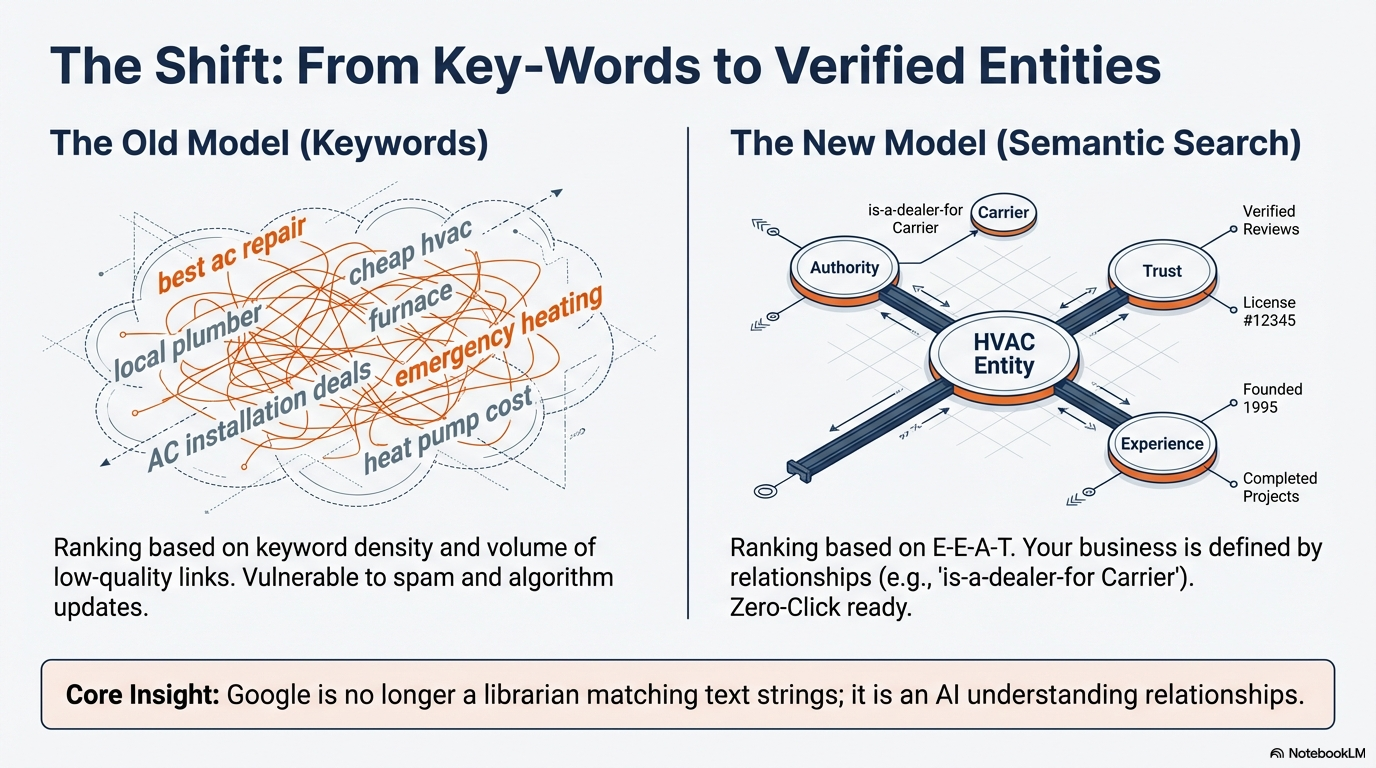
To execute a winning SEO strategy in 2026, one must first discard the outdated mental model of "keywords." In the early days of search, Google operated essentially as a librarian matching strings of text. If a user searched for "AC repair," the engine looked for pages containing that string. This era rewarded "keyword stuffing" and volume-based link acquisition, regardless of quality.
Today, search engines operate on "Semantic Search" principles powered by Knowledge Graphs. In this model, your HVAC business is not just a website; it is an Entity—a distinct object with attributes (Name, Address, Phone, Services) and relationships (is-a-member-of ACCA, is-a-dealer-for Carrier). When a high-authority entity like ASHRAE or Trane links to your website, it is not merely a vote of popularity; it is a confirmation of your entity's attributes. It tells the Knowledge Graph, "This business is a verified expert in thermal systems".
This shift explains why a single link from a manufacturer’s dealer locator is worth infinitely more than thousands of links from generic "business directories." The manufacturer link creates a semantic relationship that validates your expertise and reliability, two pillars of Google's E-E-A-T (Experience, Expertise, Authoritativeness, and Trustworthiness) framework.
1.2 The Rise of Generative Engine Optimization (GEO)
The most disruptive force in local search is the transition from "Blue Links" to "AI Answers." Platforms like Google’s AI Overviews (formerly SGE) and Perplexity do not just list websites; they synthesize answers. When a homeowner asks, "Who is the most reliable furnace installer in Chicago?", the AI analyzes thousands of data points to generate a recommendation.
Research indicates that local business queries trigger AI Overviews 2.5 times more often than general informational searches. This places HVAC contractors directly in the path of AI mediation. To be cited in these AI-generated answers, a business must be referenced by sources the AI deems credible. This elevates the importance of Brand Mentions—textual references to your company name on authoritative sites, even without a hyperlink. A mention in a local news article about a heat wave, or a citation in a trade journal, feeds the LLM's understanding of your prominence.
Consequently, the best backlinks for hvac companies in 2026 are those that serve a dual purpose: they boost traditional organic rankings through PageRank authority and they feed the data reservoirs of the LLMs that power AI search.
1.3 The Hierarchy of HVAC Backlink Value
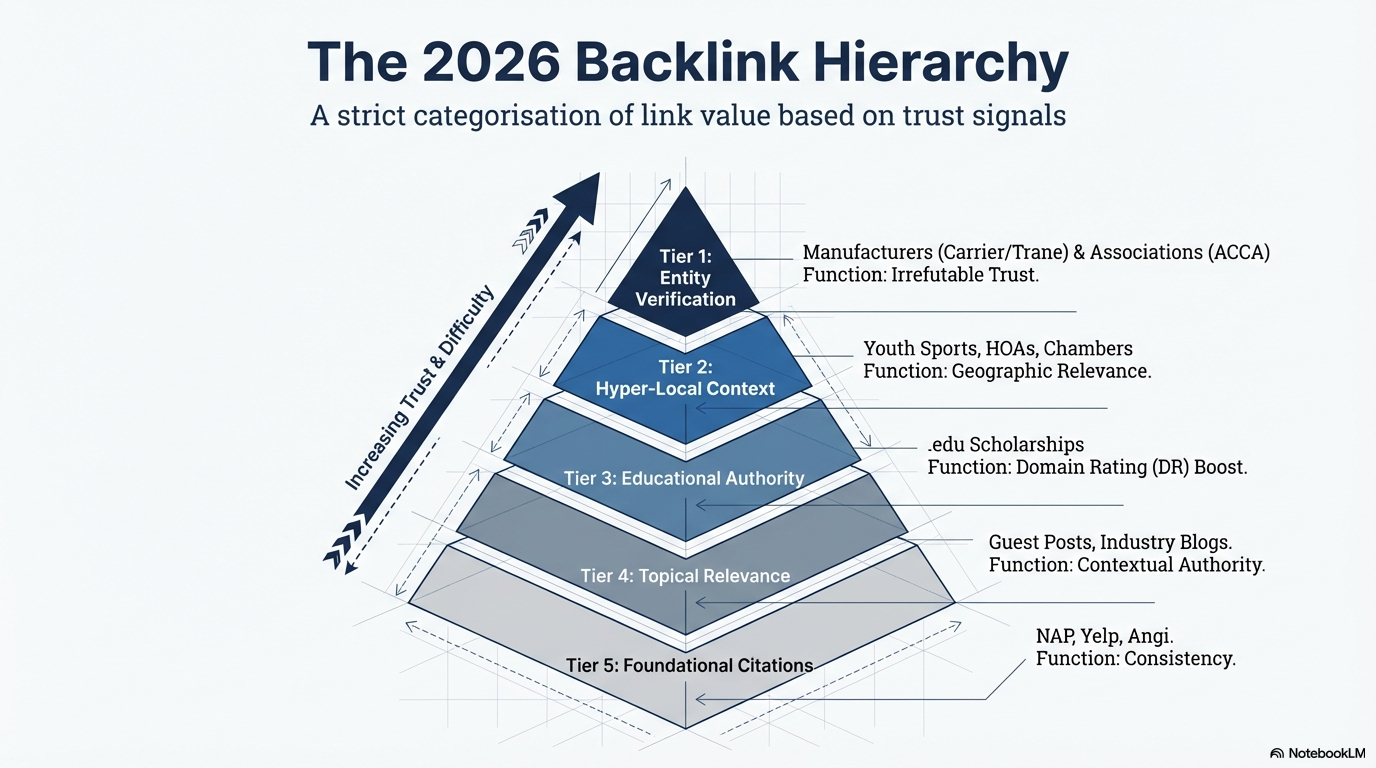
We have categorized HVAC backlinks into a rigid hierarchy based on their impact on trust, authority, and ranking potential. This hierarchy should guide all resource allocation for HVAC marketing campaigns in 2026.
Tier | Link Category | Primary Source Examples | SEO Function | Difficulty |
|---|---|---|---|---|
Tier 1 | Entity Verification | Carrier, Trane, Lennox, ACCA | Trust Signal, Domain Authority | Very High |
Tier 2 | Hyper-Local Context | Youth Sports, HOAs, Chambers | Geographic Relevance | Medium |
Tier 3 | Educational Authority | .edu domains, Trade Schools | Domain Rating (DR) Boost | High |
Tier 4 | Topical Relevance | Industry Blogs, Home Improvement | Contextual Authority | Medium/High |
Tier 5 | Foundational Citations | Angi, BBB, Yelp, YellowPages | NAP Consistency | Low |
Part II: Tier 1 – The Manufacturer Ecosystem (The Holy Grail)
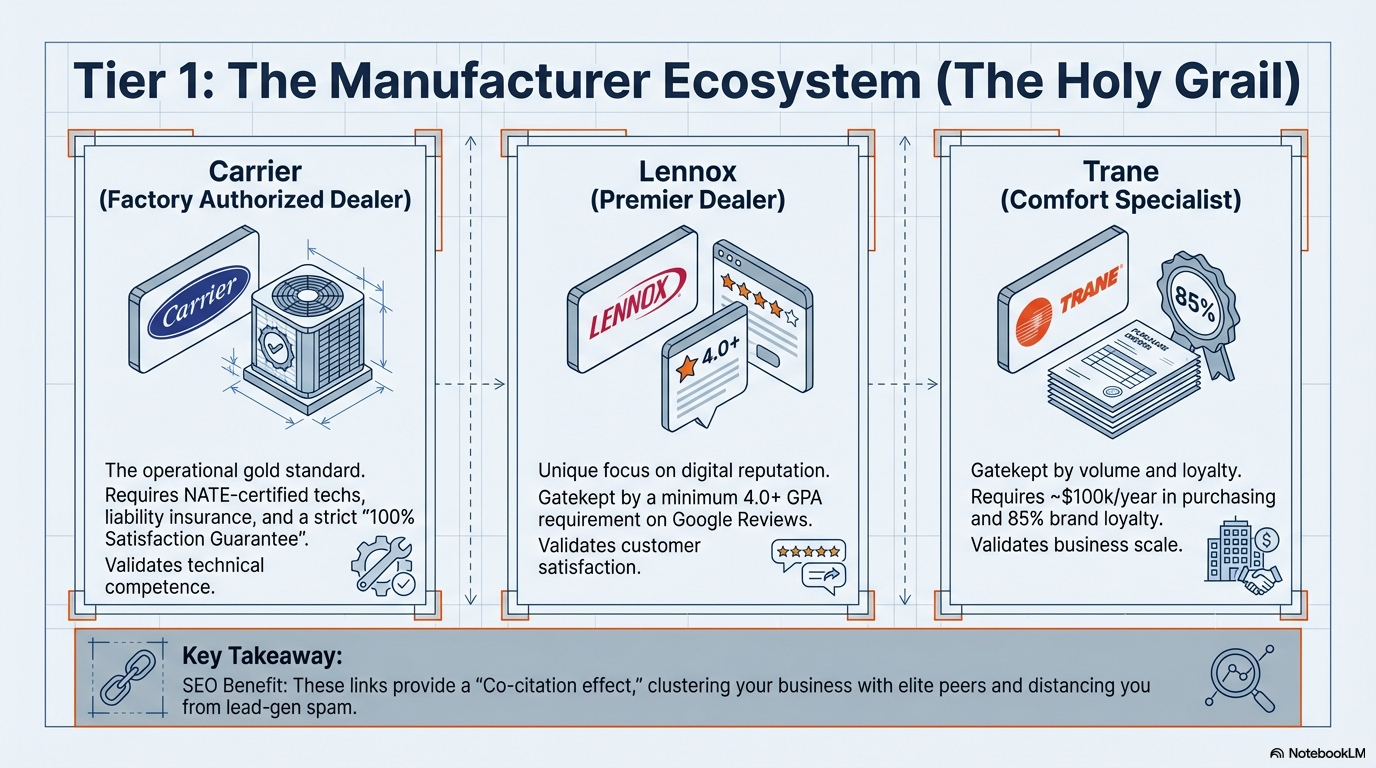
For an HVAC contractor, there is no digital asset more valuable than a backlink from a major equipment manufacturer. These links are the "Gold Standard" because they are gatekept by real-world operational requirements. A spammer cannot fake a physical storefront, a million dollars in inventory purchases, or a team of NATE-certified technicians. Therefore, Google and AI engines treat these links as irrefutable proof of legitimacy.
2.1 Carrier Factory Authorized Dealers (FAD)
Carrier’s Factory Authorized Dealer (FAD) program represents the pinnacle of manufacturer endorsement. A backlink from carrier.com (Domain Authority 70+) provides a massive injection of trust flow to a local contractor's domain.
Operational Requirements for SEO Benefit
The barrier to entry for this link is operational excellence. To appear on the Carrier Dealer Locator and earn the link, a contractor must meet rigorous standards:
Technical Training: Technicians must undergo extensive factory training on installation, maintenance, and repair. This ensures that the entity linked to is capable of servicing the manufacturer's complex systems.
Licensing and Insurance: The contractor must maintain all required local licenses and appropriate liability insurance. This vetting process effectively outsources Google’s "trust" check to Carrier’s corporate compliance team.
The 100% Satisfaction Guarantee: Perhaps the most significant signal is the requirement to honor Carrier’s 100% Satisfaction Guarantee. Dealers must agree to refund the purchase price if a customer is dissatisfied within one year. This creates a powerful consumer trust signal that translates into higher click-through rates (CTR) and lower bounce rates, which are secondary ranking factors.
NATE Certification: A specified percentage of the workforce must be NATE-certified. The dealer locator often features a specific "NATE Certified" badge, allowing users to filter for these elites.
Strategic Analysis
The SEO value here is twofold. First, the direct backlink from a highly authoritative domain. Second, the "co-citation" effect. When your business is listed alongside other elite dealers, Google clusters your entity with high-performing peers, distancing you from low-quality lead generation sites.
2.2 The Lennox Premier Dealer Program
Lennox takes a unique approach that directly intertwines operational metrics with digital reputation, creating a feedback loop that drives Local SEO success.
The Review Requirement
Unlike other programs that focus primarily on sales volume, the Lennox Premier Dealer program mandates specific digital reputation metrics for entry. A dealer must have a minimum of 10 Google consumer reviews with an average rating of 4.0 before they can even be enrolled as a Premier Dealer.
This requirement forces the contractor to focus on their Google Business Profile (GBP), which is the single most important factor for ranking in the Local Map Pack. By making GBP performance a prerequisite for the manufacturer link, Lennox ensures that its dealer network is optimized for local search. Furthermore, dealers must maintain a 4.0+ rating throughout the year to keep the status, ensuring ongoing attention to reputation management.
Training and Content
Premier Dealers must complete annual training requirements. This access to Lennox’s "Learning Solutions" provides contractors with advanced technical knowledge that can be repurposed into high-quality blog content—another pillar of SEO strategy.
2.3 Trane Comfort Specialist (TCS)
The Trane Comfort Specialist program is heavily weighted toward sales volume and loyalty, making the backlink a signal of market dominance and scale.
Financial and Loyalty Gates
To earn the TCS badge and the associated backlink, a contractor typically must meet a minimum yearly purchase volume, often cited around $100,000 in Trane equipment. Additionally, they must demonstrate that more than 85% of their total equipment purchases are Trane products. This exclusivity signals to search engines that this entity is a dedicated specialist rather than a generalist handyman.
The Locator Tool Advantage
Trane’s dealer locator is highly sophisticated, allowing users to filter by specific capabilities such as "24/7 Emergency Service" or "NATE Certified". From an SEO perspective, this means the referral traffic from Trane is "high intent." A user filtering for "Emergency Service" is likely to convert immediately. SEO strategies should ensure that every possible attribute in the dealer portal is checked and verified to maximize visibility within this ecosystem.
2.4 Rheem Pro Partner and Goodman
Rheem Pro Partner
Rheem emphasizes the sheer volume of customer feedback. Pro Partners are required to submit a minimum of 30 customer reviews per year to maintain their status. This aggressive target forces dealers to implement automated review generation systems, which naturally boosts their overall Local SEO presence across the web.
Goodman
Goodman’s dealer locator is more accessible but still valuable. It serves as a foundational manufacturer link for smaller or newer contractors who might not yet meet the volume requirements of a Trane or Carrier but still need verification of their dealer status.
Part III: Tier 1 – The Trade Association Nexus
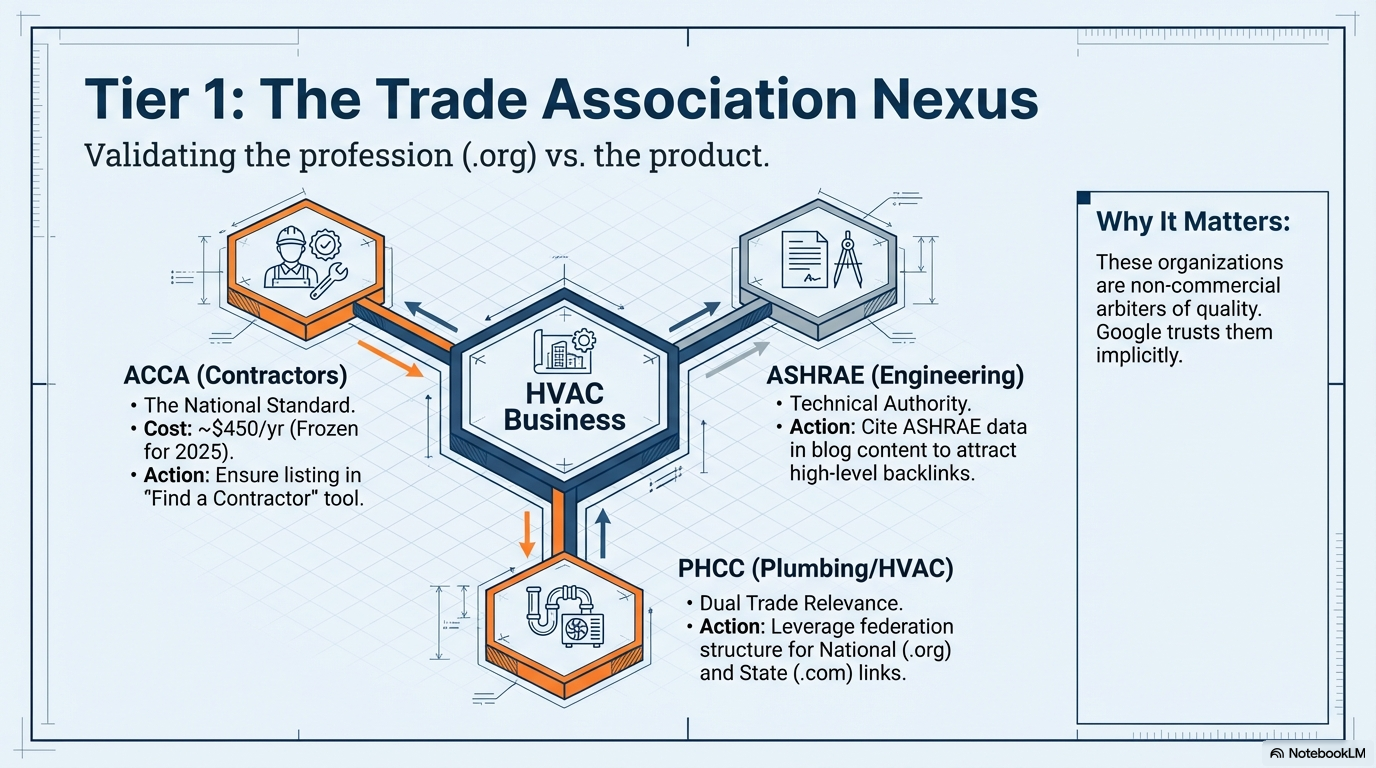
If manufacturer links validate the product you sell, trade association links validate the profession you practice. These organizations (.org domains) are viewed by Google as non-commercial arbiters of quality.
3.1 ACCA (Air Conditioning Contractors of America)
The ACCA is the premier nationwide association for HVAC professionals. A link from acca.org connects a local business to the national standard-setting body.
Cost vs. Value: For 2025, ACCA has frozen its membership dues, making it a highly efficient SEO investment. Membership costs approximately $450 per year (varying slightly by chapter, e.g., NJ ACCA at $449).
The "Find a Contractor" Tool: Members are listed in a searchable database. This directory is crawled frequently by Google. When the crawler sees a local HVAC site linked from the ACCA directory, it assigns a "verified" status to that entity.
Advocacy and Content: ACCA lobbies for the industry and sets standards (like Manual J and Manual D). Referencing these standards in your website content and linking back to ACCA creates a reciprocal authority signal.
3.2 ASHRAE (American Society of Heating, Refrigerating and Air-Conditioning Engineers)
While ACCA is contractor-focused, ASHRAE is engineering-focused. A link here signals high-level technical competence.
Content Authority: Membership provides access to the ASHRAE Handbook and the Technology Portal. Smart HVAC marketers use this access to write scientifically accurate blog posts about indoor air quality (IAQ) or thermodynamics, citing ASHRAE data. This attracts links from other high-authority sites looking for credible information.
Chapter Links: While the national site might not link to every member, local ASHRAE chapters often have member directories that are highly relevant to local search.
3.3 PHCC (Plumbing-Heating-Cooling Contractors Association)
For businesses that straddle the line between plumbing and HVAC, PHCC is indispensable.
Dual Relevance: Membership signals competence in both trades.
State and National: The federation structure means a single membership often yields links from both the national site (phccweb.org) and the state chapter site (e.g., phccnc.com).
Investment: Dues vary significantly, from $208/month in high-cost areas to $1,262/year in others. The dual-link benefit often justifies the higher cost.
Part IV: Tier 2 – Hyper-Local Link Building Strategies
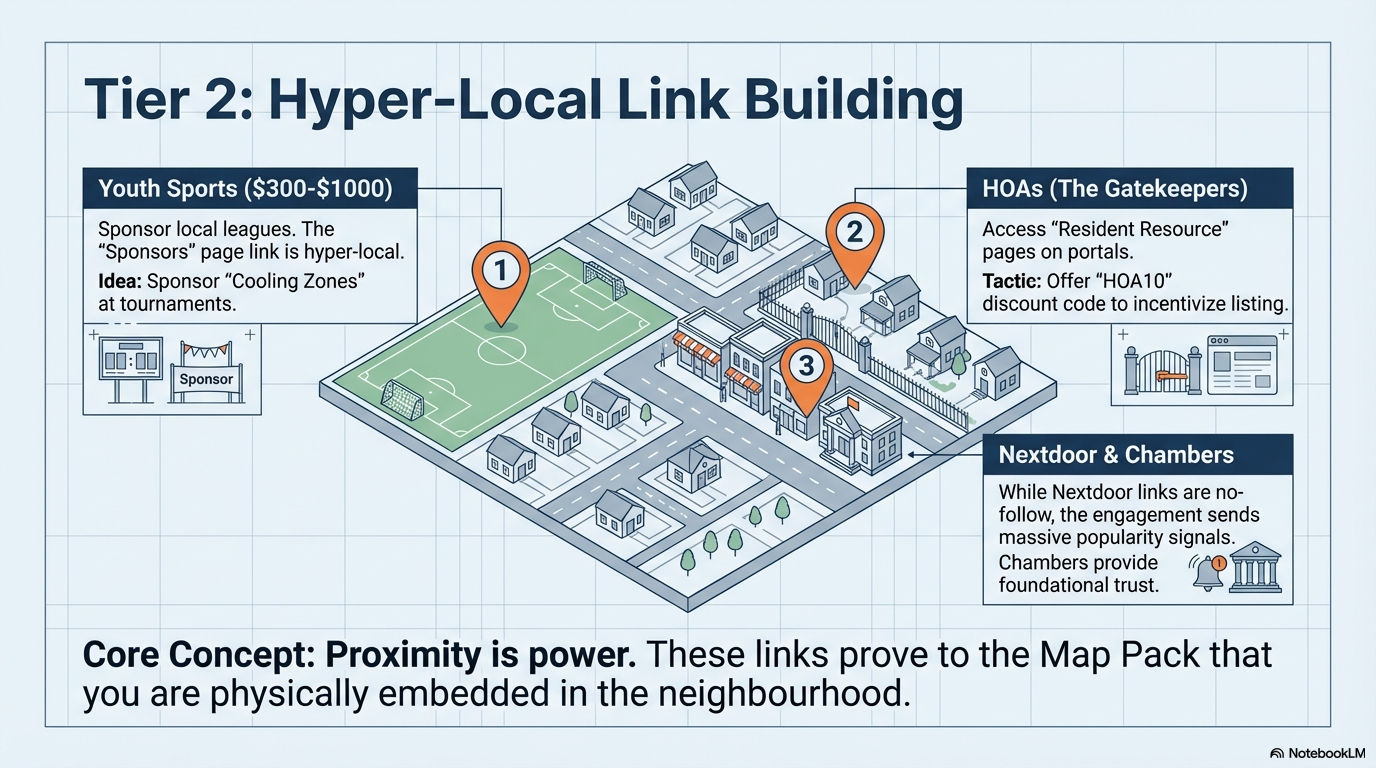
Local SEO is fundamentally about proximity. A backlink from a global news site is impressive, but a backlink from a neighborhood church or Little League team in your service area is often more effective for ranking in the "Map Pack." These links confirm to Google that your business is deeply embedded in the local community.
4.1 Youth Sports Sponsorships
This is a high-ROI strategy that combines community goodwill with powerful SEO signals. Local youth sports leagues (baseball, soccer, football) almost always operate websites to manage schedules and registrations. These sites are hyper-local; their content, traffic, and IP addresses are all tied to your specific city or county.
The Mechanism: An HVAC company sponsors a team or a field (typically $300 - $1,000). In exchange, the league places the company’s logo and a dofollow link on their "Sponsors" page.
Case Study Evidence: Research highlights an HVAC client who achieved a "rank twice" result—appearing in both the Map Pack and organic search—partially due to a backlink earned by sponsoring a local Little League organization.
Finding Opportunities: Use AI or manual searches to find leagues. Prompts like “List upcoming youth sports leagues in [City] that have sponsor pages” can rapidly generate a target list.
Activations: Companies like OFF! have partnered with Little League for mosquito protection. An HVAC company could sponsor "Cooling Zones" or hydration stations at summer tournaments, creating a relevant context for the sponsorship.
4.2 Homeowner Associations (HOAs) and Neighborhood Groups
HOAs are the gatekeepers to residential neighborhoods. Earning a spot on an HOA's "Preferred Vendor" list is a direct line to high-intent customers.
The Digital Signal: Many large HOAs maintain private or semi-private websites/newsletters. While Google may not crawl password-protected pages, many HOAs have public-facing "Resident Resources" pages that list trusted contractors.
Nextdoor: While links from Nextdoor are typically "nofollow" (passing no direct link equity), the engagement signals are massive. A business with high engagement and "Faves" on Nextdoor sends a strong signal of local popularity to search algorithms.
Strategy: Offer a specific discount code for residents (e.g., "HOA10"). This encourages the HOA board to list the discount—and your link—on their site.
4.3 Chambers of Commerce
Joining the local Chamber of Commerce is a foundational step for any local business.
Authority: Chambers are usually .org or .com sites with high Domain Authority and trust.
Validation: A Chamber link validates your physical address and business legitimacy. It is a primary data source for aggregators.
Networking: Beyond the link, Chamber events provide opportunities to network with other business owners who might link to you (e.g., realtors, builders).
Part V: Tier 3 – The Educational Authority (.edu Strategies)
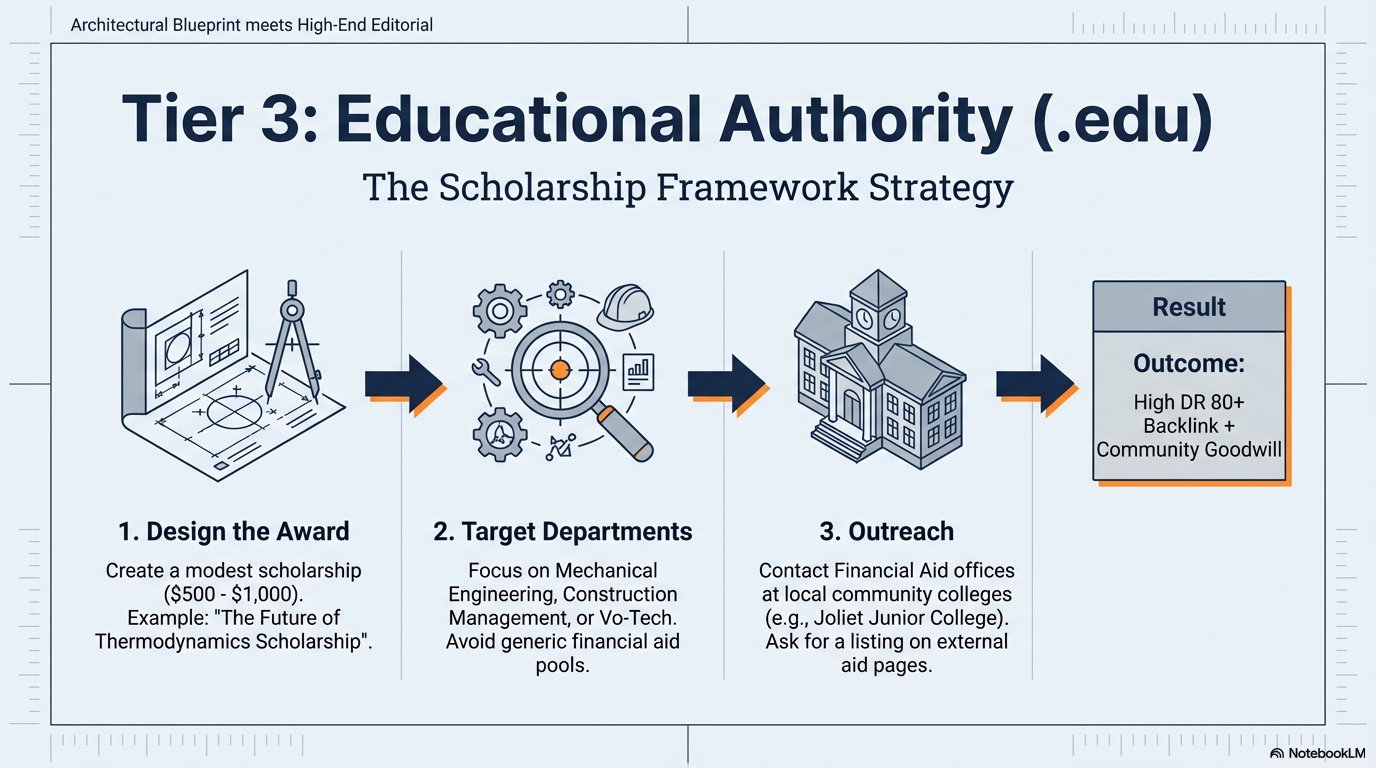
Backlinks from educational institutions (.edu domains) are the most coveted in SEO. Google trusts universities implicitly. However, you cannot simply "buy" a link from a university. You must offer value. The Scholarship Strategy is the most effective method for HVAC contractors to earn these elite links.
5.1 The Scholarship Link Building Framework
The premise is straightforward: The HVAC company creates a scholarship award (e.g., "The Future of Thermodynamics Scholarship") and asks universities to list it on their "External Scholarships" or "Financial Aid" pages.
Step 1: Program Design: Create a scholarship with clear criteria. It does not need to be massive; awards of $500 to $1,000 are standard and effective.
Step 2: Relevance Targeting: Target departments relevant to the trade. Instead of a general scholarship, create one for "Mechanical Engineering," "Construction Management," or "Vocational Tech" students. This increases the relevance of the backlink.
Step 3: Outreach: Contact the financial aid offices of local community colleges, trade schools, and state universities. Provide them with the details and a link to the scholarship page on your site.
Examples of Success:
Dunwoody College of Technology lists specific HVAC scholarships on its site, including the "Anthony M. Burtzel Memorial Scholarship" ($1,500) and the "Laudy E. Ribar HVAC & HEAT Scholarship" ($1,000).
Joliet Junior College lists the "Edward J. Cwiklo Technical Scholarship" for technical majors.
These institutions are actively looking for financial aid resources for their students. By providing one, you solve a problem for them while earning a DR 80+ backlink.
5.2 Trade School Partnerships
Beyond scholarships, direct partnerships with local trade schools can yield links.
Career Pages: Trade schools often have "Career" or "Job Board" pages where they link to companies that hire their graduates. Establishing a recruitment pipeline can get your site listed here.
Advisory Boards: Business owners who sit on the advisory boards of local technical colleges often get a bio and a backlink on the college's website.
Part VI: Tier 4 – Guest Posting & The Economics of Authority
Guest posting—writing content for other websites in exchange for a backlink—remains a scalable way to build authority. However, the market is fraught with pricing opacity, "link farms," and agency overcharging. For 2026, an HVAC business owner must approach this tier with the mindset of a savvy investor.
6.1 The "Agency Arbitrage" Crisis
The guest post market is currently inefficient. Marketing agencies often charge clients a premium "retail" price for a link they purchase at a deeply discounted "wholesale" price.
Table 1: The Economics of Guest Posting (Agency vs. Wholesale)
Domain Rating (DR) | Average Wholesale Cost (Direct to Site) | Average Agency Price (Client Cost) | Typical Markup |
|---|---|---|---|
DR 20-30 | $30 - $60 | $150 - $250 | 400% |
DR 30-45 | $80 - $150 | $365 | 140% - 350% |
DR 60+ | $300 - $450 | $930 - $1,000+ | 200%+ |
Data synthesized from.
Analysis: The data reveals that the average cost of a guest post is roughly $365, but high-quality placements command significantly more. However, over 85% of the "linkable" domains on the market are low-quality sites with inflated metrics but no real traffic. Agencies often sell these low-quality links at high-quality prices.
6.2 The Solution: Linkpricer.com
To combat this arbitrage, HVAC marketers must utilize comparison tools. Linkpricer.com has emerged as a critical utility for cost control and strategic transparency.
Functionality: Linkpricer aggregates pricing data from over 50 guest post marketplaces and sellers. It allows a user to search for a specific target website (e.g., contractingbusiness.com) and see the price offered by multiple different vendors.
Cost Savings: By comparing prices, an HVAC business can identify that Vendor A charges $450 for a link while Vendor B charges $150 for the exact same link. This transparency can save up to 70% on link acquisition costs.
Budget Efficiency: In an industry where marketing budgets are often tight (averaging $2,000 - $11,000 per month for small-to-medium shops), saving $300 per link allows the business to acquire more links or reallocate funds to other high-impact channels like Google Local Services Ads (LSA).
Strategic Vetting: Beyond price, tools like Linkpricer help verify if a site is a "public marketplace" site (which carries some risk) or a more exclusive opportunity.
6.3 Vetting Guest Post Targets
Never purchase a link based solely on Domain Authority (DA).
Traffic is the Truth: Use tools like Ahrefs or Semrush to verify the site has real organic traffic. A site with DR 50 but zero traffic is a "ghost town" and likely penalized by Google. A link from such a site can be toxic.
Relevance is Key: An HVAC link on a "Home Improvement" site is natural. An HVAC link on a "Crypto Advice" blog is spam. Relevance protects your site from algorithmic penalties.
Editorial Guidelines: Respect the guidelines of high-quality industry publications. For example, ACHR News accepts guest columns but mandates they be "impartial, unbiased, product-neutral," and non-promotional. These are the hardest links to get but the most valuable.
Part VII: Tier 5 – Foundational Citations & NAP Consistency
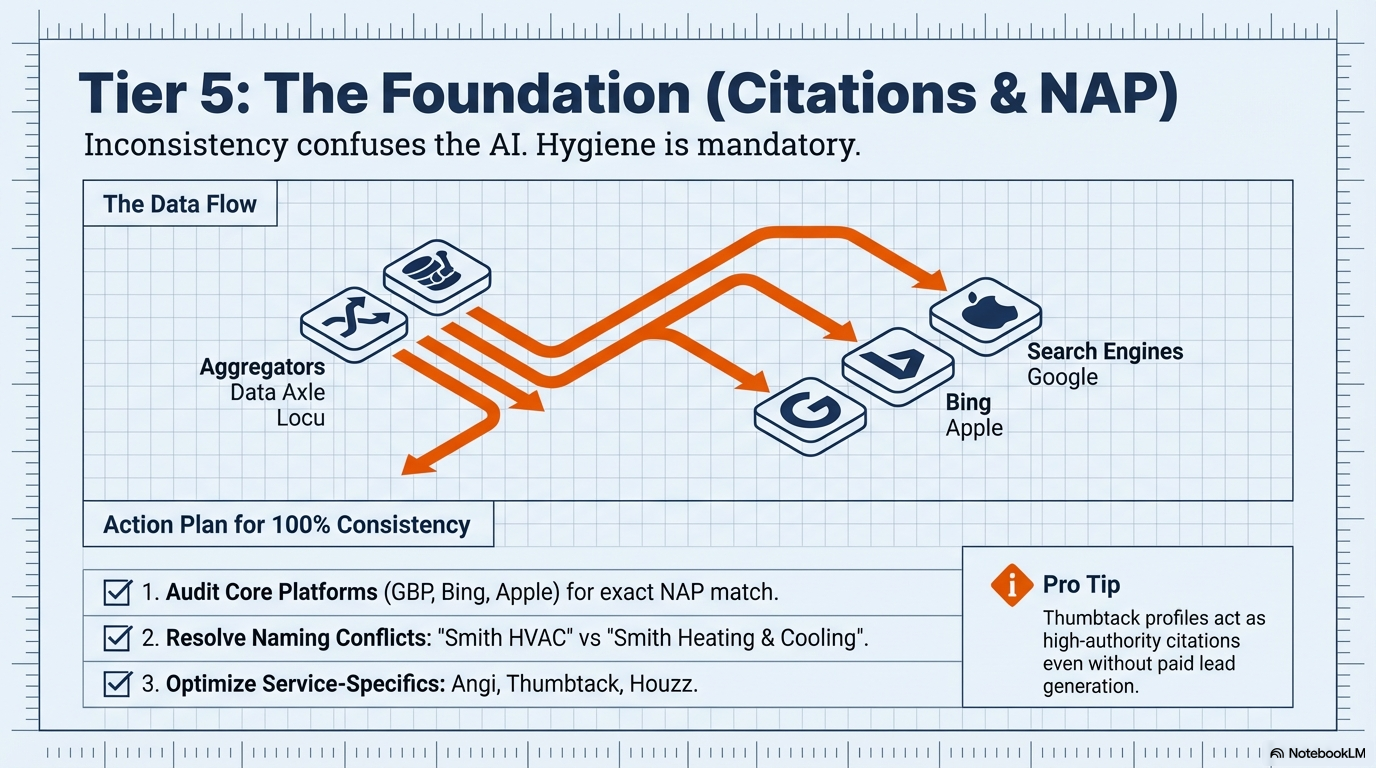
Before chasing elite links, the foundation must be solid. For local businesses, the bedrock of SEO is NAP Consistency (Name, Address, Phone Number).
7.1 The Data Aggregator Ecosystem
Local search relies on data aggregators (Data Axle, Locu, Foursquare) that feed information to search engines. If your business is listed as "Smith HVAC" on one site and "Smith Heating and Cooling" on another, Google’s confidence in your data drops. This "confusion" can prevent you from ranking in the Map Pack.
Strategy: Ensure character-for-character consistency across all platforms. Use tools like BrightLocal or Whitespark to audit and fix these listings.
7.2 Key Citation Sources
Core Platforms: Google Business Profile, Bing Places, Apple Maps.
Service-Specific: Angi, Thumbtack, HomeAdvisor.
Thumbtack: While a lead generation platform, the Thumbtack profile acts as a high-authority citation. The "Pro" app facilitates quick responses, improving engagement signals.
Houzz: For HVAC contractors working on high-end remodels or new construction, a Houzz profile connects you with the design/build ecosystem. While paid leads on Houzz receive mixed reviews, the free profile is a valuable citation.
Part VIII: Generative Engine Optimization (GEO) & The Future of Search
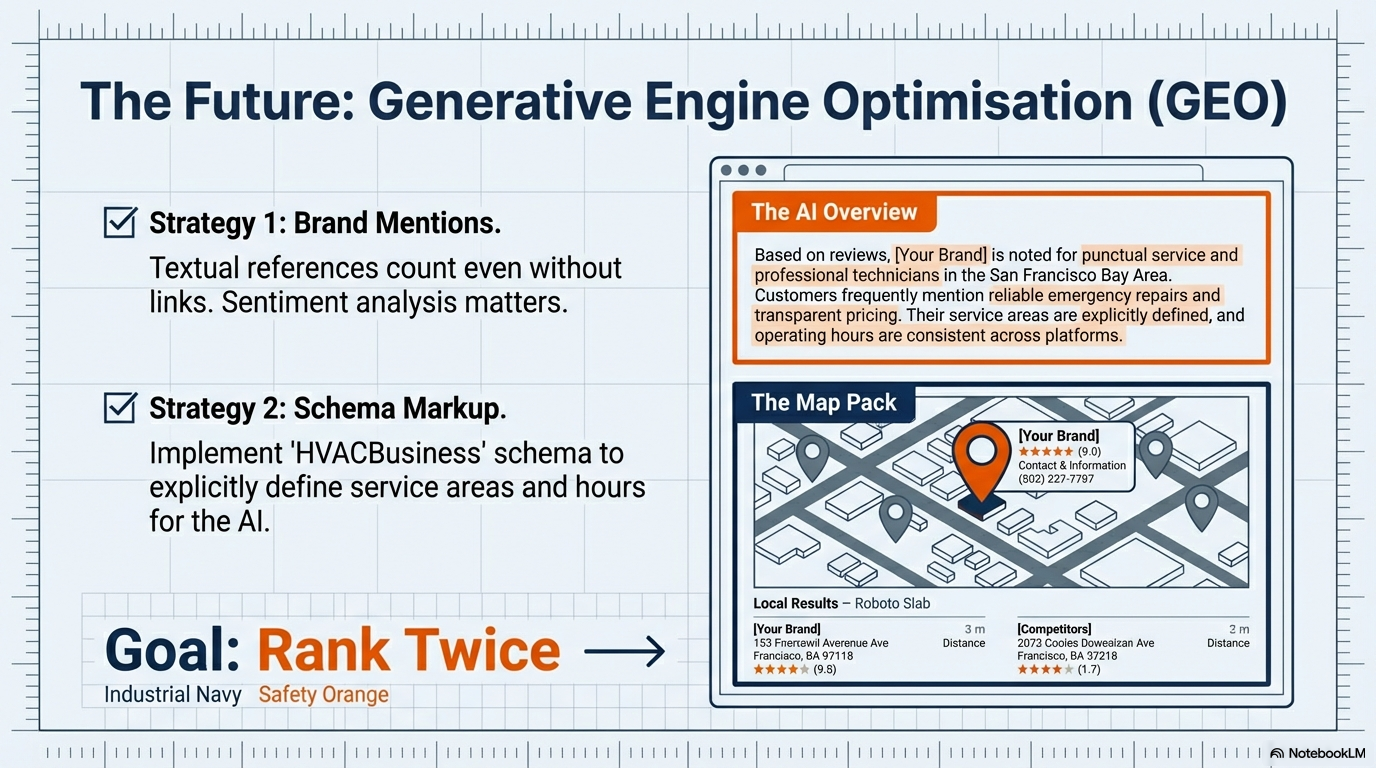
As 2026 progresses, the definition of "search" is expanding. Generative Engine Optimization (GEO) is the practice of optimizing content and entity signals to be cited by AI models.
8.1 Optimizing for the AI "Zero-Click" World
More than 50% of Google searches now end without a click. The user sees the answer directly on the results page (via AI Overviews) and calls the business without ever visiting the website.
Strategy: To win in a zero-click world, you must optimize for the answer, not just the click.
E-E-A-T and Brand Mentions: AI models rely heavily on "Brand Mentions" and sentiment analysis. They read reviews to determine who is "best." If reviews consistently mention "punctual," "honest," and "fair pricing," the AI associates those attributes with your entity.
Schema Markup: Use "LocalBusiness" and "HVACBusiness" schema to speak directly to the AI. This structured data explicitly tells the engine: "This is our service area. These are our hours. These are our reviews." It removes ambiguity.
8.2 The "Rank Twice" Strategy
The ultimate goal is to dominate the visual real estate of the search page.
Slot 1: The AI Overview: Achieved through high-authority mentions and schema.
Slot 2: The Map Pack: Achieved through GBP optimization, reviews, and proximity.
Slot 3: Organic Results: Achieved through high-quality content and backlinks.
Case Study: George Brazil HVAC successfully executed a "rank twice" strategy in Phoenix. By optimizing their GBP for the Map Pack and creating city-specific landing pages for organic search, they captured traffic from both "near me" searches and broader informational queries.
Part IX: Proven Results – HVAC SEO Case Studies
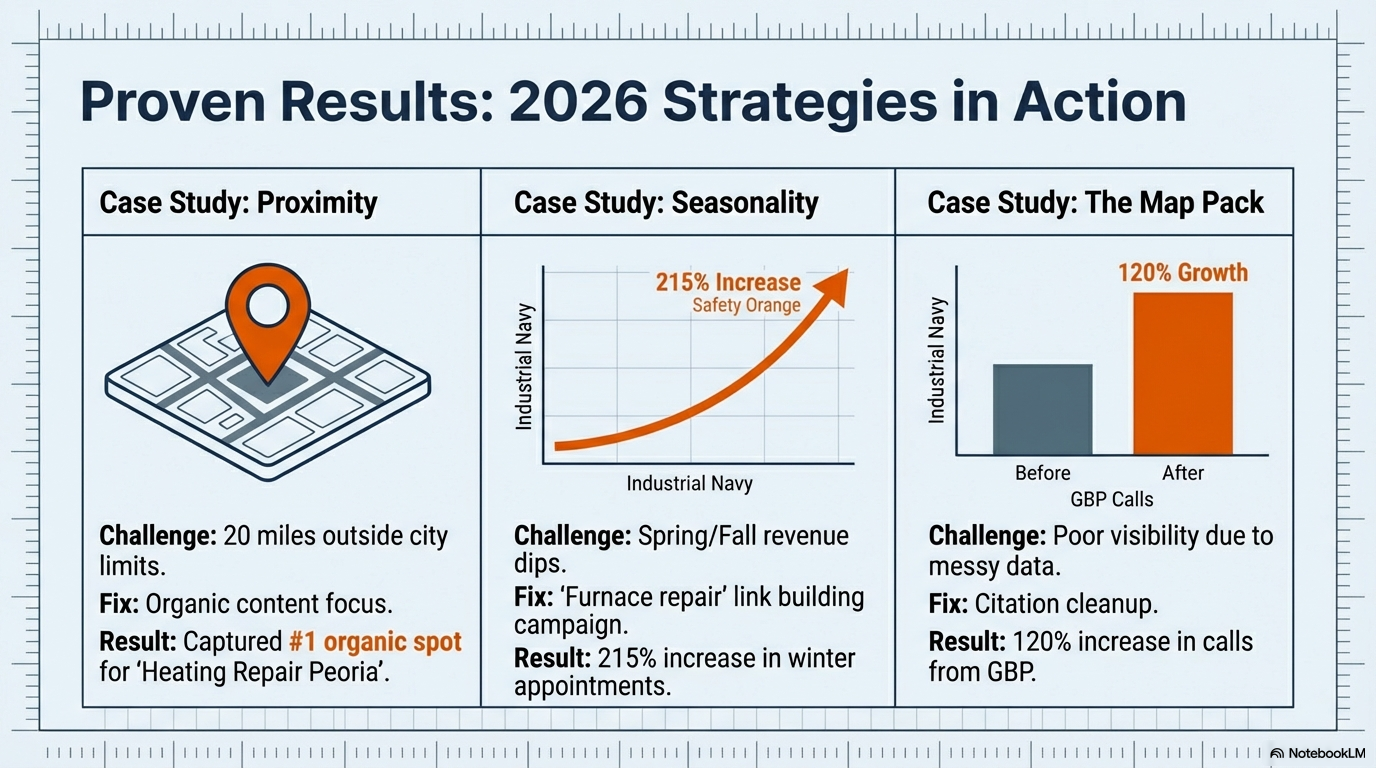
The strategies outlined above are not theoretical. They are backed by measurable market data.
9.1 Overcoming Proximity Limitations
Challenge: An HVAC company located 20 miles outside a target city (Peoria, AZ) could not rank in the Map Pack due to proximity filters.
Solution: They shifted focus to organic SEO, creating high-quality, location-specific content targeting "Heating & Air Conditioning Repair Peoria."
Result: While they remained absent from the Map Pack, they captured the #1 organic spot, winning customers from the outlying city despite the distance.
9.2 The Seasonality Fix
Challenge: "Premier Comfort Systems" faced revenue dips during the shoulder seasons (Spring/Fall).
Solution: A targeted SEO campaign focused on "furnace repair" and "maintenance plans" was launched, supported by seasonal content and local link building.
Result: Winter service appointments increased by 215%, and annual recurring maintenance contracts rose by 94%, stabilizing revenue year-round.
9.3 The "Map Pack" Domination
Challenge: "Comfort Air Solutions" had a great reputation but poor online visibility due to inconsistent NAP data.
Solution: A comprehensive citation cleanup and Google Business Profile optimization campaign.
Result: Within 6 months, phone calls from GBP increased by 120%, and the company achieved Top 3 rankings for key local keywords.
Part X: Technical Foundation – Speed, Mobile, and Structure
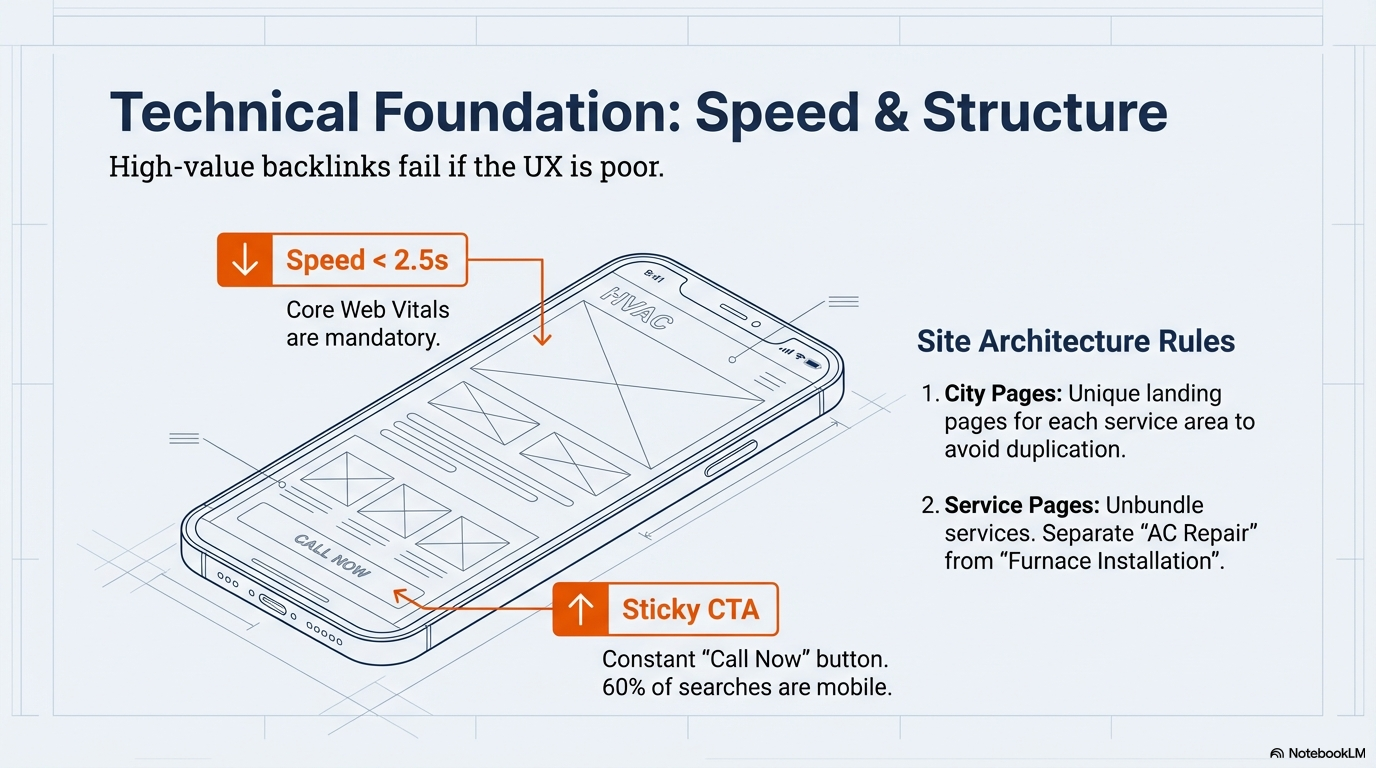
All the backlinks in the world will not save a site that provides a poor user experience.
10.1 Mobile-First Indexing
60% of HVAC searches occur on mobile devices. If your site is slow or difficult to navigate on a phone, users will bounce, sending negative signals to Google.
Requirement: Ensure your site passes Google’s "Core Web Vitals" assessment. Pages must load in under 2.5 seconds.
Call-to-Action (CTA): On mobile, the "Call Now" button must be sticky and visible at all times.
10.2 Site Structure and Landing Pages
Service Pages: Do not list all services on one page. Create dedicated pages for "AC Repair," "Furnace Installation," "Duct Cleaning," etc. This helps you rank for specific long-tail keywords.
City Pages: Create unique landing pages for each city in your service area (e.g., "HVAC Services in [City A]," "HVAC Services in"). Avoid duplicate content; each page must have unique descriptions and reviews relevant to that location.
Conclusion: The Actionable Path Forward for 2026
The era of "set it and forget it" SEO is over. For HVAC companies in 2026, winning the search battle requires a multi-layered strategy that combines technical precision with real-world relationship building.
Your 2026 Execution Checklist:
Audit Manufacturer Status: Immediately review your standing with Carrier, Trane, or Lennox. If you are close to "Premier" or "Factory Authorized" status, make the operational changes to bridge the gap. That single backlink is worth more than 50 blog posts.
Activate the Community: Budget $2,000 for local sponsorships. Find three youth sports leagues and one HOA to partner with.
Launch a Scholarship: Create a $500 - $1,000 scholarship for trade students. Reach out to local community colleges to get it listed.
Audit Guest Post Spending: Use Linkpricer.com to audit your agency’s link prices. Stop paying retail for wholesale links.
Future-Proof with GEO: Update your website schema to "HVACBusiness" and ensure your brand is mentioned (even without links) in trusted local news sources.
By following this hierarchy—Manufacturer, Community, Education, and Editorial—you build a "defensive moat" around your digital presence. This moat is built on trust, authority, and local relevance, the three qualities that no algorithm update can devalue.