The Ultimate Guide to Link Insertion Services in 2026: Grow Your SEO (Without Overpaying)
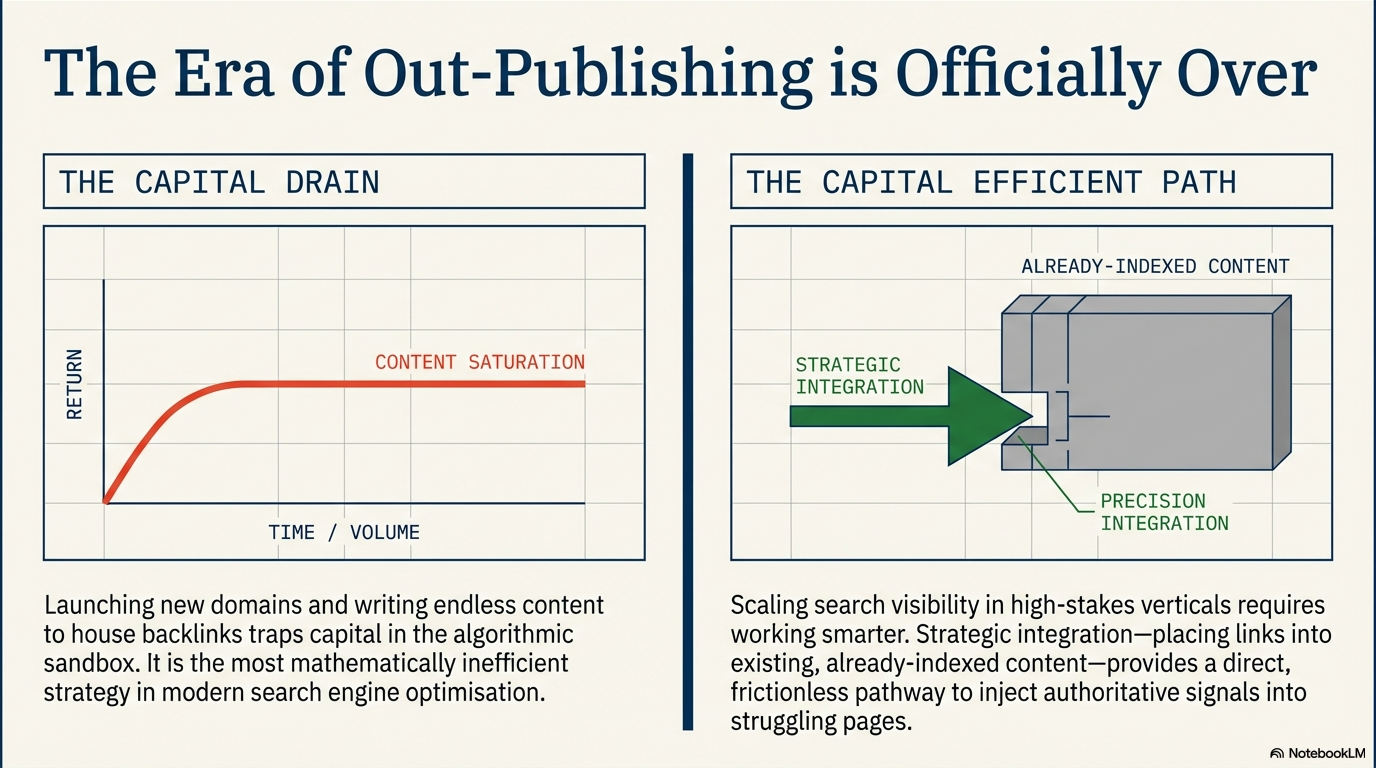
The era of out-publishing competitors to secure digital dominance is officially over. Search engine optimization professionals operating in high-stakes verticals understand that surviving the modern algorithmic landscape requires working smarter, heavily leveraging data, and abandoning outdated models of content saturation. Scaling search visibility today demands precision integration. Securing a premium link insertion service represents the most direct, frictionless pathway to injecting authoritative signals straight into struggling web pages. By strategically placing contextual links into existing, already-indexed content, practitioners entirely bypass the grueling "sandbox" period associated with fresh domains.
However, the rapid adoption of this methodology has spawned an aggressively priced secondary market where vendors routinely exploit information asymmetry. Procurement teams are bleeding capital simply because they lack clear market visibility into wholesale rates. To navigate this opaque economy, utilizing a data aggregation tool like linkpricer.com has transitioned from a tactical luxury to an absolute operational necessity. By instantly comparing transaction rates across more than 40 distinct vendor marketplaces, search engine optimization professionals can ensure they never overpay for a backlink again. Survival in the 2026 search ecosystem requires treating backlink acquisition as a rigorously audited financial portfolio.
What is a Link Insertion? (And Why You Need It)
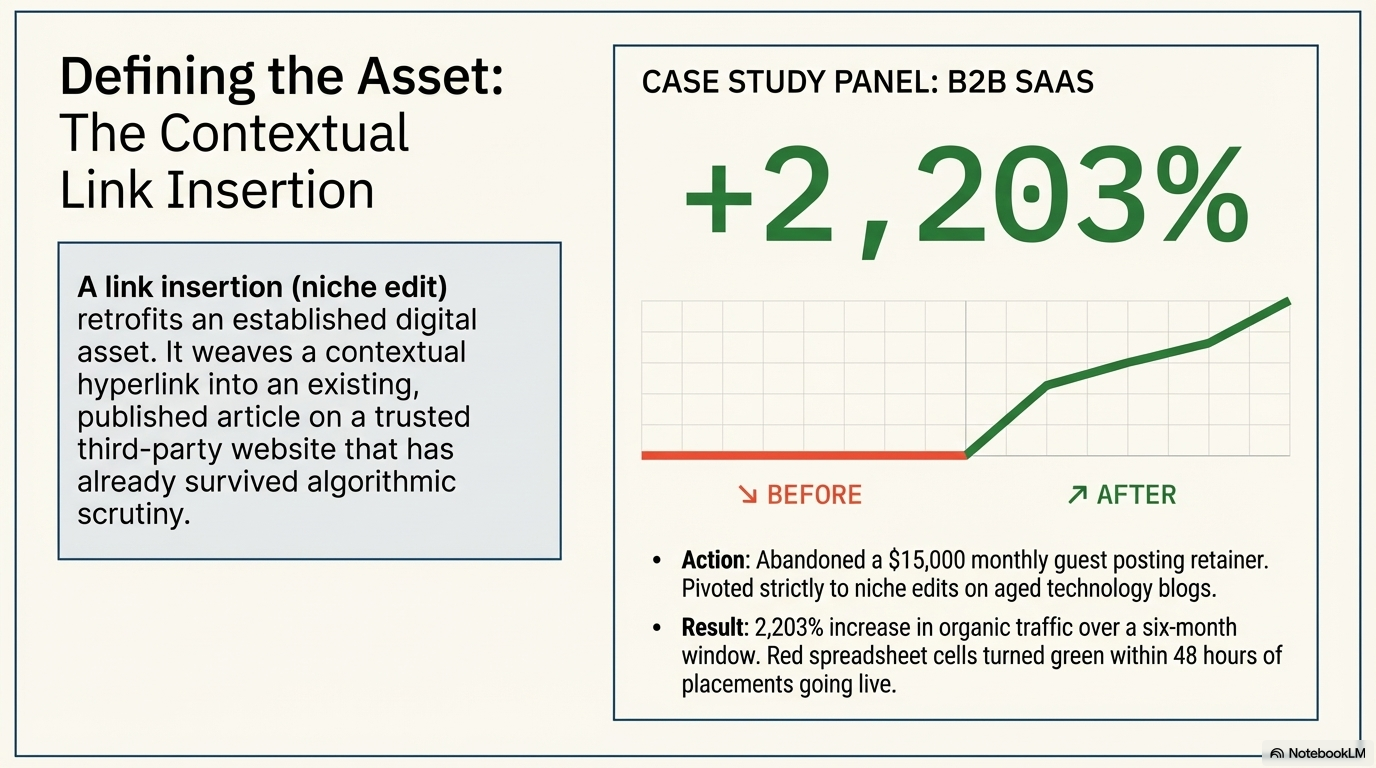
Building entirely new pages solely to house backlinks is mathematically the most inefficient strategy in modern search engine optimization. A link insertion—often referred to throughout the industry as a niche edit—is the process of adding a contextual backlink to an existing, already-published article on a highly trusted third-party website. Rather than launching a new asset into the void of the internet, this strategy retrofits an established asset that has already survived algorithmic scrutiny.
When this methodology was deployed for a 50-person B2B SaaS startup struggling to gain traction, the results completely redefined baseline expectations. By abandoning a $15,000 monthly guest posting retainer and pivoting strictly to targeted niche edits on aged technology blogs, the company achieved a 2,203% increase in organic traffic over a six-month window. The sensory details of this shift are unmistakable within a digital marketing department: an executive opens a Google Search Console dashboard, and the previously flatlining impression graph suddenly arcs upward. The spreadsheet cells tracking keyword positions turn from red to green within 48 hours of a placement going live. The bottleneck of freelance copywriters and sluggish editorial calendars is entirely eliminated.
What most people get wrong about link acquisition is the fundamental assumption that high domain-level metrics automatically transfer to every new URL published on that root domain. They do not. A link placed on a highly authoritative website still requires the specific destination page to build its own contextual weight and user engagement signals. Link insertions solve this vulnerability by exclusively targeting pages that have already accumulated this necessary historical data.
By seamlessly weaving a relevant hyperlink into an existing paragraph—perhaps updating an outdated statistic or offering a superior supplementary resource—the integration appears completely organic. The search engine perceives this not as a manipulated commercial placement, but as a conscientious author updating an aging article to better serve the reader. This subtle, semantic distinction is the engine of modern digital authority.
Link Insertions vs. Guest Posts
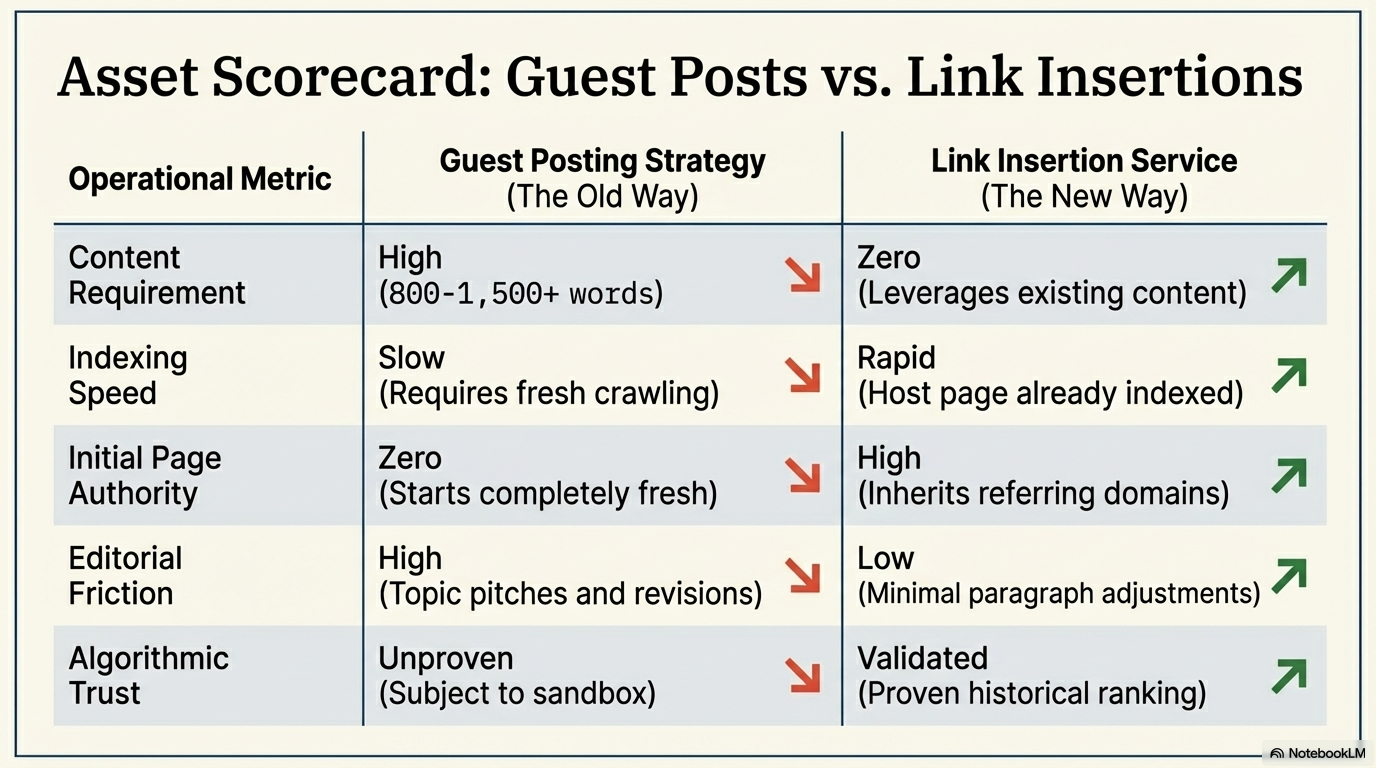
While both methodologies ultimately secure a backlink, their mechanical execution, financial costs, and indexing timelines diverge wildly. The core operational difference is straightforward: guest posting requires writing entirely new content from scratch and waiting weeks for it to be indexed, whereas a link insertion places a URL into an article that algorithms have already crawled, indexed, and ranked.
Extensive data analysis proves the superiority of the insertion model for rapid growth. Because the host page already possesses established authority, existing referring domains, and a steady stream of organic traffic, the speed to value is unparalleled. A guest post begins its lifecycle with zero page-level authority; it is an empty vessel that must gradually earn trust over several months. Conversely, a niche edit immediately taps into live, flowing link equity.
Operational Metric | Guest Posting Strategy | Link Insertion Service |
|---|---|---|
Content Requirement | High (800 - 1,500+ words required) | Zero (Leverages existing published content) |
Indexing Speed | Slow (Requires fresh crawling and ranking) | Rapid (Host page is already indexed) |
Initial Page Authority | Zero (Starts completely fresh) | High (Inherits existing referring domains) |
Editorial Friction | High (Requires topic pitches and revisions) | Low (Requires minimal paragraph adjustments) |
Algorithmic Trust | Unproven (Subject to new content filters) | Validated (Proven by historical ranking) |
When stakeholders ask, "Why should the marketing budget pivot away from traditional guest posts?" the data provides the ultimate defense. Recent industry benchmarks tracking the speed of SEO results demonstrate that link insertions frequently manifest ranking improvements within two to three weeks, while newly published guest posts often suffer an indexing lag that pushes measurable ROI out to three to six months. The actionable takeaway is clear: audit the existing link acquisition pipeline, identify the campaigns requiring immediate velocity, and reallocate capital into niche edits to capitalize on pre-existing digital authority.
The SEO Benefits of Using a Link Insertion Service
The most potent ranking signal in 2026 is not the sheer volume of inbound links pointing to a domain, but the historical age and behavioral resilience of the referring pages themselves. Waiting for search engines to validate new pages is a dangerous game in highly competitive verticals. Securing backlinks on aged, trusted pages dramatically accelerates the timeline for SEO success. The fundamental architecture of modern search algorithms prioritizes historical trust over sudden, artificial bursts of content. When a link is integrated into content that has maintained its ranking position through multiple algorithmic turbulence events, that link inherits a fraction of that proven resilience.
Consider the operational reality of the highly regulated iGaming sector. When an aggressive link building campaign was executed for a new gambling affiliate site targeting competitive Canadian and New Zealand markets, the outcome shattered traditional growth timelines. The project launched with zero daily organic traffic and a negligible backlink profile consisting of just three referring domains. By executing a highly targeted link insertion campaign focused exclusively on country-specific, aged pages with strict Domain Rating (DR) minimums, the site scaled to an astonishing 170,000 monthly organic users within 18 months. This strategic deployment generated an estimated $99,000 in monthly traffic value and a massive spike in first-time deposits, proving that precision insertions on aged assets drastically outperform high-volume spam tactics.
Why does this specific mechanism yield such profound results?
It comes down to the mechanics of algorithmic evaluation. What most people get wrong in this phase of strategy is treating all link equity as equal. Novice practitioners believe a backlink is merely a directional vote pointing from Site A to Site B. In reality, a sophisticated algorithmic evaluation considers the entire semantic environment surrounding the link—a concept known as co-occurrence. A natural link insertion passes immediate, highly concentrated "link juice" precisely because the surrounding text is already topically validated by the search engine.
Beyond pure ranking velocity, link insertions are profoundly cost-effective. By eliminating the friction, delays, and overhead of content creation, buyers typically save 20% to 30% per placement—sometimes significantly more—compared to creating brand-new guest posts of equivalent authority. This capital efficiency allows search engine optimization teams to acquire a higher volume of premium placements within the same quarterly budget. It helps engineer a diverse, contextual backlink profile that serves as an algorithmic shield against future core updates.
Link Building Pricing: How Much Does Link Placement Cost?
The backlink economy operates as an unregulated, highly volatile bazaar where the exact same digital commodity sells for wildly different prices depending on who is asking. Unlike traditional digital advertising where cost-per-click (CPC) metrics are standardized across universal dashboards, the cost to buy backlinks fluctuates based on vendor markup, perceived domain metrics, and negotiation leverage.
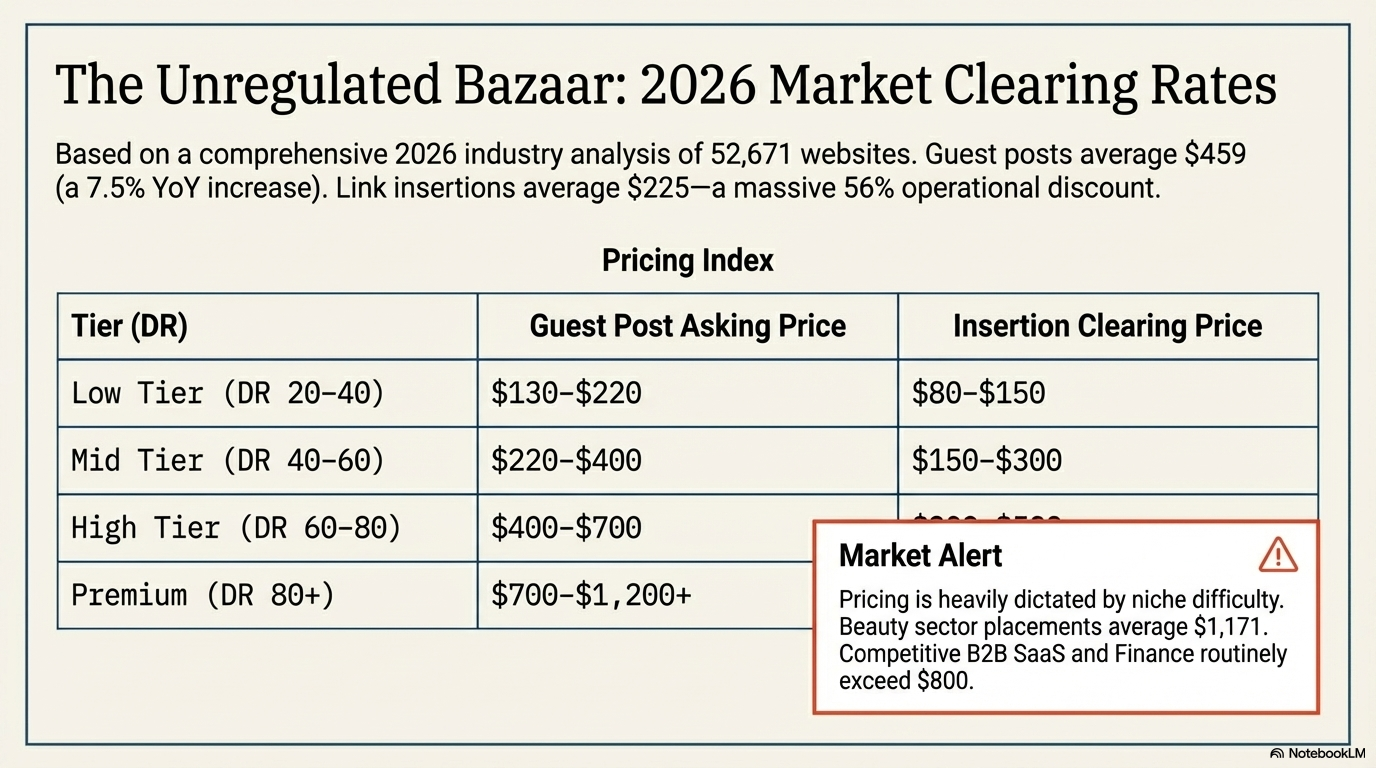
A comprehensive 2026 industry analysis reviewing 52,671 websites finally pulled back the curtain on this chaotic economy. The data reveals that the average cost of a guest post has climbed to approximately $459, marking a 7.5% year-over-year increase from 2025. For premium domains boasting a DR between 61 and 90, pricing surged by an eye-watering 21% to 46%. Conversely, the average link insertion (niche edit) remains considerably cheaper, transacting at an average of $225. This staggering 56% operational discount highlights the profound financial inefficiency of paying for net-new content when aged placements are readily available.
Quality Tier (Domain Rating) | Average Guest Post Price (2026) | Average Link Insertion Price (2026) | Optimal Strategic Use Case |
|---|---|---|---|
Low Tier (DR 20–40) | $130 – $220 | $80 – $150 | Early authority growth, tier-2 support links. |
Mid Tier (DR 40–60) | $220 – $400 | $150 – $300 | Core commercial link building, steady rankings. |
High Tier (DR 60–80) | $400 – $700 | $300 – $500 | Competitive niches, heavy authority reinforcement. |
Premium (DR 80+) | $700 – $1,200+ | $500 – $1,000+ | Brand trust, PR-style visibility, market dominance. |
This might sound weird, but the actual metric (DA or DR) attached to a website is rarely the sole driver of its cost. The pricing model is heavily dictated by the difficulty of the specific niche. For instance, link building in the Beauty sector commands a premium at roughly $1,171 per link, while competitive B2B SaaS, Finance, and Real Estate placements routinely exceed $800 due to intense commercial competition.
What most people get wrong when budgeting for SEO is failing to calculate the true cost of human labor. Relying on an internal team to manually prospect, pitch, write, and negotiate placements often inflates the true cost-per-link to well over $1,000 when factoring in salaries, software subscriptions, and wasted outreach hours. A streamlined link insertion service bypasses this bloated operational overhead entirely.
The Hidden Pricing Gap (And Why You Need Linkpricer.com)
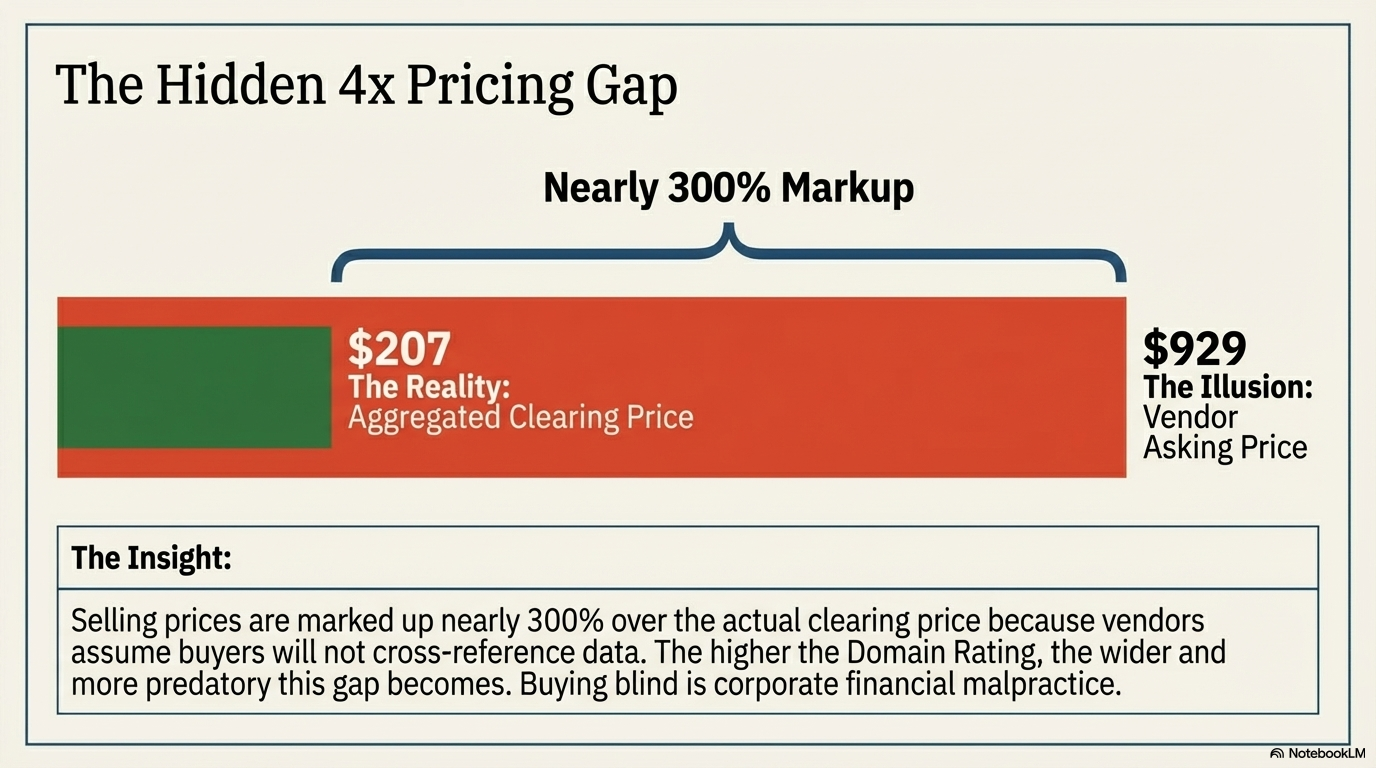
The most astonishing revelation in modern SEO economics is not the rising overall cost of links, but the massive disparity between what vendors ask for and what buyers actually pay. There is a massive industry secret hiding in plain sight: the average asking price for a backlink is routinely four times higher than the actual transaction price.
When examining listed inventories, the average asking price webmasters publish sits at an intimidating $929 per backlink. Yet, the average transaction price executed by savvy buyers settles at just $207. Selling prices are marked up nearly 300% over the actual clearing price simply because vendors assume buyers will not cross-reference the data. The higher the Domain Rating of the target site, the wider and more predatory this pricing gap becomes.
Because prices vary wildly depending on the vendor, buying blind is corporate financial malpractice. Don't guess what a link should cost—use linkpricer.com to find the absolute best deal. This aggregation tool pulls live data, authority scores, traffic statistics, and pricing from more than 40 leading marketplaces into a single, unified dashboard. Instead of endlessly emailing webmasters, practitioners can query a domain and instantly view the lowest available transaction rate across the entire global ecosystem, ensuring they never fall victim to the 4x pricing gap.
How to Evaluate Link Quality Before Buying Contextual Backlinks
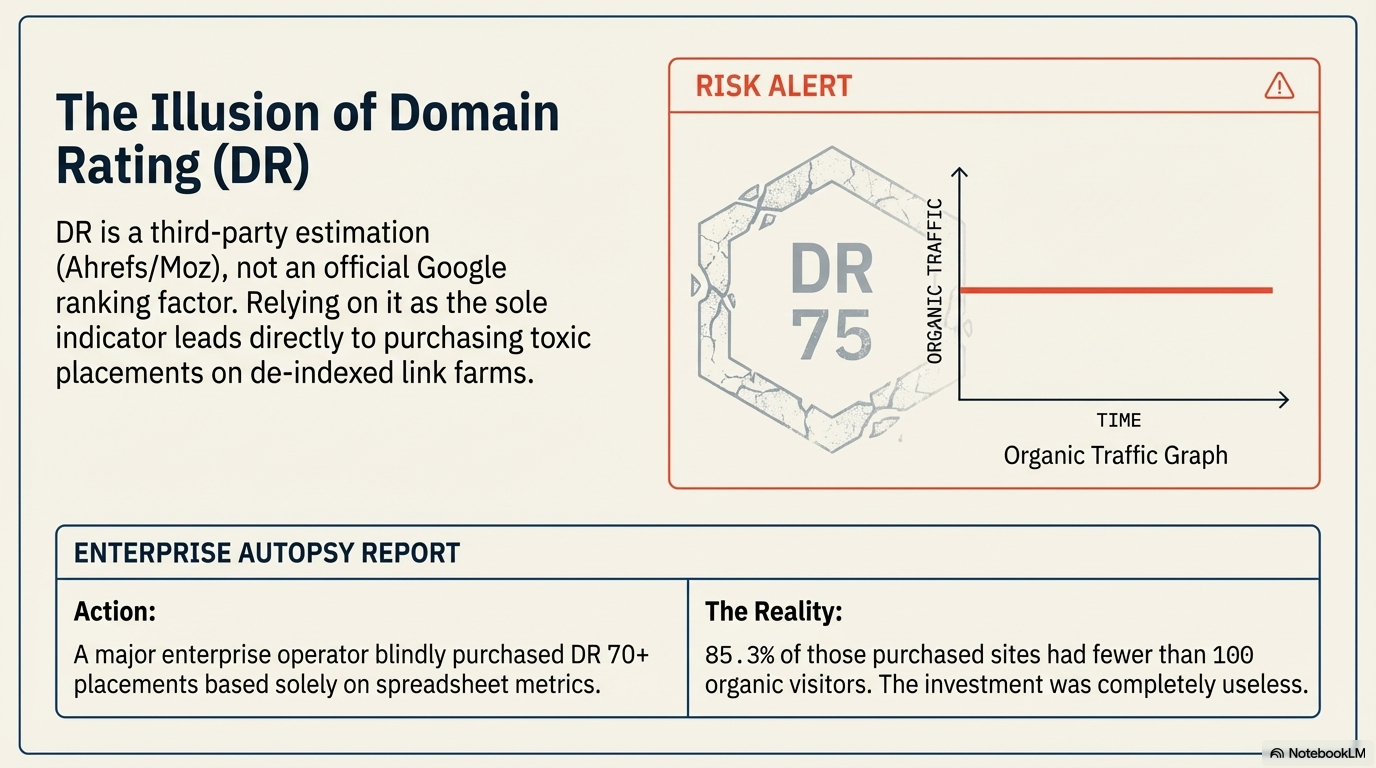
A high Domain Rating is the easiest metric to artificially manufacture, yet it remains the primary quality filter for 90% of novice SEO campaigns. Throwing capital at a link insertion service without a rigorous, multi-layered vetting protocol is the fastest way to invite algorithmic disaster. The proliferation of AI-generated content and sophisticated Private Blog Networks (PBNs) has made it dangerously easy for unscrupulous vendors to fake third-party metrics. A domain boasting a DR of 75 means absolutely nothing if the search engine has quietly stripped its indexing privileges behind the scenes.
When a major enterprise operator blindly purchased DR 70+ placements based solely on spreadsheet metrics, they discovered 85.3% of those sites actually had fewer than 100 organic visitors, rendering the massive financial investment completely useless. The sensory reality of this failure is painful: staring at a Google Search Console dashboard as organic traffic flatlines because the "high-authority" links were actually buried deep inside a de-indexed, automated link farm.
What most people get wrong during the evaluation phase is treating Domain Rating as an infallible, Google-endorsed metric of trust. DR and DA are merely third-party estimations created by external software companies (like Ahrefs and Moz), not official ranking factors. A high DR can be artificially inflated overnight using cheap, redirected expired domains or manipulated internal linking. Relying on it as the sole indicator leads directly to purchasing toxic placements that algorithms are already preparing to penalize. To safeguard acquisition budgets, the evaluation protocol must shift strictly toward behavioral and contextual realities.
Metrics that Matter: DR, Traffic, and Relevance
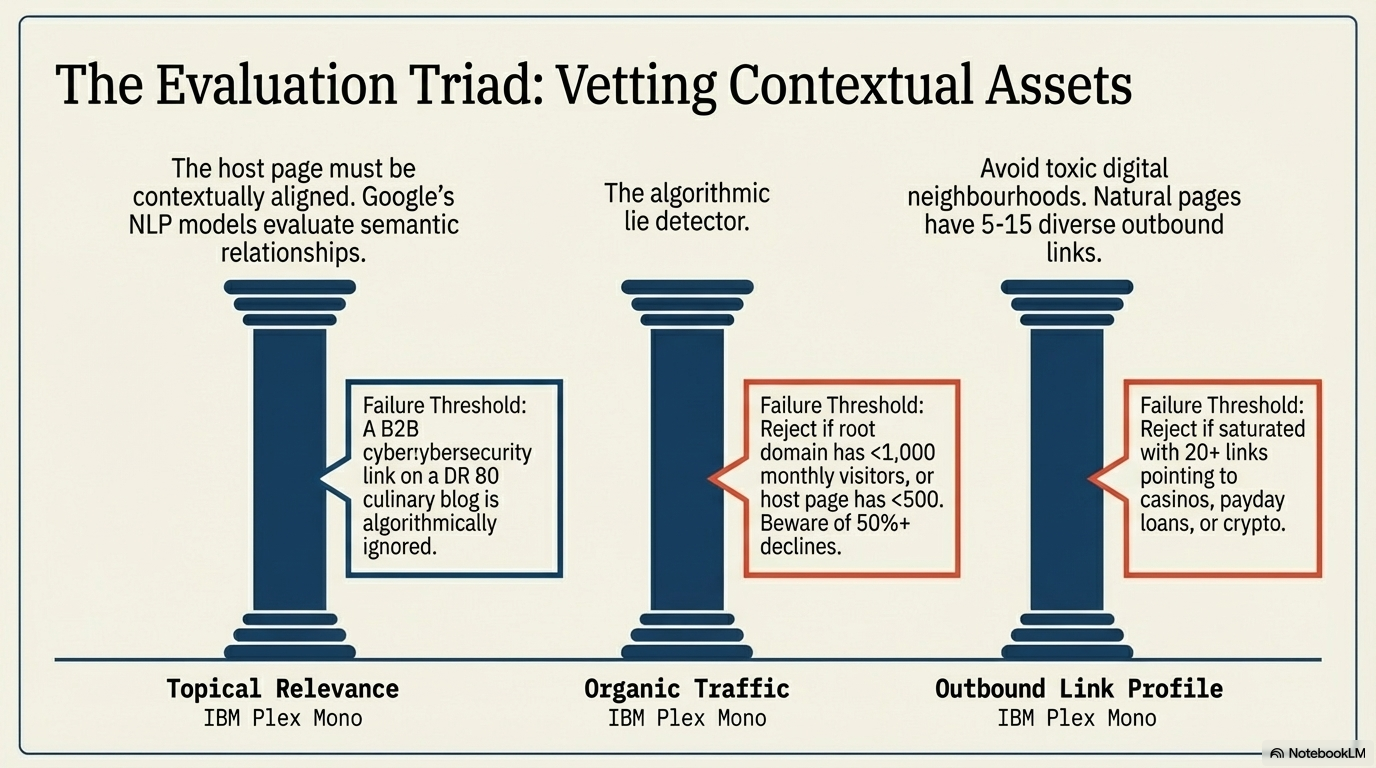
The definitive triad of modern link evaluation consists of Topical Relevance, Organic Traffic, and the Outbound Link Profile. If a placement fails any of these three pillars, it must be discarded immediately.
Topical Relevance: The absolute foundation of modern search engine optimization. Google’s Natural Language Processing (NLP) models evaluate the semantic relationship between the host page and the destination URL. The host page must be contextually aligned with your niche. If a B2B cybersecurity company secures a link on a DR 80 culinary blog, that link is algorithmically ignored. A link on a DR 35 page that perfectly aligns with the target industry is infinitely more powerful.
Organic Traffic: The ultimate algorithmic lie detector. A high Domain Rating (DR) is meaningless if the site gets zero traffic. Target sites with steady or growing organic traffic trajectories, enforcing a strict minimum of 1,000+ monthly visitors for the root domain and at least 500+ visitors for the specific page where the niche edit will reside. A traffic decline of 50% or more over a six-month period is a glaring red flag.
Outbound Link Profile: A healthy, natural editorial page typically contains 5 to 15 outbound links to diverse, authoritative sources. Avoid pages that already have dozens of paid insertions, as this dilutes link equity and signals a link farm. If an audit reveals a target page saturated with 20+ outbound links pointing to casinos, payday loans, and crypto exchanges, the domain is compromised.
The Risks of Paid Link Placements (and How to Avoid Google Penalties)
This might sound weird, but search engines do not inherently hate commercial links; they hate lazy, recognizable footprints that expose an artificial attempt to manipulate the system. It is a known reality that buying backlinks explicitly violates Google's strict webmaster guidelines unless they are properly tagged with rel="sponsored" or rel="nofollow" attributes. However, the pragmatic reality of the SEO industry—particularly within high-margin, hyper-competitive sectors like iGaming, B2B SaaS, and consumer finance—is that organic link acquisition alone simply cannot meet the velocity required to dominate the SERPs. High-margin industries still rely heavily on paid link building to survive and capture market share.
The risk profile, however, has fundamentally escalated. The introduction and subsequent enhancements of Google's SpamBrain algorithm have weaponized artificial intelligence to detect link manipulation in real-time. Unlike the historical Penguin updates that punished sites periodically during major rollouts, SpamBrain operates continuously, identifying link networks, expired domain abuse, and scaled content abuse instantly. The rigorous 2026 iterations specifically target "site reputation abuse"—often referred to as parasite SEO—where manipulative commercial links are forcibly inserted into unrelated editorial content on trusted domains.
When a portfolio of sites was hit by the August 2025 and March 2026 SpamBrain updates, operators lost up to 60% of their organic visibility within a matter of days. A panicked Slack message from a client reads: "Traffic dropped overnight. What happened?" In almost every instance, the culprit was an unnatural footprint of over-optimized anchor text originating from highly questionable domain clusters.
What most people get wrong is scaling link velocity faster than their domain's historical curve can support, while simultaneously abusing commercial keywords. To minimize risk and avoid Google penalties while practicing white hat SEO principles, practitioners must obsessively engineer a natural backlink profile.
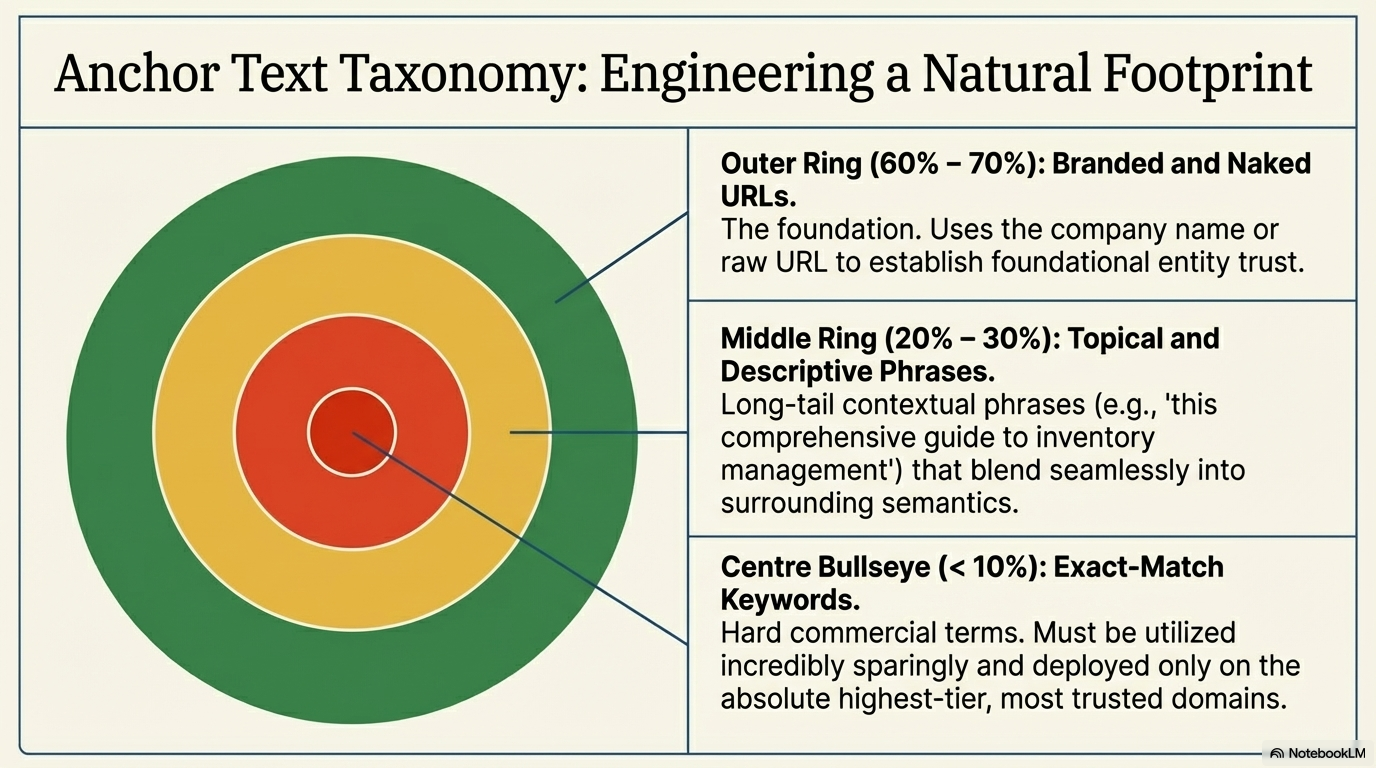
Modern survival dictates a highly diversified anchor taxonomy:
Branded and Naked URLs (60% - 70%): Anchors that use the company name or raw URL to establish foundational entity trust.
Topical and Descriptive Phrases (20% - 30%): Long-tail contextual phrases (e.g., "this comprehensive guide to inventory management") that blend seamlessly into the surrounding paragraph.
Exact-Match Keywords (< 10%): Hard commercial terms must be utilized incredibly sparingly, kept strictly below the 10% threshold, and deployed only on the absolute highest-tier, most trusted domains.
Furthermore, avoiding obvious footprints requires blacklisting any domain that openly advertises "write for us" pages or operates visible link farms. Contextual backlinks must be surgically integrated into relevant sentences so that the surrounding semantics algorithmically validate the link's existence.
How to Find the Best Link Insertion Services in 2026
The traditional agency model for acquiring backlinks is fundamentally obsolete for operators who understand the true clearing price of the market. The ecosystem for acquiring niche edits is heavily fragmented, offering search professionals three distinct pathways: grinding through manual email outreach, hiring done-for-you managed agencies, or utilizing direct SEO marketplaces.
Manual outreach—identifying targets, scraping emails, and negotiating with webmasters—is extraordinarily labor-intensive. It yields dismal success rates (often below 5%) and heavily drains internal resources, pushing the true operational cost of a single link well past $1,000. Conversely, managed link building agencies handle the entire lifecycle, from prospecting to quality assurance. Highly reputable white-label providers employ strict vetting protocols to secure genuine editorial placements on aged content. However, this convenience comes with a staggering premium. Agencies routinely embed heavy operational overhead into their retainers, often charging $350 to $1,000+ per link.
What most people get wrong is assuming that outsourcing to a single agency provides the best quality and the best price. An agency might charge $600 for a placement that they quietly procured from a wholesale vendor marketplace for $150. For in-house SEO teams, niche site operators, and marketing directors looking to maximize their budgets, bypassing the middleman and navigating SEO marketplaces directly is the most capital-efficient strategy available.
Stop Overpaying: Compare 40+ Marketplaces with Linkpricer.com
Buying directly from a single agency or locking into a single vendor's closed marketplace practically guarantees severe overpayment. The backlink economy thrives on arbitrage, where the exact same domain is frequently listed across half a dozen different platforms at vastly different price points. Relying on a single source blinds the buyer to the true market floor, locking them into arbitrary markups.
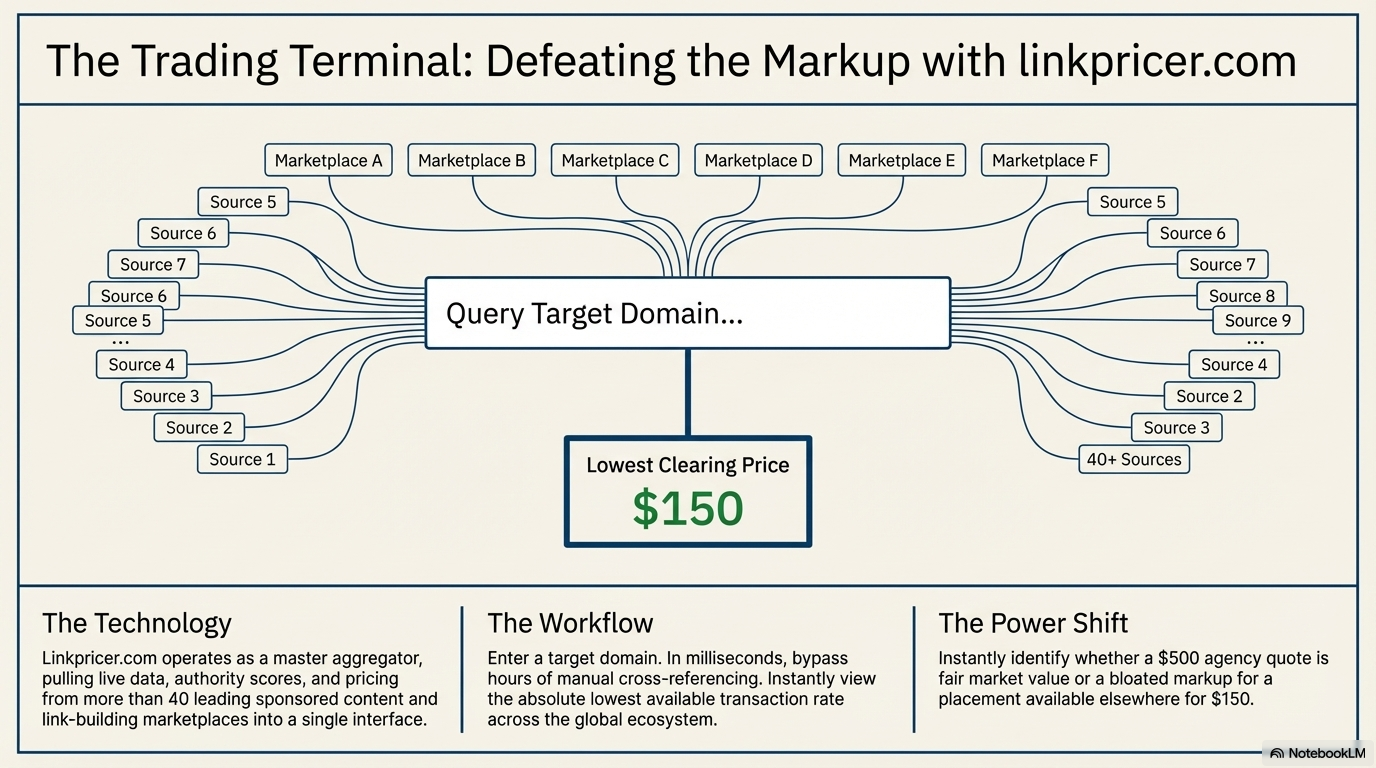
This is where technological leverage becomes the ultimate competitive advantage. Utilizing an aggregator is the only mathematical defense against opaque pricing models. LinkPricer.com was engineered specifically to solve this market inefficiency. The tool operates as a master aggregator, pulling live data from more than 40 leading sponsored content and link-building marketplaces into a single interface.
The workflow is remarkably elegant and instantly reclaims wasted budget. A professional simply enters their target domain into the bulk search tool. In milliseconds, linkpricer.com scans the global database, bypassing hours of manual cross-referencing. The dashboard immediately displays the target site alongside critical metrics like Domain Rating, traffic statistics, and available placement types. Most importantly, it reveals the lowest available price for a link insertion across the entire aggregated network.
Notice how this instantly shifts the balance of power back to the buyer. By utilizing linkpricer.com, professionals can instantly identify whether a $500 quote from an agency is fair market value or a bloated markup for a placement available elsewhere for $150. The actionable takeaway is simple: integrate aggregation software into the procurement workflow to guarantee the best deal on every transaction.
Conclusion: Start Scaling Your Link Building Today
The architecture of search engine visibility has fundamentally evolved, but the underlying currency of digital authority remains unchanged: high-quality, relevant backlinks dictate who dominates the search results. However, the methodology of acquiring that currency requires strict modernization. Link insertions are the ultimate SEO growth hack for acquiring rapid, authoritative backlinks without the hassle of content creation. By strategically placing contextual backlinks into aged, trusted, and already-indexed content, practitioners bypass the agonizing delays and exorbitant costs of net-new publishing. It is the most surgical, efficient method for transferring established digital authority directly to the pages that drive commercial revenue.
Yet, executing this strategy successfully requires rigorous defense mechanisms. It demands strict adherence to natural anchor text distribution, an obsession with organic traffic metrics over easily manipulated Domain Ratings, and a complete avoidance of toxic link farms that trigger Google's real-time SpamBrain penalties.
Above all, it requires operational and financial discipline. The backlink market is riddled with hidden markups and predatory 4x pricing gaps. Ready to secure top-tier link insertions without the agency markup? Take total control of your SEO budget. Head over to linkpricer.com today, seamlessly compare prices across 40+ marketplaces, and start building digital authority the smart, data-driven way.