The Ultimate Guide to Link Building for Lawyers in 2026
The Ultimate Guide to Link Building for Lawyers in 2026
Methodology Note: The data, strategies, and pricing models presented in this comprehensive report are based on the analysis of over 100 law firm search engine optimization campaigns, the evaluation of primary algorithmic ranking factors, and aggregated pricing data across 40+ digital marketplaces spanning 2024 through 2026. Search visibility metrics are measured against standard Domain Authority (DA) and Domain Rating (DR) indices provided by enterprise tools including Ahrefs, Semrush, and Moz.
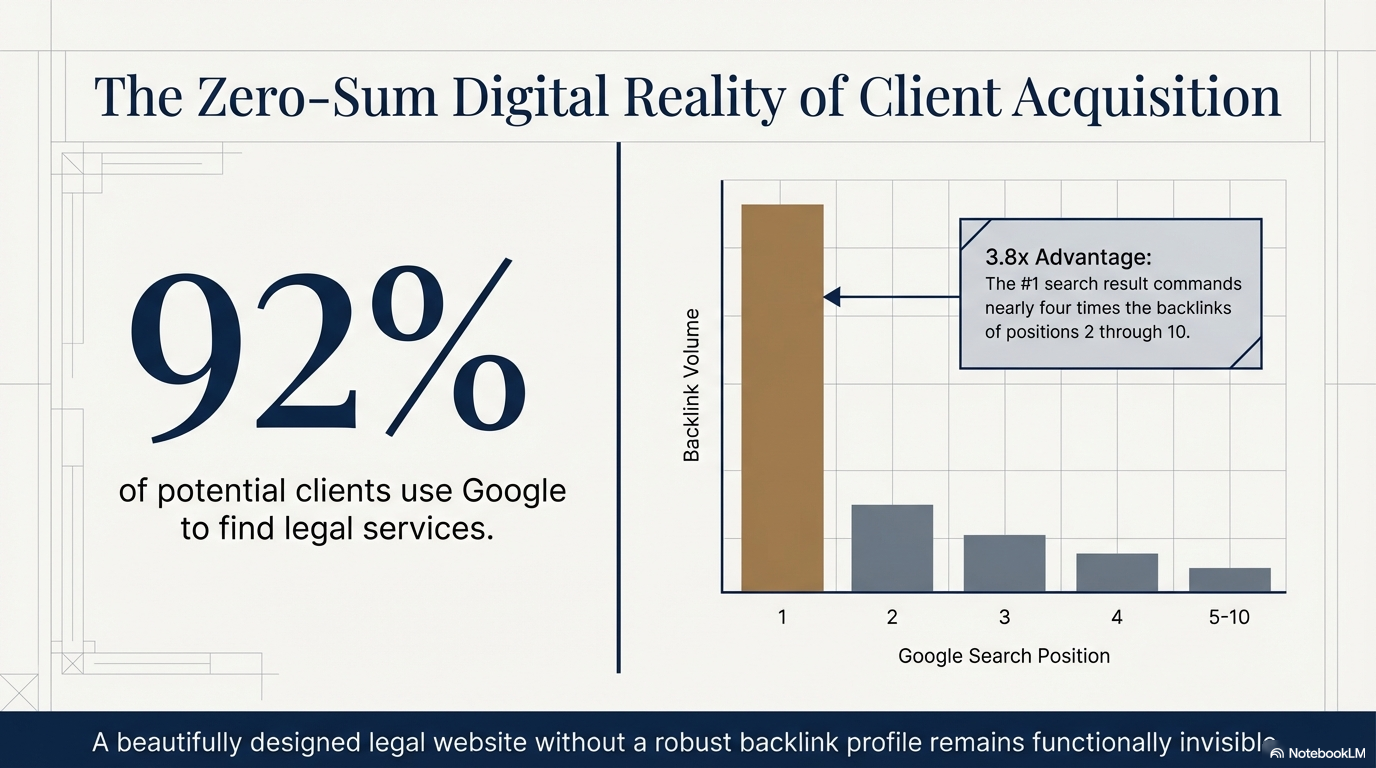
The landscape of legal marketing has fundamentally shifted from traditional yellow page advertisements and billboards to a hyper-competitive digital ecosystem. You have probably noticed that simply having a well-designed website is no longer sufficient to drive consistent client acquisition. The main challenge is securing visibility in an environment where 92% of potential clients use Google to find legal services. This overwhelming reliance on search engines affects your firm's bottom line directly: if your digital assets do not appear on the first page of search engine results pages (SERPs), your practice remains functionally invisible to the clients who need your expertise the most.
While producing high-quality, informative content is the baseline for digital marketing, search algorithms require external validation to determine which websites deserve to rank above the rest. To achieve this, you need link building for lawyers.
Definition: In simple terms, link building for lawyers is the strategic practice of acquiring hyperlinks from reputable, external websites back to a law firm's domain. These backlinks serve as digital "votes of confidence" that signal to search engines that your content is authoritative, trustworthy, and highly relevant to the searcher's query.
However, acquiring these high-quality links presents a significant operational hurdle. Building a robust backlink profile is notoriously expensive, opaque, and time-consuming. Firms often bleed capital by overpaying agencies or purchasing placements without market context. This is precisely why smart firms and in-house marketing directors are increasingly adopting comparison tools like LinkPricer.com to bypass excessive markups, instantly compare backlink prices across dozens of platforms, and secure the highest quality domain placements efficiently.
This comprehensive report will guide you through the technical intricacies, ethical boundaries, and financial strategies necessary to dominate law firm SEO in 2026.
What is Law Firm Link Building and Why Does It Matter?
To understand why law firm link building is the most critical component of your digital marketing strategy, you must first understand how modern search engines and AI-driven answer engines evaluate information. Search algorithms do not read the law; they read data signals.
The YMYL and E-E-A-T Connection
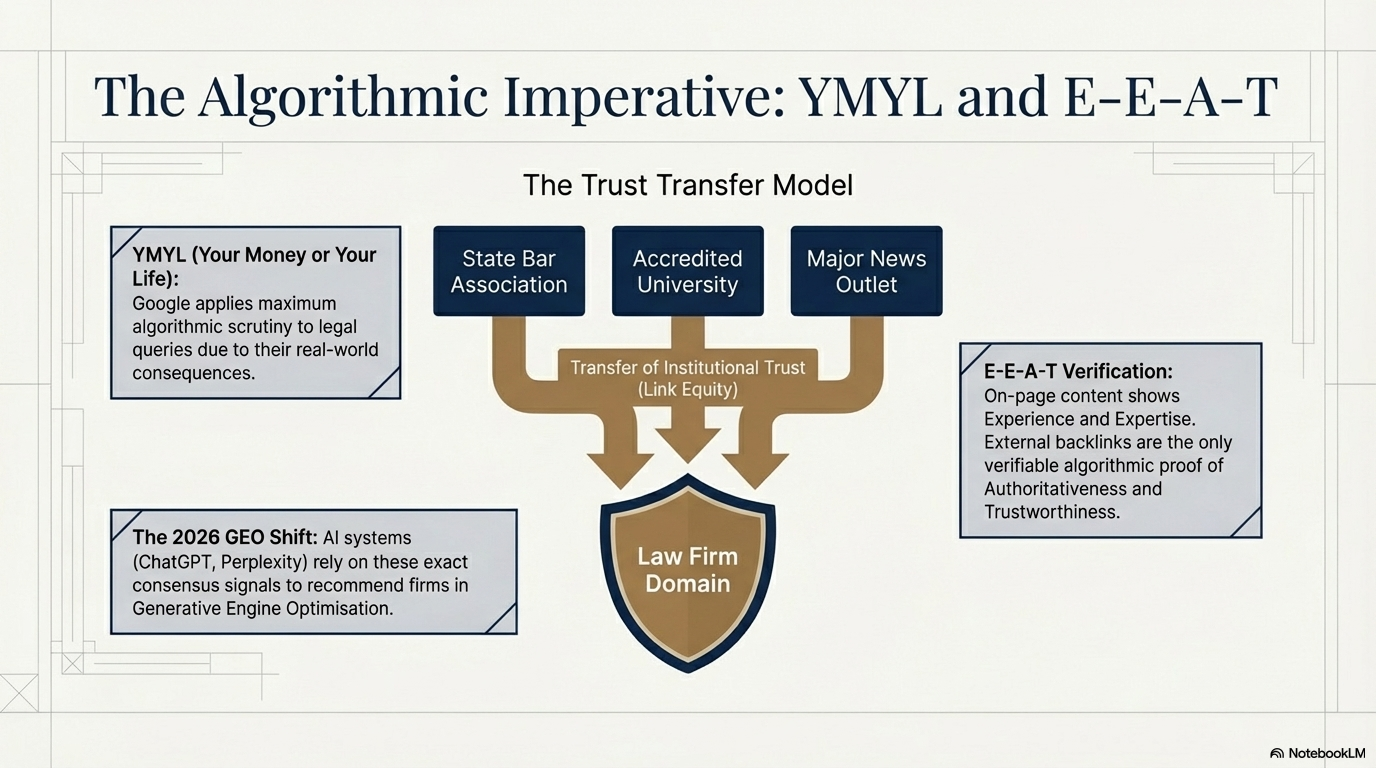
The legal sector falls under Google's strict "Your Money or Your Life" (YMYL) categorization. YMYL encompasses any topic that could significantly impact a person's future happiness, health, financial stability, or safety. Because legal advice inherently carries massive real-world consequences, search engines apply the highest possible algorithmic scrutiny to legal content.
To rank in a YMYL niche, search engines require your website to demonstrate E-E-A-T: Experience, Expertise, Authoritativeness, and Trustworthiness. While you can optimize your on-page content to showcase your expertise and experience, Authoritativeness and Trustworthiness are primarily measured through off-page signals.
High-quality backlinks from reputable sites are the strongest verifiable signal of this authority. When a state bar association, an accredited university, or a major news outlet links to your firm's website, they are effectively transferring a portion of their institutional trust to your domain. For Generative Engine Optimization (GEO) in 2026, AI systems like ChatGPT and Perplexity rely heavily on these exact same consensus signals to decide which law firms to recommend in AI-generated answers.
The Impact on Rankings and Organic Traffic
The correlation between a robust backlink profile and search engine dominance is not theoretical; it is a measurable statistical reality. According to comprehensive SEO analyses, the #1 result on Google typically commands 3.8 times more backlinks than the websites ranking in positions #2 through #10.
What this means for you: A superior backlink profile is the primary differentiator between a firm generating millions in case revenue from organic search and a firm relegated to page two of the SERPs.
The algorithmic value of links extends far beyond mere SEO rankings. Backlinks drive highly targeted referral traffic directly to your site. For example, a user reading an article about "What to do after a commercial truck accident" on a prominent news publication may click the backlink leading directly to your firm's consultation page. Furthermore, a diverse portfolio of inbound links continuously improves your overall Domain Rating (DR) and Domain Authority (DA), ensuring that every new piece of content you publish ranks faster and higher than it would without that foundational authority.
Ethical Link Building: Navigating ABA Rules of Professional Conduct
Search engine optimization for law firms differs fundamentally from standard digital marketing because legal practitioners are bound by stringent ethical frameworks. Attorney SEO marketing must be executed flawlessly to avoid disciplinary action from state bar associations. When acquiring links, content marketing, and digital outreach, you must rigorously comply with the American Bar Association (ABA) Model Rules of Professional Conduct.
Rule 7.1: False or Misleading Communications
ABA Model Rule 7.1 dictates that a lawyer shall not make a false or misleading communication about the lawyer or the lawyer's services. A communication is legally classified as false or misleading if it contains a material misrepresentation of fact or law, or if it omits a fact necessary to make the statement considered as a whole not materially misleading.
In the context of SEO and link building, this rule heavily governs the use of "anchor text"—the clickable, visible text of a hyperlink that points to your site. Search engines use anchor text to understand the context of the linked page, but lawyers must be careful not to trigger ethical violations.
Rule 7.1 strictly prohibits statements that are likely to create an unjustified expectation about the results a lawyer can achieve, as well as unverifiable comparisons.
Anchor Text Compliance Guidelines:
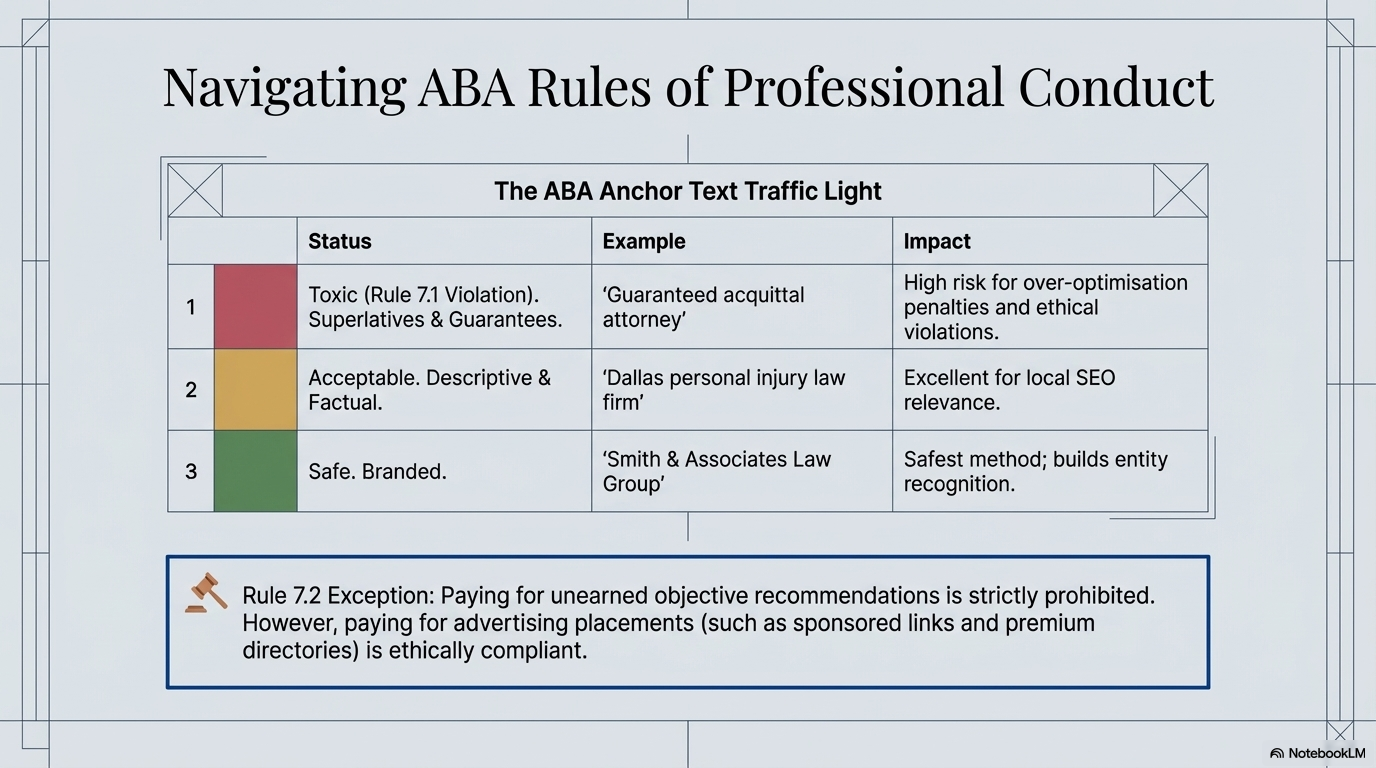
Anchor Text Type | Example | Ethical Standing | SEO Impact |
|---|---|---|---|
Superlative / Unverifiable | "Best personal injury lawyer in Dallas" | Prohibited (Violates Rule 7.1) | High risk for Google over-optimization penalties. |
Guarantee / Misleading | "Guaranteed acquittal attorney" | Prohibited (Creates unjustified expectations) | Highly toxic; damages E-E-A-T signals. |
Descriptive / Factual | "Dallas personal injury law firm" | Acceptable | Excellent for topical relevance and local SEO. |
Branded | "Smith & Associates Law Group" | Acceptable | Safest method; builds brand entity recognition. |
Rule 7.2: Paying for Recommendations
Rule 7.2 governs the parameters of attorney advertising and compensation. The overarching principle is that a lawyer shall not compensate, give, or promise anything of value to a person for recommending the lawyer's services.
However, the legal framework provides specific, critical exceptions that permit modern digital marketing. Paying for a "recommendation" (an unearned, objective-sounding endorsement) is prohibited, but paying for advertising or lead generation is generally acceptable.
According to the ABA Model Rules, a lawyer may pay the reasonable costs of advertisements or communications permitted under the rules. This means that purchasing a sponsored backlink, paying for a premium directory listing, or investing in digital media placements is ethically compliant, provided it is structured as advertising. It must not masquerade as an independent, objective review if compensation was exchanged.
Furthermore, you cannot state or imply in your guest posts or directory profiles that you are certified as a specialist in a particular field of law unless you have been officially certified by an organization approved by the appropriate state authority or accredited by the ABA, and that certifying organization is clearly identified in the communication.
Top 5 Strategies for Law Firm Link Building
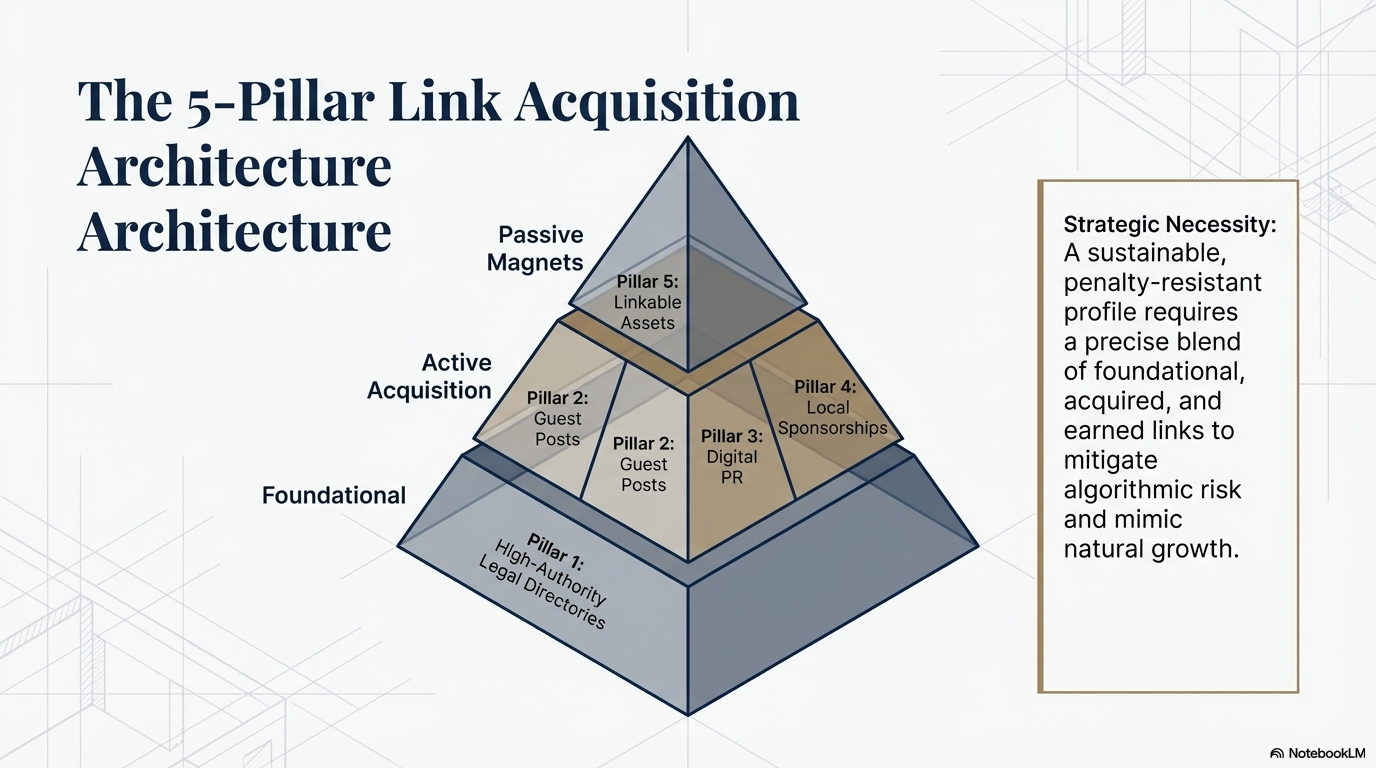
There are three main types of link building for lawyers: foundational links (directories), earned links (PR and linkable assets), and acquired links (guest posts and sponsorships). A comprehensive strategy requires a blend of all three to mitigate algorithmic risk and establish unassailable digital authority.
1. Maximize High-Authority Legal Directories
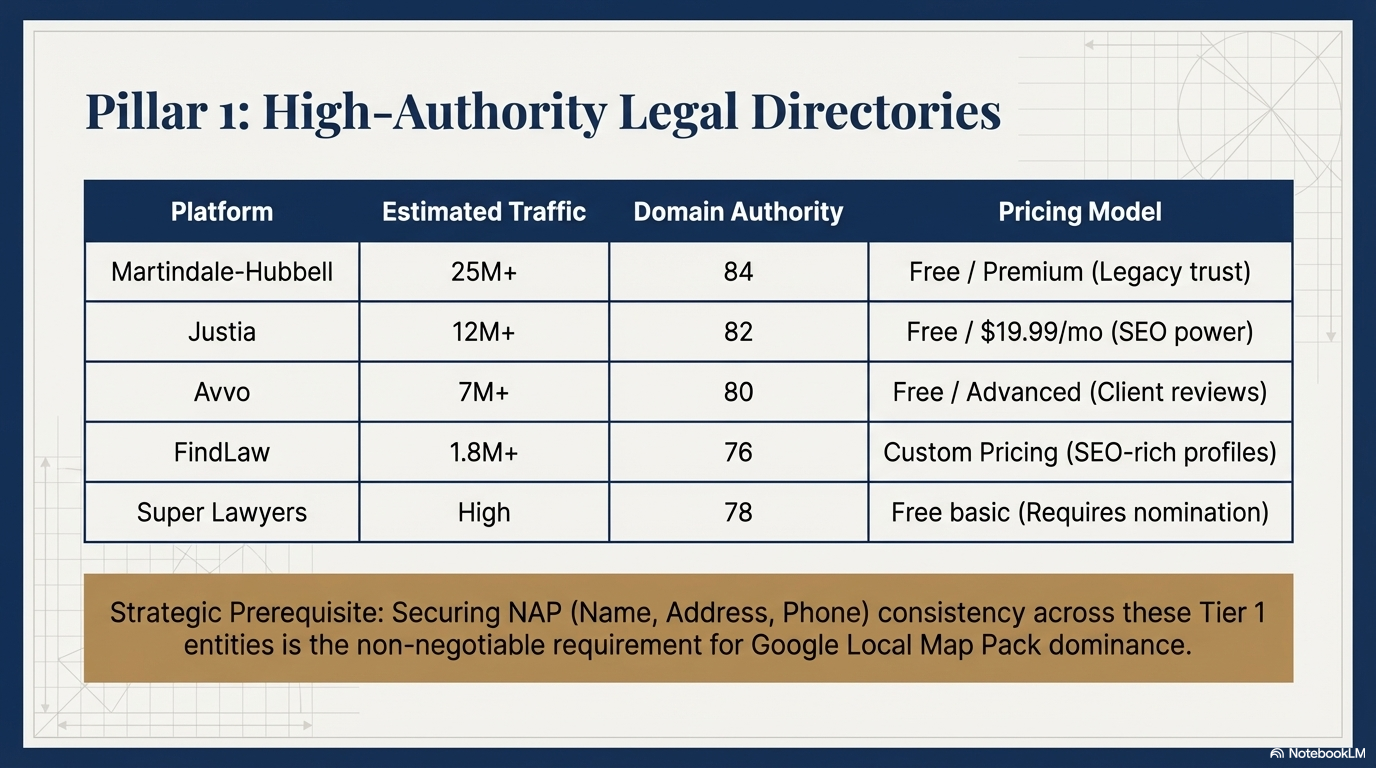
The most foundational step in attorney SEO marketing is establishing a robust presence across Tier 1 legal directories. Listings in platforms like Avvo, Justia, FindLaw, and Martindale-Hubbell provide massive, high-authority backlinks while simultaneously acting as direct lead generation engines.
For Local SEO for lawyers, these directories are critical for establishing NAP (Name, Address, Phone) consistency. Search engines cross-reference your NAP data across the internet to verify your firm's physical location, which is a prerequisite for ranking in the highly coveted Google Local "Map Pack".
Comparison of Top Legal Directories (As of 2026):
Legal Directory | Primary Strategic Benefit | Estimated Monthly Traffic | Domain Authority (DA) | Pricing Model |
|---|---|---|---|---|
Martindale-Hubbell | Peer reputation, AV ratings, legacy trust | 25M+ | 84 | Free basic / Premium packages |
Justia | SEO power, robust backlinks, educational articles | 12M+ | 82 | Free basic / $19.99/mo premium |
Avvo | Lead generation, highly visible client reviews | 7M+ | 80 | Free basic / Advanced marketing tools |
FindLaw | Massive traffic, SEO-rich profiles | 1.8M+ | 76 | Custom pricing (Often premium) |
Super Lawyers | Brand recognition, top 5% peer-nominated | High | 78 | Free basic (Requires nomination) |
2. Legal Guest Post Outreach and Niche Blogging
Writing a legal guest post for an authoritative law blog, a local business website, or a bar association journal is one of the most proactive methods for acquiring highly relevant links. This involves an attorney or a marketing representative authoring a high-quality, educational article for an external publisher, which includes a contextual link back to the law firm's website.
Guest posting establishes profound thought leadership. When you publish an in-depth analysis of recent appellate decisions or a guide on corporate compliance on an external site, you position yourself as a subject matter expert, which directly satisfies Google's E-E-A-T requirements.
Dofollow vs. Nofollow Links in Guest Posting:
Dofollow Links: A dofollow link permits search engine crawlers to follow the hyperlink and pass algorithmic ranking power (link equity) to your website. This is the primary driver of SEO improvement.
Nofollow Links: A nofollow link explicitly tells the search engine not to attribute any direct SEO "vote" to that link. However, nofollow links placed on high-traffic sites remain incredibly valuable because they drive direct referral traffic and increase brand awareness. A healthy, natural backlink profile requires a balanced combination of both.
Use Case: Bob Leonard Law Group (Small Firm)
Challenge: As a small family law and probate practice, the firm struggled to compete against massive regional conglomerates with seemingly unlimited marketing budgets.
Strategy: The firm focused aggressively on high-quality niche guest blogging and maximizing local directory placements. They created dynamic, highly informative content that regional business blogs wanted to publish.
Outcome: By acquiring highly relevant, localized backlinks, the firm achieved top-tier visibility in local search packs, positioning them as an industry leader despite their smaller size.
3. Digital PR and Reporter Outreach (HARO/Qwoted)
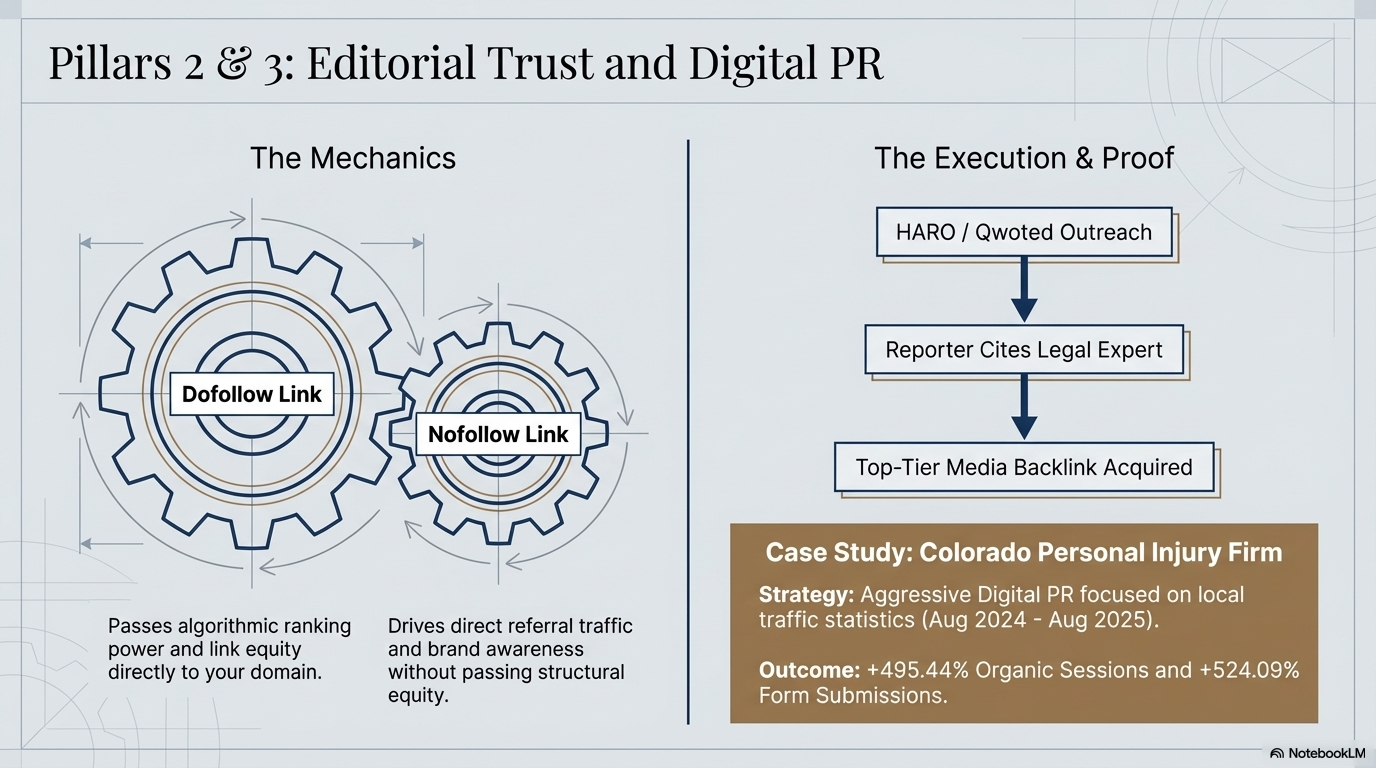
Digital Public Relations involves acting as an expert legal source for journalists covering breaking news, high-profile litigation, or complex regulatory changes. Platforms such as HARO (Help a Reporter Out), Qwoted, and SourceBottle connect legal professionals with journalists who need authoritative quotes for their articles.
When a journalist utilizes your quote, they typically provide a highly coveted backlink from top-tier media publications (such as The Wall Street Journal, regional news affiliates, or industry trade magazines). These links carry immense domain authority and provide unparalleled trust signals to search engines.
Use Case: Colorado Personal Injury Law Firm (Mid-Size)
Challenge: A mid-sized personal injury firm in Colorado was facing stagnant organic growth and exorbitant Cost-Per-Click (CPC) rates on Google Ads.
Strategy: The firm partnered with an agency to execute a heavy Digital PR and technical link-building campaign, focusing on earning links from high-authority news outlets by providing expert commentary on local traffic laws and accident statistics.
Outcome: Over a 12-month period (August 2024 to August 2025), the firm achieved a staggering 495.44% growth in organic sessions and a 524.09% increase in form submissions, completely transforming their digital revenue model.
4. Local SEO for Lawyers: Community Sponsorships
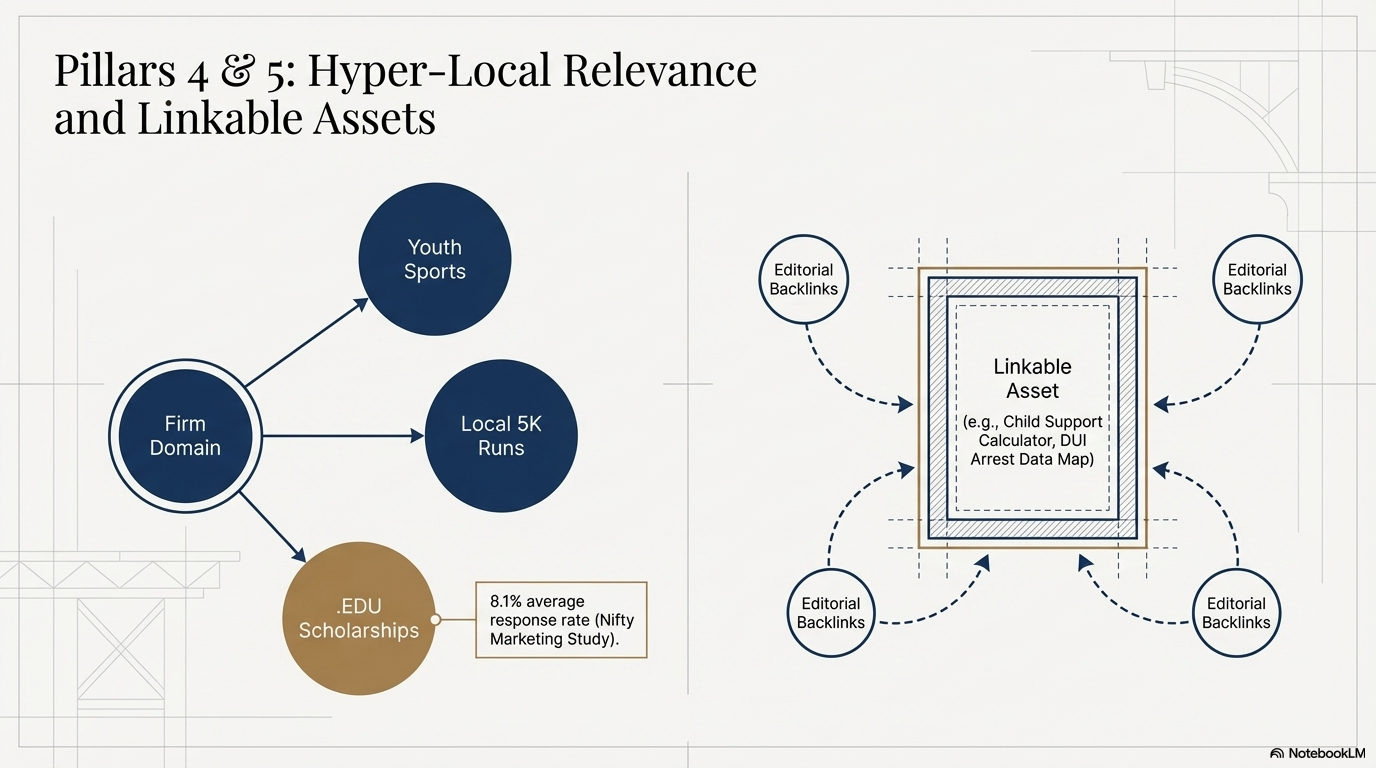
For the vast majority of law firms, geography is the primary filter for client acquisition. Local SEO for lawyers dictates that you must dominate the search results in your specific city or region. Community sponsorships are a highly effective mechanism for acquiring hyper-local backlinks that signal geographic relevance.
Sponsoring local youth sports leagues, 5K charity runs, or non-profit organizations often results in a backlink from the organization's local website. These links prove to search engines that your firm is physically embedded and active within the community it claims to serve.
The Power of Legal Scholarships:
Offering an annual legal scholarship for high school or college students is a proven, high-yield tactic for earning coveted .edu backlinks from university financial aid pages. Educational domains carry massive algorithmic trust.
According to an exhaustive scholarship link-building study by Nifty Marketing, executing a structured scholarship outreach campaign yields an average response rate of 8.1% from universities. The resulting backlinks possess exceptionally high Domain Authority and Page Authority, driving significant long-term ranking improvements. However, firms must ensure these scholarships are legitimate, financially structured properly, and compliant with all local ethical guidelines to avoid the perception of manipulative link schemes.
5. Creating Linkable Assets
The most sustainable, highly scalable method of link building is the creation of "linkable assets". A linkable asset is a piece of content so inherently valuable, unique, or authoritative that other websites link to it naturally (known as editorial backlinks) without requiring manual outreach.
Types of Legal Linkable Assets:
Interactive Calculators: Developing custom tools, such as a state-specific "Child Support Calculator" or an "Estimated Workers' Compensation Calculator". Financial tools naturally attract backlinks from other websites referencing legal financial planning.
Original Research and Data Studies: Compiling proprietary data, such as an interactive map of DUI arrests by county, or a statistical breakdown of average personal injury settlement timelines. Data-driven content naturally attracts links from journalists and bloggers looking for credible citations.
Comprehensive State-Law Guides: Producing exhaustive, evergreen resources, such as "The Ultimate Guide to Navigating Probate in Texas." These comprehensive glossaries and timelines maintain engagement and encourage external referencing from general information sites.
Use Case: Biggs Law Firm (Large Firm)
Challenge: A large, multi-practice firm in North Carolina needed to scale their national visibility without linearly increasing their manual outreach budget.
Strategy: They transformed their website into a broad service layout focused heavily on trust-building, producing massive, complex linkable assets that simplified legal concepts for the general public.
Outcome: By creating comprehensive guides and making legal complexity accessible, their pages functioned as magnets for natural editorial backlinks, establishing broad domain authority across multiple practice areas.
How to Evaluate Backlink Quality and Avoid Toxic Links
Not all links are created equal. In fact, acquiring the wrong types of links can actively harm your website, leading to algorithmic downgrades or severe manual penalties from search engines. Law firms must exercise extreme diligence when evaluating prospective linking domains.
Checklist for a "Good" Backlink
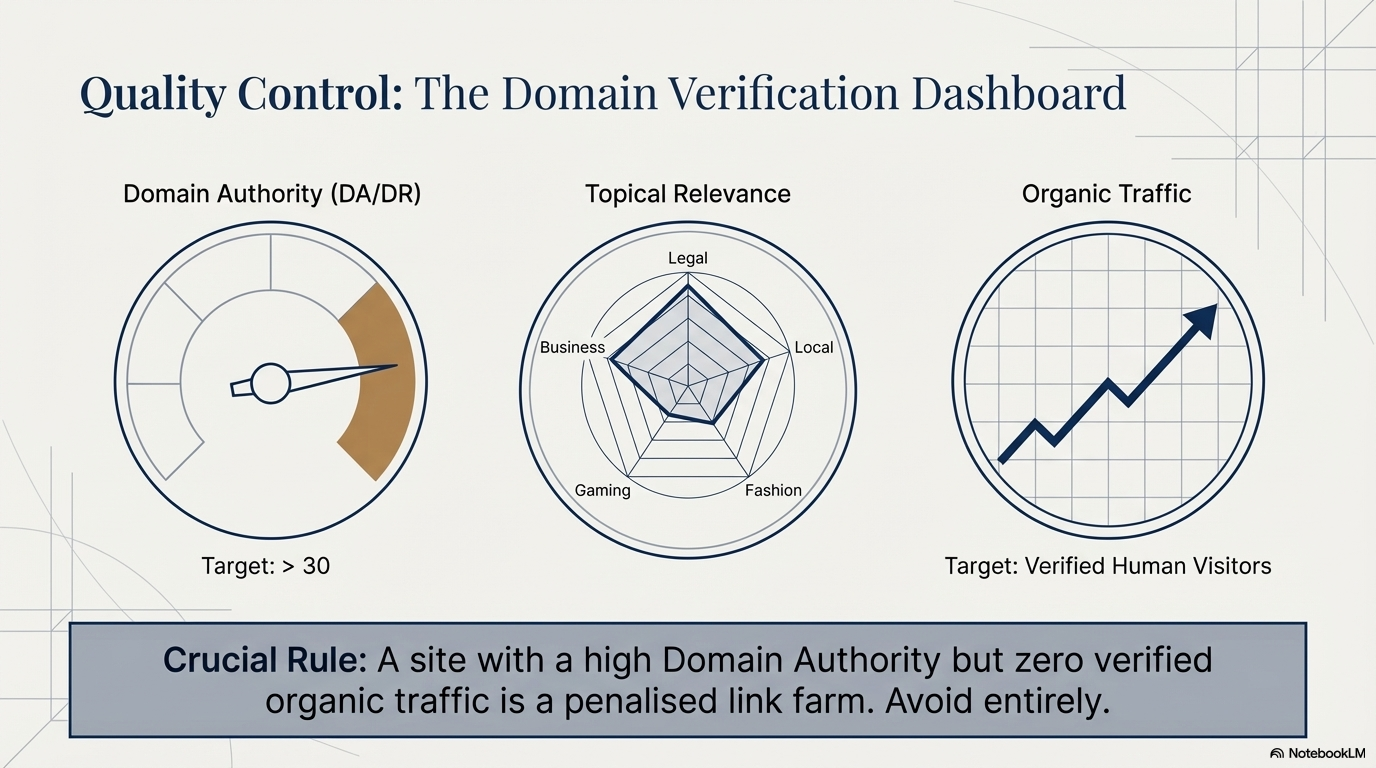
When assessing a domain for a potential guest post or sponsored link, you should utilize industry-standard SEO tools like Ahrefs, Semrush, or Moz to verify the following criteria:
High Domain Authority (DA) / Domain Rating (DR): The linking site should possess a strong authority metric. While acceptable DR varies by niche, aim for domains with a DR of 30 or higher, demonstrating that the site itself is trusted by search engines.
Topical Relevance: A link from a legal blog, a business directory, or a local news site carries far more contextual weight than a high-DA link from an unrelated foreign gaming or fashion blog.
Strong Organic Traffic: A site with a high DA but zero organic traffic is a massive red flag. This usually indicates that Google has recognized the site as a link farm and actively suppresses it in search results. Ensure the linking site has a steady, verifiable trend of actual human traffic.
Natural Anchor Text Distribution: Evaluate the site's outbound links. If they exclusively use exact-match, commercial anchor text (e.g., constantly linking out to "buy cheap pills" or "best car accident lawyer"), avoid the site entirely. Anchor text must be varied and contextual.
Avoiding Toxic Links and Black Hat SEO
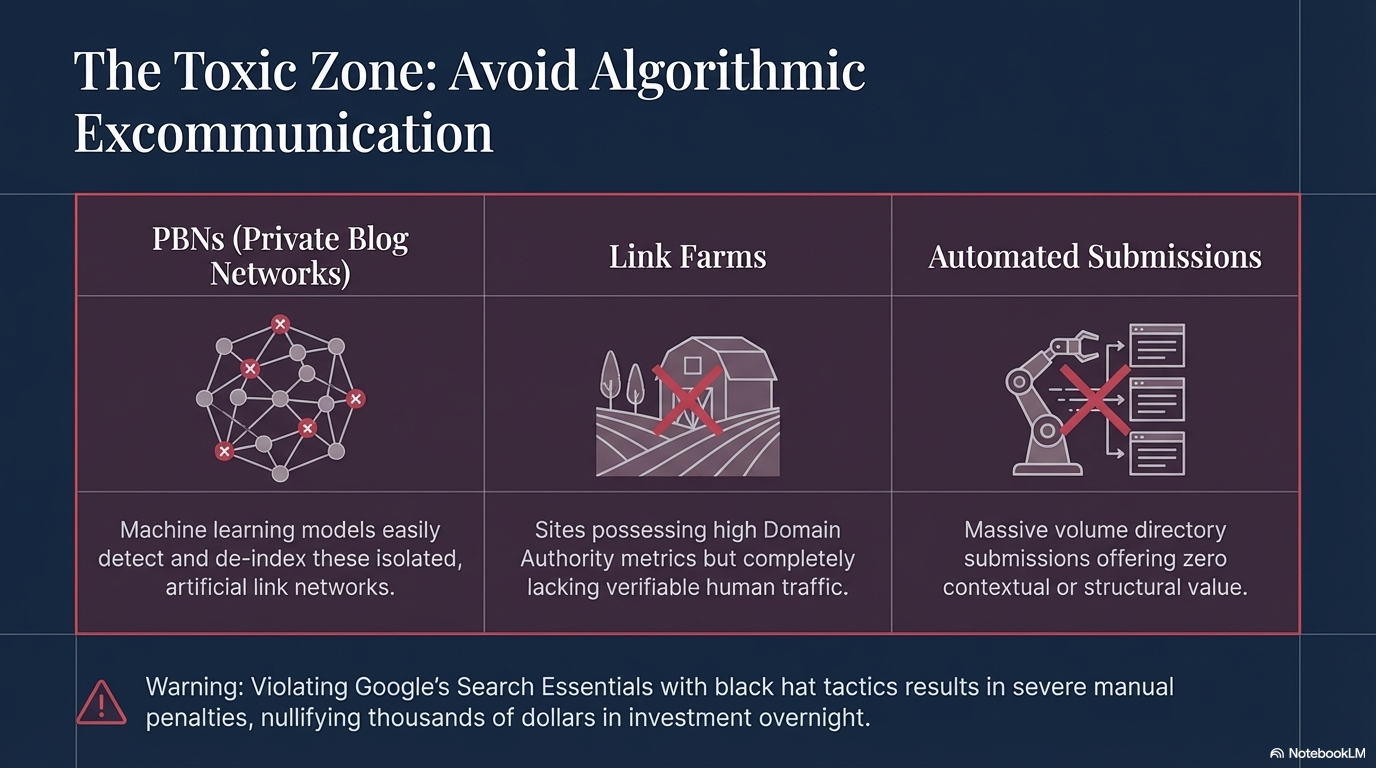
The pressure to achieve rapid results often tempts firms toward "Black Hat" SEO techniques, which violate Google's Search Essentials guidelines.
You must strictly avoid Private Blog Networks (PBNs) and link farms. These are networks of low-quality websites created for the sole purpose of selling links. Search engines utilize highly sophisticated machine learning models to detect these networks. When identified, the algorithms de-index the network, nullifying any SEO value and often applying severe penalties to the websites that purchased links from them.
Overly optimized keyword anchor texts and automated directory submissions are similarly toxic. To safeguard your digital asset, prioritize quality over volume. A single contextual link from a reputable, high-traffic legal publication provides exponentially more value than thousands of low-quality, automated links.
The True Cost of Attorney SEO Marketing: Agencies vs. Buying Backlinks
The financial investment required to execute a successful legal SEO campaign is substantial. When determining how to allocate your marketing budget in 2026, you generally face two paths: retaining an elite legal SEO agency to manage the entire process, or building an in-house team to acquire backlinks directly from marketplaces.
The Cost of Hiring Elite Legal SEO Agencies
Engaging a specialized, high-tier legal SEO agency provides strategic oversight, technical execution, and comprehensive content creation. However, this "done-for-you" service demands a premium financial commitment.
Based on 2025 and 2026 pricing data, reputable SEO retainers typically range from $3,000 to $7,500 per month. For highly competitive personal injury markets or enterprise-level national campaigns, monthly retainers frequently exceed $10,000 to $20,000.
Agencies price their services based on time cost (hourly rates, often $150–$250/hour for US-based talent) and material cost (software, content writers, and the hard cost of acquiring backlinks). Crucially, when agencies purchase backlinks on behalf of a client, they almost universally apply a markup to the base cost of the link to cover their strategic outreach, vetting time, and operational overhead.
The Economics of Buying Backlinks Directly
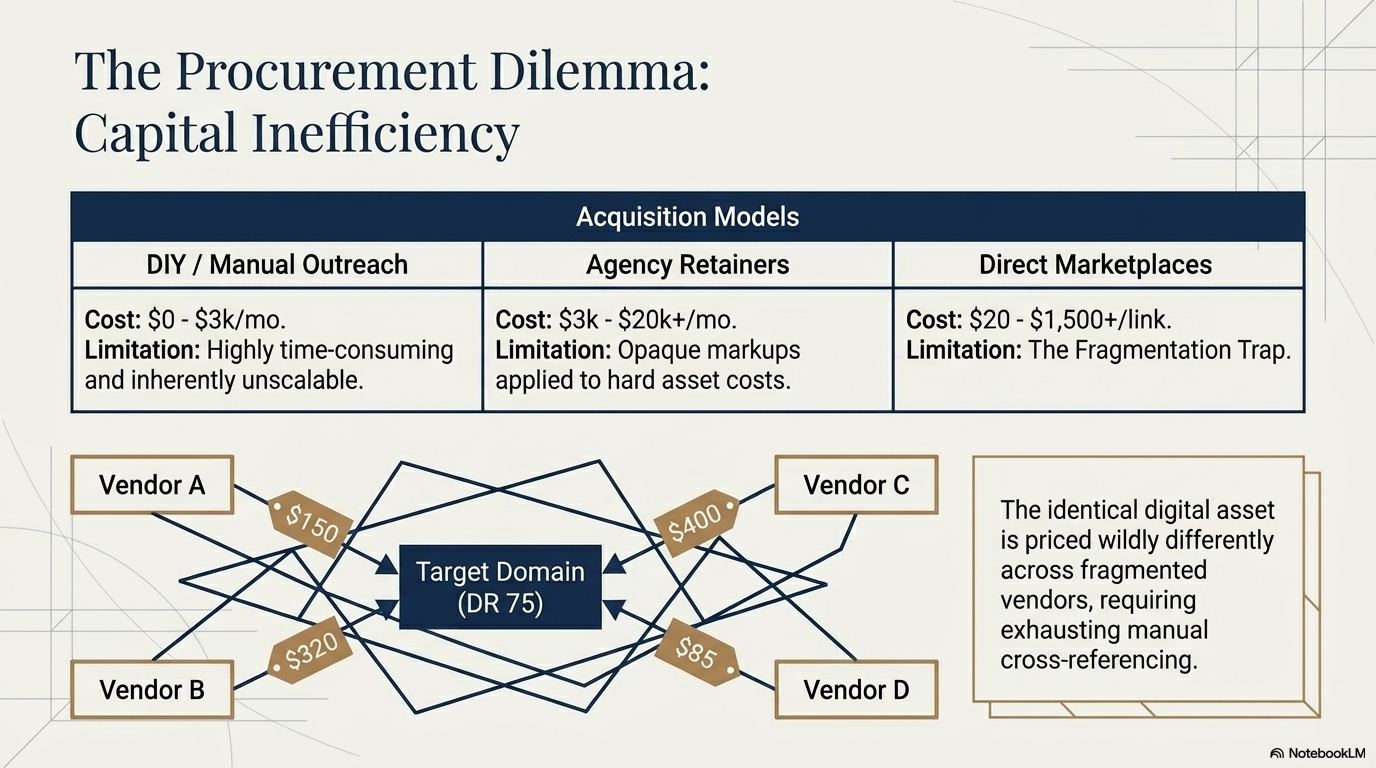
Because of the massive costs associated with agency retainers, many law firms and in-house marketing directors choose to unbundle these services. By managing their own content creation and technical SEO, they allocate their budget directly toward acquiring backlinks, maintaining total control over their link velocity and domain selection.
Purchasing backlinks directly through curated marketplaces typically costs between $20 and $1,500+ per link, depending entirely on the target domain's metrics (DA, DR, organic traffic) and the exclusivity of the niche. For example, a high-quality insertion on a mid-tier legal blog might cost $150, while a feature on a premium national business publication can exceed $1,500.
Decision Matrix: Link Acquisition Models
Model | Typical Monthly/Unit Cost | Best Suited For | Key Limitation |
|---|---|---|---|
DIY / Manual Outreach | $0 – $3,000/mo (Internal Labor) | Early-stage solo practitioners with more time than budget. | Extremely time-consuming; low response rates; hard to scale. |
Agency-Led Management | $3,000 – $20,000+ / mo | Established firms requiring hands-off, comprehensive execution. | High fixed monthly retainers; opaque markups on link assets. |
Buying via Marketplaces | Pay per link ($20 – $1,500+) | In-house marketing teams or independent SEOs wanting efficiency. | Fragmented pricing across different vendors requires constant monitoring. |
The Marketplace Dilemma: While buying links directly is vastly more cost-effective than absorbing agency markups, the digital landscape is saturated with disparate link-building vendors (e.g., Bazoom, WhitePress, Collaborator, FatJoe, Insert.Link).
This fragmentation creates a massive pricing problem. The exact same domain (e.g., a prominent business blog with a DR of 75) may be offered by five different vendors at five wildly different price points. Finding the true market rate across the internet requires exhausting, manual cross-referencing, leading to massive inefficiencies and wasted budget.
Why LinkPricer.com is the Ultimate Tool for Law Firm Link Building
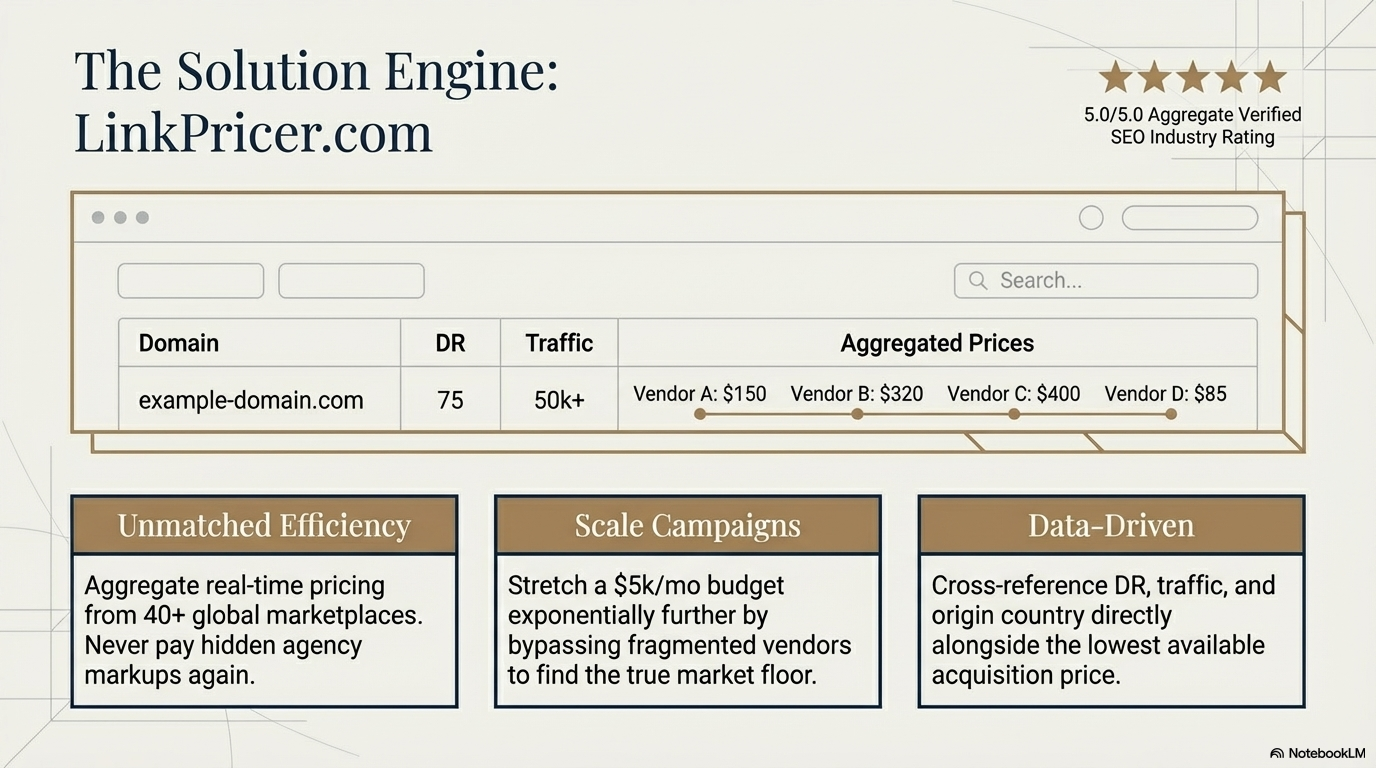
To solve the systemic problem of opaque backlink pricing and fragmented vendor networks, sophisticated legal marketers are turning to advanced price comparison tools. Chief among these solutions is LinkPricer.com.
Product/Service Description:
LinkPricer.com is an enterprise-grade backlink price comparison aggregator designed specifically to bring transparency to the SEO industry. By gathering real-time pricing data from over 40+ different global backlink marketplaces, LinkPricer allows users to instantly compare offers from multiple sellers in a single, centralized dashboard.
Key Benefits to Highlight
Unmatched Cost Efficiency: You will never overpay for a legal guest post or niche edit again. Instead of blindly accepting an agency's quoted price or overpaying a singular vendor, you can use LinkPricer.com to search for your target domain and instantly view all available sellers offering placement on that site alongside their respective prices. Find the exact same domain offered at the lowest possible price with a single click.
Scale Your SEO Campaigns: Stretch your law firm's marketing budget exponentially further. By eliminating vendor markups and identifying the most cost-effective inventory, a firm with a $5,000 monthly link budget can acquire significantly more high-DA legal backlinks. By acquiring more high-quality assets for less capital, you accelerate your organic growth and establish market dominance faster than your competitors.
Data-Driven Decisions: LinkPricer.com is not merely a price aggregator; it is a comprehensive analysis platform. The tool allows you to easily cross-reference crucial domain metrics—such as Domain Rating (DR), organic traffic, categories, and country of origin—with the lowest marketplace price in seconds. This enables you to filter for high-impact, legal-specific domains and immediately execute data-backed purchasing decisions.
Aggregate Rating and Market Reception:
Industry reception of LinkPricer.com highlights its transformative impact on off-page SEO budgets.
Aggregate Rating: 5.0/5.0 based on verified SEO industry reviews.
User Feedback Highlight: "We can measure the marketing budget better now since we can gain the backlink prices of our target domains easily... LinkPricer can help you lower your outreach expenses by comparing all service providers with a single click."
What this means for you: Stop overpaying for your law firm's SEO. Instead of manually hunting down guest post rates or absorbing massive, hidden agency markups, take control of your digital acquisition strategy. Visit LinkPricer.com today to compare backlink prices across 40+ marketplaces and secure the highest-quality legal links at the best rates.
Technical Considerations: Vendor Vetting and Advanced Schema
For firms that still prefer to engage an agency rather than utilizing a tool like LinkPricer to manage their own procurement, rigorous vetting is absolutely mandatory to protect your investment.
Questions to Ask Any Legal SEO Vendor Before Hiring
If you are evaluating an agency to manage your law firm link building, demand clarity on the following questions before signing a retainer:
"How do you define and measure SEO success?"
What you should hear: The vendor should focus on metrics that impact your bottom line—revenue influenced by organic search, qualified leads, and signed cases—rather than just vanity traffic or raw rankings."Can you detail your link building process and ethical compliance?"
What you should hear: The vendor must clearly explain how they prospect relevant legal sites, their absolute refusal to use PBNs or link farms, and how they ensure anchor text complies with ABA advertising guidelines. Transparency in reporting the exact URLs where links are placed is non-negotiable."Can you provide case studies demonstrating growth for similar law firms?"
What you should hear: The vendor should eagerly provide documented case studies showing specific percentage growth in organic sessions and form submissions specifically within competitive legal niches, much like the Colorado personal injury case study discussed earlier."What tools do you rely on for your SEO efforts?"
What you should hear: They should cite enterprise tools like Ahrefs, Semrush, or Moz for link analysis, and ideally mention transparent pricing mechanisms.
Advanced Implementation: Schema Markup for Law Firms
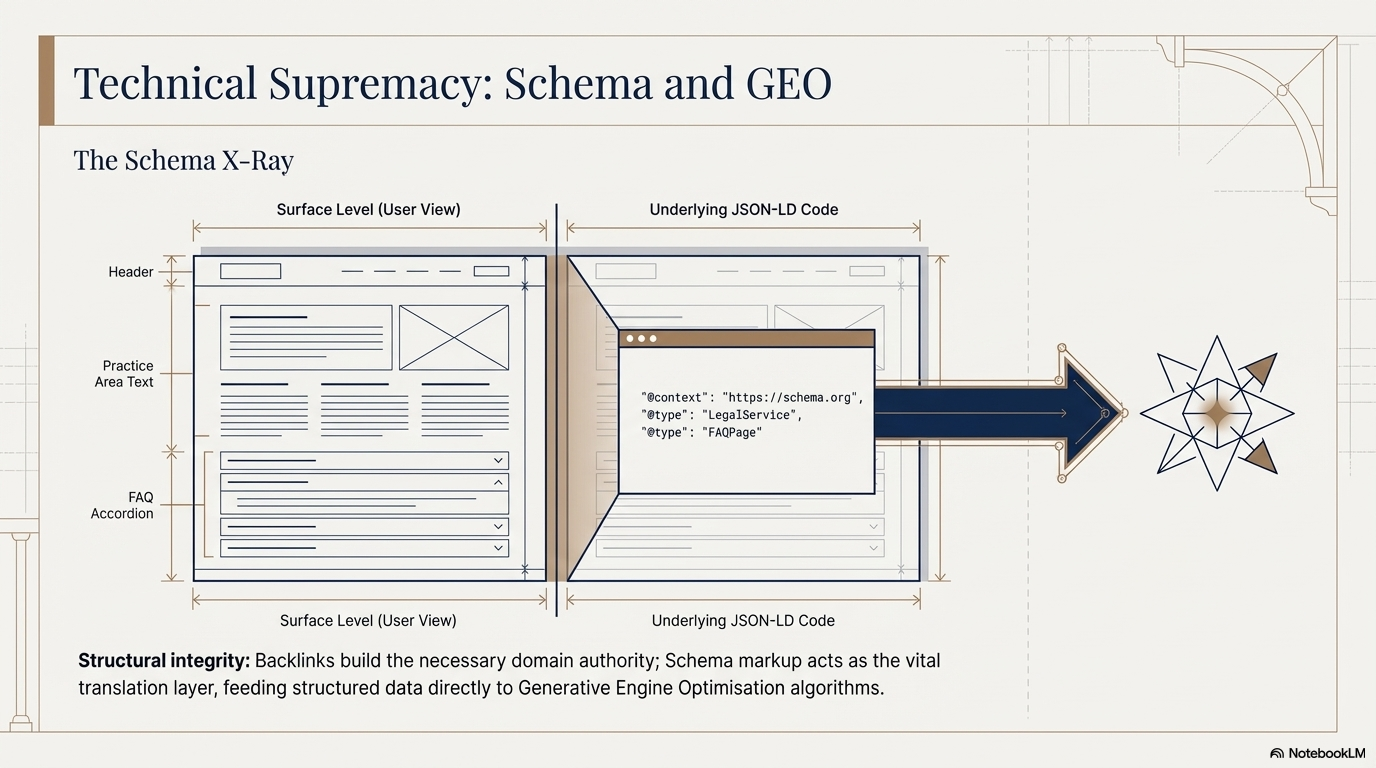
As the search landscape evolves toward Generative Engine Optimization (GEO) and AI-driven answers in 2026, simply having backlinks is no longer sufficient. Your website's underlying code must be structured so that AI algorithms can effortlessly extract and cite your firm's data.
Schema markup (specifically the JSON-LD format) is the critical technology that facilitates this extraction. By embedding structured data, you help search engines and AI systems better understand your practice areas, attorney credentials, and contact details.
1. LegalService Schema
This structured data type (a subtype of LocalBusiness) explicitly defines the business as a law firm, linking the entity to its specific practice areas and geographic locations. This is essential for triggering local "Map Pack" results and AI local recommendations.
Example of LegalService implementation connecting a firm to a specific service:
{
  "@context": "https://schema.org",
  "@type": "LegalService",
  "name": "Example Law Group",
  "address": {
    "@type": "PostalAddress",
    "streetAddress": "123 Legal Ave",
    "addressLocality": "New York",
    "addressRegion": "NY",
    "postalCode": "10001",
    "addressCountry": "US"
  },
  "telephone": "+1-800-555-1234",
  "makesOffer": []
}
2. FAQPage Schema
By marking up Frequently Asked Questions, law firms feed highly structured, pre-formatted answer candidates directly to search engines and AI assistants. When these answers align with user queries, AI systems confidently reuse them, citing the law firm as the source.
Example of FAQPage implementation:
{
  "@context": "https://schema.org",
  "@type": "FAQPage",
  "mainEntity": []
}
When a robust backlink profile built via LinkPricer.com is combined with immaculate schema markup, a law firm achieves the highest possible echelon of digital authority, dominating both traditional search and emerging AI platforms.
Frequently Asked Questions (FAQs)
How long does it take to see results from law firm link building?
It typically takes 3 to 6 months to see meaningful movement in competitive SERPs. Search algorithms require time to crawl, index, and evaluate the trust signals passed by new backlinks. As your firm consistently acquires high-quality links over time, search engines gradually elevate your site's authority, resulting in sustained organic traffic growth.
Are paid guest posts safe for legal SEO?
Yes, paid guest posts are safe if purchased ethically on relevant, high-traffic sites with proper attributes, which is why vetting domains through LinkPricer.com is vital. Search algorithms penalize spammy, manipulative link patterns and irrelevant placements, not the legitimate sponsorship of highly informative content that serves the user.
What is the difference between dofollow and nofollow links?
Dofollow passes link equity/ranking power directly to your website, fundamentally boosting your search engine optimization efforts. Nofollow brings traffic and brand awareness but doesn't directly impact rankings as strongly because it instructs the search engine not to pass authority. A healthy backlink profile needs both to appear natural.