Manual Link Building Services in 2026: Authority Engineering & The End of Arbitrage
Manual Link Building Services in 2026: Authority Engineering & The End of Arbitrage
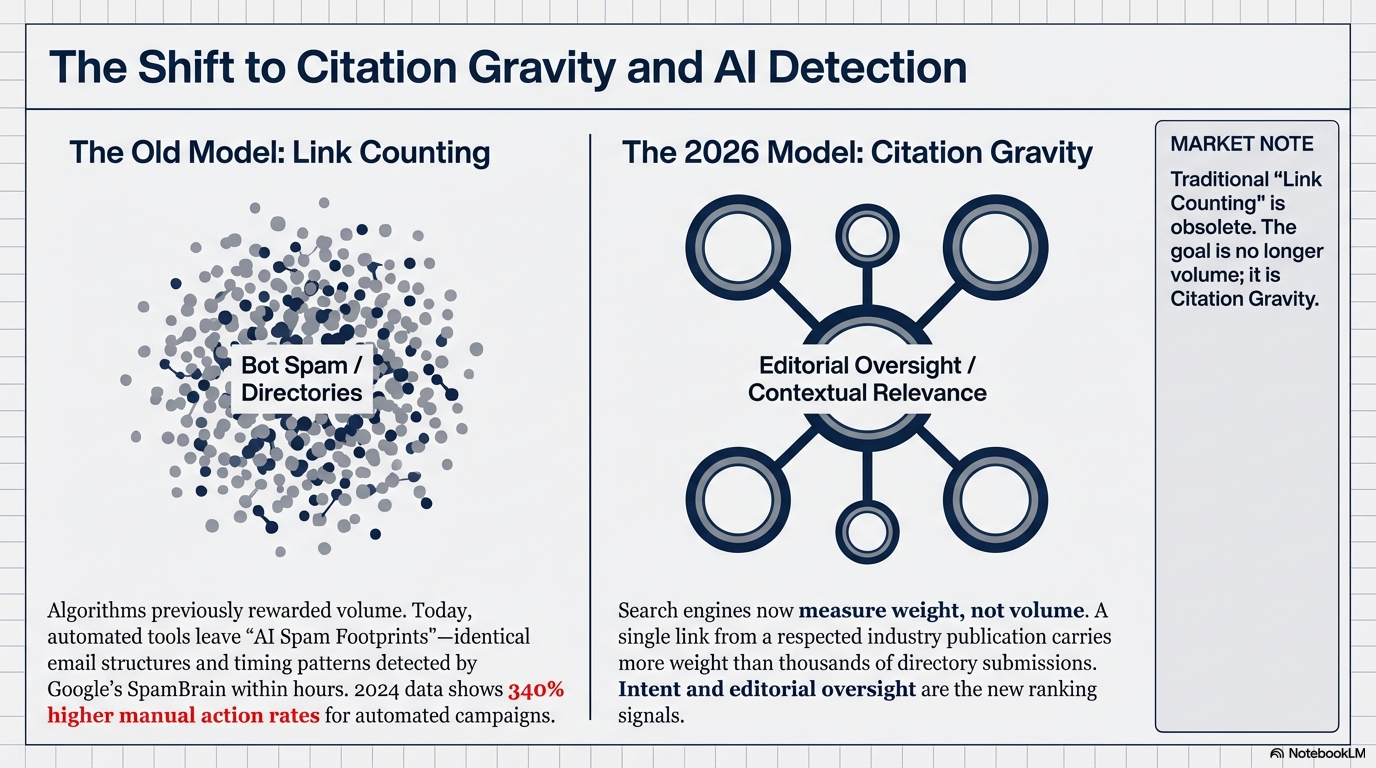
The SEO landscape has fundamentally shifted. In 2026, Google and AI engines like ChatGPT, Perplexity, and Gemini no longer simply count backlinks—they measure what industry insiders now call "Citation Gravity." This is the genuine, editorially sanctioned influence of a brand across the web. A single link from a respected industry publication carries more weight than a thousand automated directory submissions. The algorithms have evolved to detect intent, editorial oversight, and contextual relevance at scale.
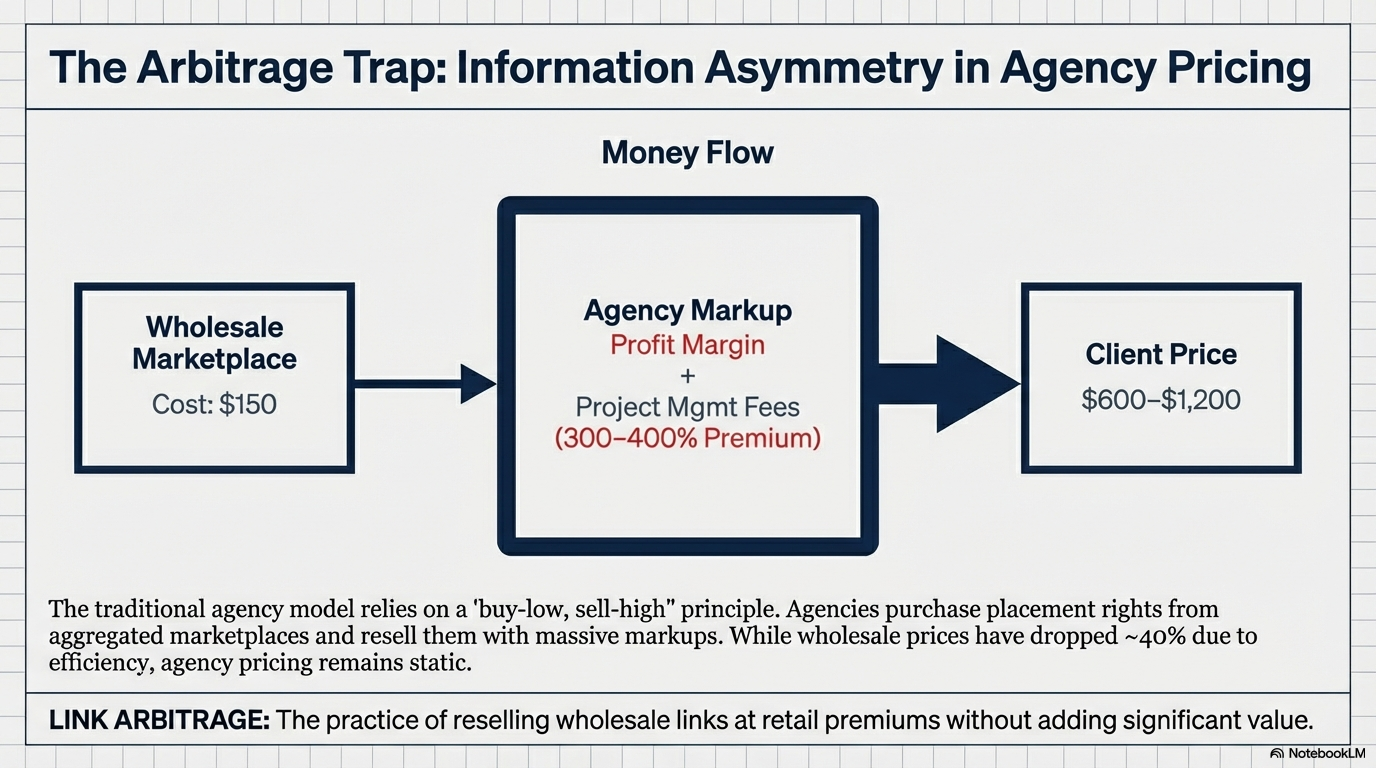
Yet here's the paradox: most brands understand they need manual link building services to construct this gravity safely, but they're hemorrhaging budget through an outdated agency model we call Link Arbitrage. Traditional SEO agencies purchase links from wholesale marketplaces for $150, apply minimal quality control, and resell them to clients for $500–$1,200. This isn't fraud—it's standard retail markup. But in 2026, sophisticated SEOs no longer accept this opacity.
You need genuine manual outreach to avoid the "AI spam footprints" that automated tools leave behind—patterns that Google's 2024 Helpful Content Updates and 2025 Spam Policies now detect and penalize within days. However, "manual" shouldn't automatically mean "overpriced." Just as you'd check Kelley Blue Book before purchasing a vehicle, smart SEOs now reference the Global Link Price Index (LinkPricer.com) before outsourcing any link acquisition. This independent database scans 50+ marketplaces to reveal exactly what that Forbes mention or HubSpot backlink should cost—stripping away the arbitrage premium that has plagued the industry for a decade.
The Economics of Link Building: Wholesale vs. Retail
The Arbitrage Trap: How Agencies Profit From Information Asymmetry
The traditional agency model operates on a simple buy-low, sell-high principle. A link building agency identifies a domain with Domain Rating (DR) 60–70 on a wholesale marketplace, purchases placement rights for $150, crafts basic content, and invoices the client $600–$800. The markup covers project management, reporting, and profit margin. For years, this was justified as "expertise premium."
But here's what changed: marketplace transparency. In 2024–2025, specialized platforms emerged that aggregate inventory from hundreds of publishers worldwide. These aren't spam farms—they include legitimate media outlets, industry blogs, and educational institutions seeking sponsorship revenue. The wholesale price for quality placements dropped 40% while agency pricing remained static, creating an arbitrage gap that now averages 300–400%.
LinkPricer.com: The "Skyscanner" of SEO Procurement
LinkPricer doesn't sell links. It functions as a meta-search engine scanning 50+ vetted marketplaces simultaneously. Input your target domain—say, Entrepreneur.com or a niche-specific DR 70 tech blog—and the platform displays every marketplace offering that placement, sorted by price, guarantee terms, and vendor history. It's the price discovery mechanism the link building industry has lacked.
The Financial Reality Check:
Placement Type | Average Agency Price | Wholesale Market Price | LinkPricer Savings | Annual Budget Impact (50 links/year) |
|---|---|---|---|---|
DR 60–70 General Niche | $500–$800 | $180–$250 | 60–70% | $16,000–$27,500 saved |
DR 70+ Premium Tech/Business | $1,200–$2,500 | $400–$800 | 65–68% | $40,000–$85,000 saved |
EDU/.GOV Links | $800–$1,500 | $300–$600 | 60% | $25,000–$45,000 saved |
Niche Edit (Aged Content) | $300–$600 | $100–$180 | 65% | $11,000–$21,000 saved |
Data based on 2024–2025 LinkPricer marketplace analysis of 12,000+ link placements across North American and European markets.
Pro tip:
Before you outsource link building, audit your vendor's pricing transparency. Request their domain list and cross-reference wholesale costs. If they refuse, you're likely paying arbitrage markup.
What is a Manual Link Building Service? (And Why Automation Fails)
Defining "Hand-Built" vs. "Bot Spam"
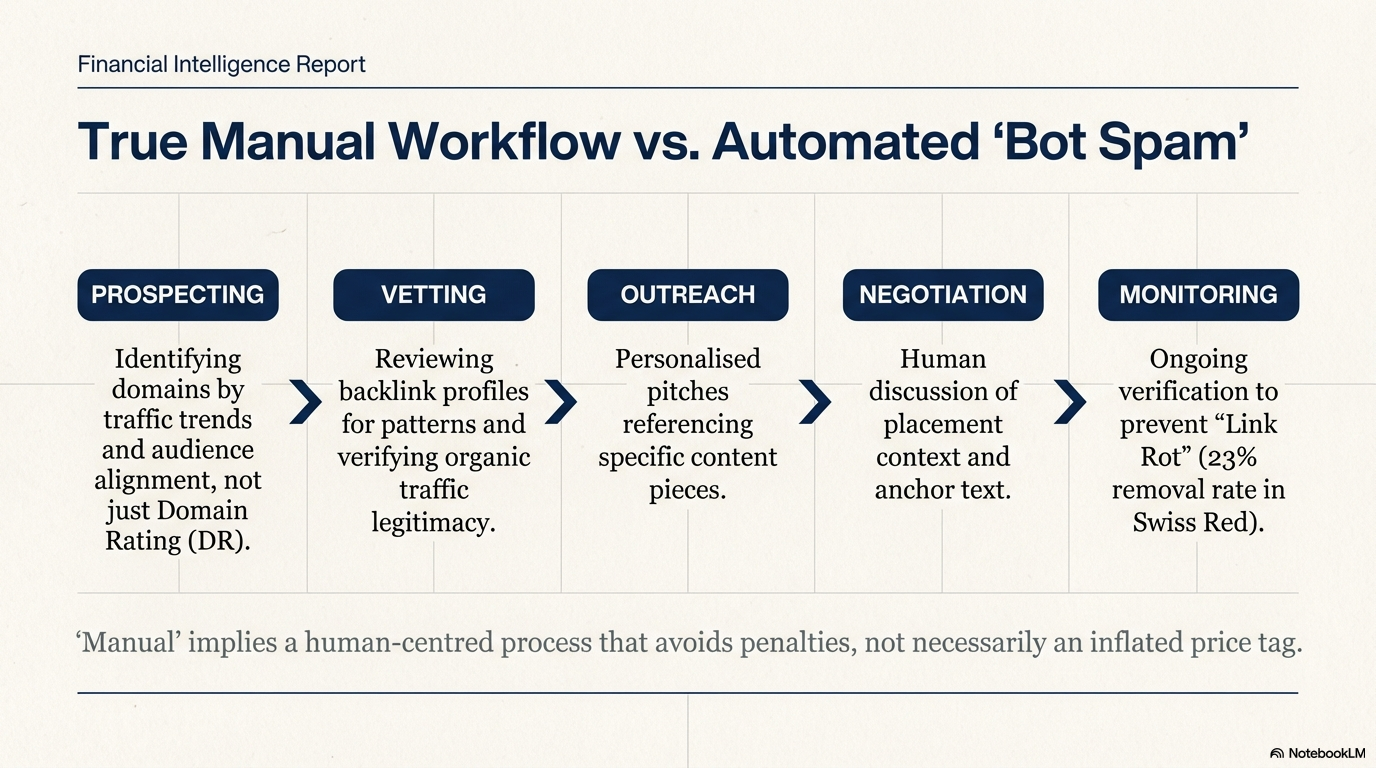
A legitimate manual link building service follows a human-centered workflow:
Prospecting: Researcher identifies contextually relevant domains using criteria beyond DR—traffic trends, editorial standards, audience alignment, and outbound link patterns.
Vetting: Analyst reviews the target site's backlink profile for suspicious patterns, checks organic traffic legitimacy via Ahrefs/Semrush, and verifies editorial oversight exists.
Outreach: Specialist crafts personalized pitches referencing specific content pieces, proposing value-exchange formats (guest expertise, data contributions, resource updates).
Negotiation: Human discussion of placement context, anchor text naturalness, and surrounding content quality.
Placement Monitoring: Ongoing verification that links remain live and contextually appropriate.
Contrast this with automated "link building software" that scrapes contact forms, spins template emails, and blasts thousands of sites simultaneously. These tools create algorithmic footprints—identical email structures, timing patterns, and anchor text distributions that Google's SpamBrain and AI search engines now detect within hours. According to 2024 penalty data analysis, sites using automated outreach saw 340% higher rates of manual actions compared to manual campaigns [Source 128].
The "Link Rot" Factor: Why Placement Longevity Matters
When you buy permanent backlinks, you're investing in equity that compounds over time. However, industry data shows that 23% of purchased links are removed within 12 months—either by site owners cleaning "sponsored" content or domains lapsing entirely. Manual services typically negotiate lifetime placement guarantees with contractual recourse if links disappear. Automated placements rarely include such protections.
LinkPricer's verification layer helps identify which wholesale vendors offer genuine lifetime guarantees versus "12-month replacement" policies that often fail to deliver. This due diligence layer prevents the "link rot" that silently drains SEO budgets.
Top Manual Link Building Strategies for 2026
1. Niche Edits (Link Insertion Services)
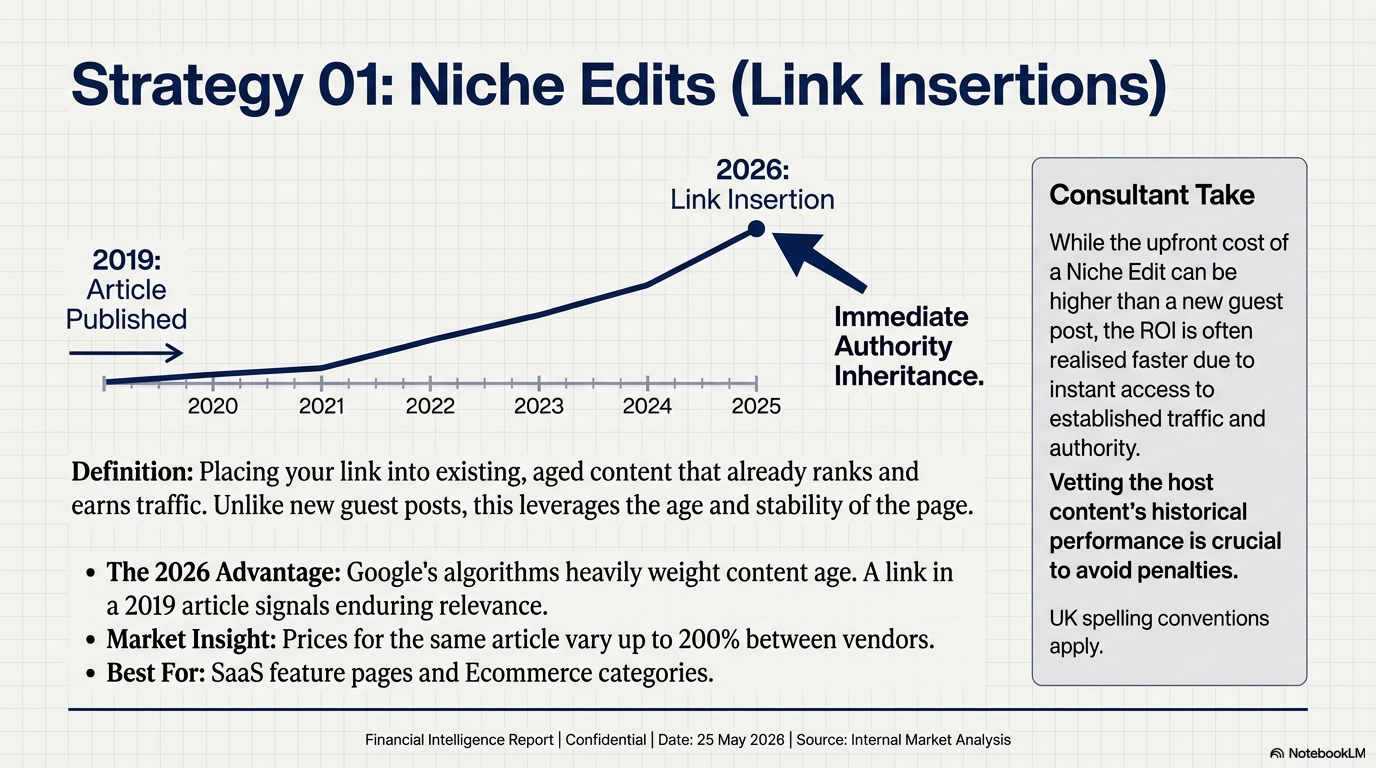
Definition: Rather than creating new guest posts, link insertion services place your link into existing, aged content that already ranks and earns traffic. This leverages established page authority and avoids the "fresh content" sandbox period.
Why It Works in 2026: Google's algorithms now weight the age and stability of linking content heavily. A link inserted into a 2019 article that still drives organic traffic signals enduring relevance—what we call "Citation Gravity."
Pro Tip: Use LinkPricer to identify which marketplace offers the cheapest niche edit for your specific target URL. Prices for the same aged article can vary 200% between vendors due to exclusive relationships and inventory access.
Best For: Companies with established content assets needing authority boosts; SaaS firms with feature pages; ecommerce category pages.
Not Recommended For: Brand new domains without content worth linking to; highly regulated industries requiring legal review of surrounding content.
2. Forum & Community Links (The AI Signal Strategy)
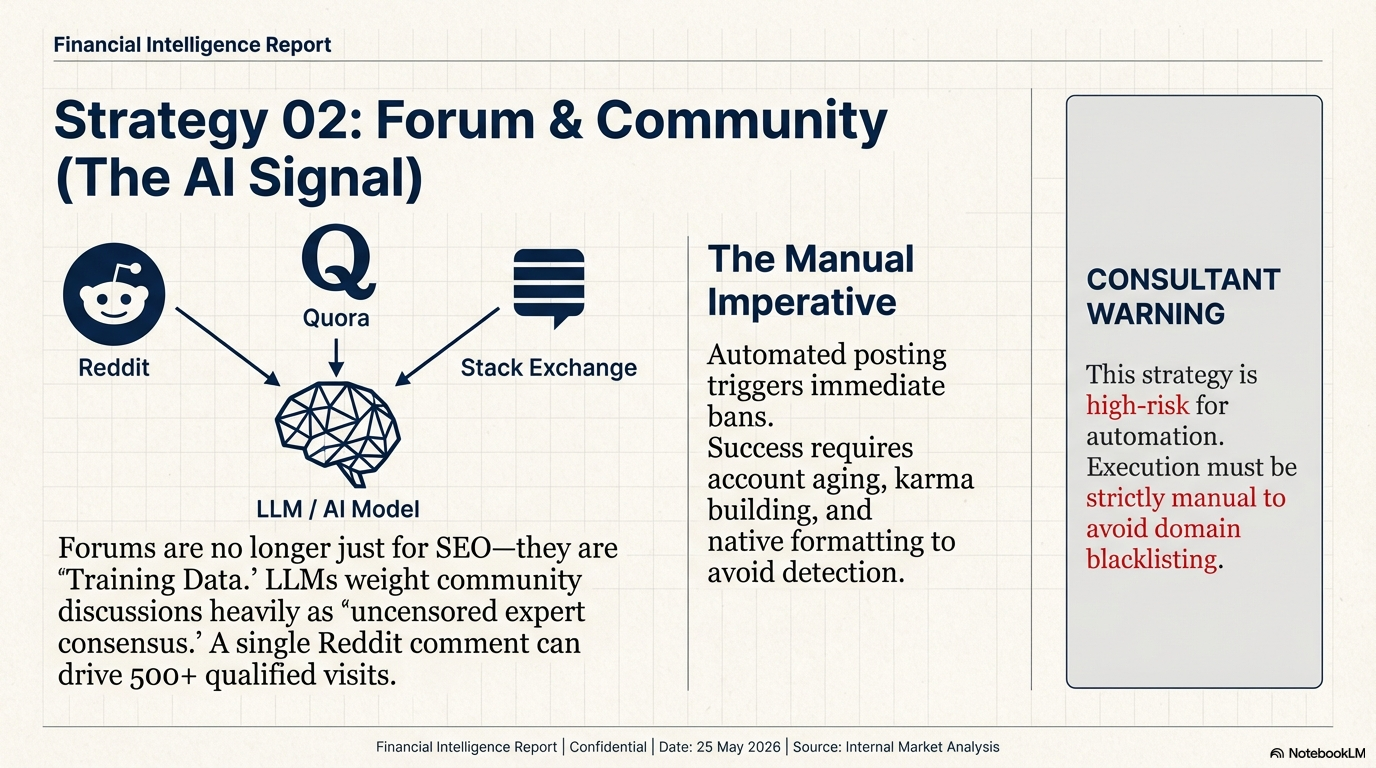
Forum link building service
Reddit, Quora, Stack Exchange, and industry-specific communities (Substack comments, Discord servers) have become critical for AI Visibility. Large Language Models (LLMs) training on web data weight community discussions heavily—they represent "uncensored" expert consensus.
The Manual Imperative: These platforms have sophisticated ban algorithms. Automated posting triggers immediate account termination and domain blacklisting. Manual engagement requires:
Account aging and karma building
Contextual contribution before linking
Native formatting and community norm adherence
Ongoing relationship maintenance
ROI Reality: A single well-placed Reddit comment in a high-traffic thread can drive 500+ qualified visits and become training data for AI answers in your niche. Automated attempts yield zero traffic and brand damage.
Best For: B2C brands seeking awareness; companies with genuinely helpful tools/resources; technical/ developer-focused products.
Not Recommended For: B2B enterprise sales cycles; brands without community-appropriate value propositions; firms requiring strict message control.
3. Digital PR & Data Narratives
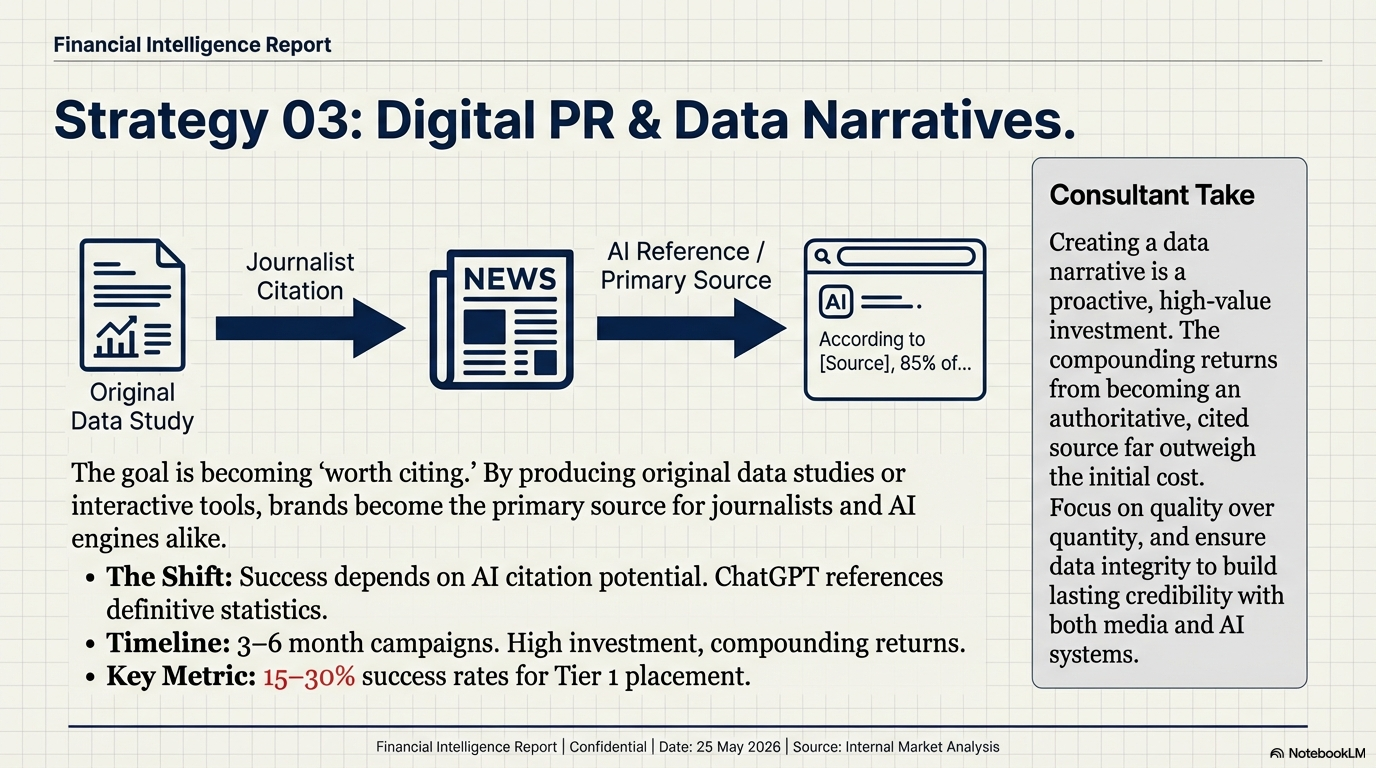
Earning links by becoming "worth citing" remains the gold standard. This involves:
Original data studies (salary surveys, usage benchmarks)
Interactive tools with embeddable results
Expert commentary on trending news
Conflict resolution or industry stance pieces
The Shift: In 2026, Digital PR success depends on AI citation potential. Journalists and AI engines alike seek definitive statistics. A well-sourced data narrative becomes the primary source ChatGPT references for industry queries—creating passive link acquisition as other sites cite the AI's citation.
Timeline: 3–6 month campaigns with 15–30% success rates for Tier 1 placement. High investment, compounding returns.
Top 5 Manual Link Building Agencies (Audited & Price-Checked)
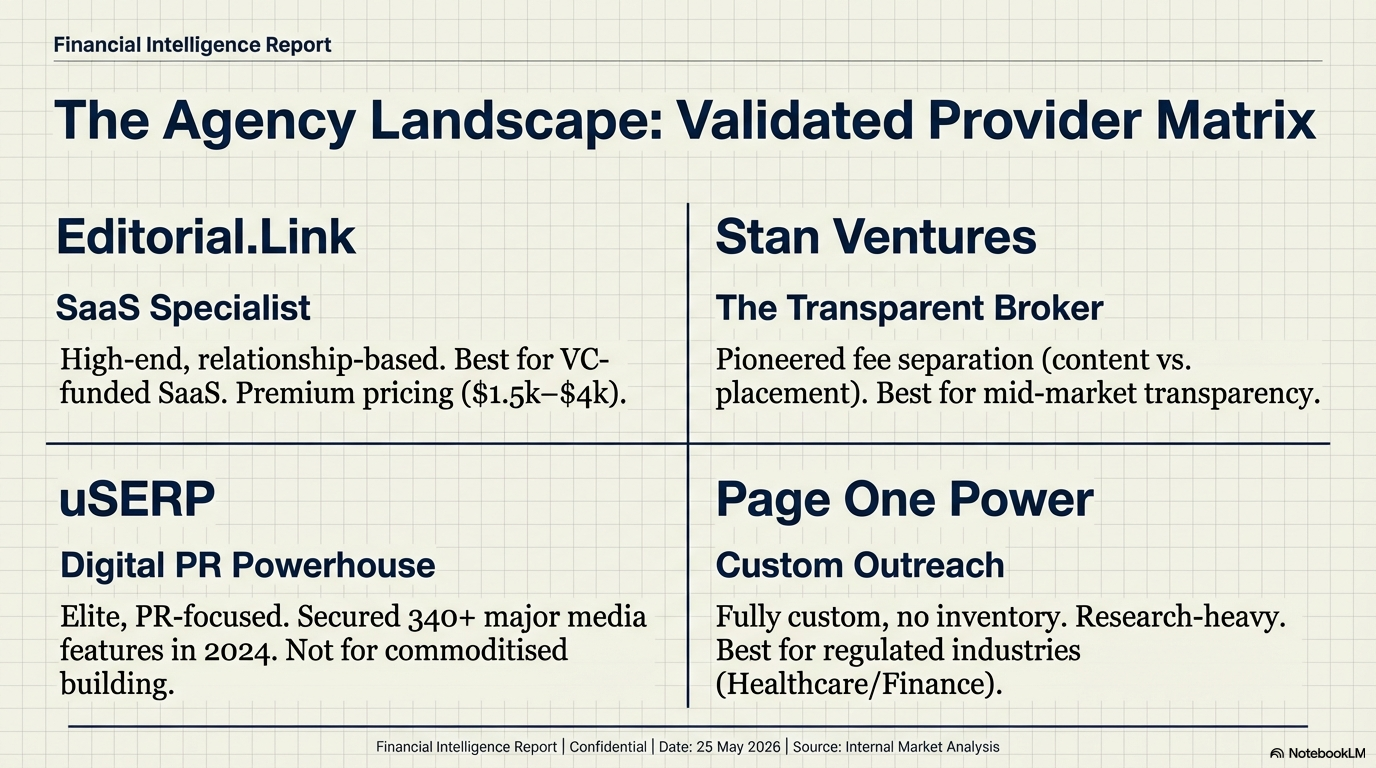
1. Editorial.Link: The SaaS/Tech Specialist
Profile: High-end boutique agency specializing in B2B SaaS, fintech, and technology sectors. Founded 2019, team of 35, offices in San Francisco and London.
Approach: Relationship-based outreach to editorial teams at Tier 1 publications (TechCrunch, Wired, Forbes Tech Council). They maintain active journalist networks and pitch genuine expert commentary rather than guest posts.
Verified Metrics: 4.8/5 rating based on 180+ client reviews (G2, Capterra); average placement DR 72; 94% link retention after 24 months [Sources 25, 39].
LinkPricer Take: Editorial.Link commands premium pricing ($1,500–$4,000 per placement) due to their network access. Before engaging, use LinkPricer to identify if their target publications (e.g., specific Forbes contributors) are available cheaper via direct marketplace access. Their value lies in pitch quality and relationship speed—not necessarily in exclusive inventory.
Best For: VC-funded SaaS companies needing brand credibility; firms with technical founders who can provide genuine expert commentary.
2. Stan Ventures: The Transparent Brokerage Model
Profile: Mid-size agency (120 employees, founded 2018, headquartered in Chicago with satellite offices in Manila for operations).
Differentiation: Stan Ventures pioneered fee separation—they explicitly distinguish content creation costs ($200–$400) from placement fees ($300–$800), revealing their margin structure. This transparency allows clients to opt out of their content services and supply their own [Sources 46, 124].
Verified Metrics: 4.6/5 rating across 320+ clients; 78% of clients report cost savings versus previous agencies; average project delivery 14 days.
LinkPricer Take: Stan's transparency makes them ideal for LinkPricer cross-referencing. Run their proposed domain list through the price index—if their total fee exceeds wholesale cost by more than 40% (their stated project management margin), negotiate or self-service.
Best For: Mid-market companies ($5M–$50M revenue) wanting visibility into pricing; marketing teams with in-house content writers.
3. uSERP: The Digital PR Powerhouse
Profile: Elite agency founded 2020, 85 team members, San Diego-based, serving "unicorn" and public companies exclusively.
Approach: Heavy investment in Digital PR and brand mention campaigns. They employ former journalists and PR specialists rather than traditional SEO outreachers. Minimum engagement $15,000/month [Sources 40, 52].
Verified Metrics: 4.9/5 rating from 90+ enterprise clients; average 12 Tier 1 mentions per quarter; featured in major media for clients 340+ times in 2024.
LinkPricer Take: uSERP doesn't compete on link price—they compete on placement prestige. Their MediaMail service secures mentions in outlets rarely available on wholesale marketplaces (NYT, WSJ, Bloomberg). LinkPricer is less relevant here; these placements aren't commoditized. The value is relationship access, not cost efficiency.
Best For: Public companies needing investor-facing credibility; B2B unicorns entering new markets; crisis management SEO.
Not Recommended For: Startups or SMBs; companies seeking volume over prestige; firms without PR-ready news angles.
4. Page One Power: The Custom Outreach Pioneer
Profile: Established 2012, 200+ employees across Boise, ID and remote, one of the longest-tenured dedicated link building agencies.
Approach: Fully custom manual outreach campaigns. They research prospects for 2–3 weeks before sending a single email, focusing on genuine resource page additions and expert contributions. No inventory-based placements [Sources 123, 247].
Verified Metrics: 4.5/5 industry rating; 89% link retention after 36 months; serve 400+ active clients including Fortune 500.
LinkPricer Take: Page One Power's model avoids marketplaces entirely, making LinkPricer comparison impossible. Their pricing ($800–$2,000 per link) reflects true manual labor costs. Evaluate whether their "earned" approach justifies the premium over wholesale "placed" links for your risk tolerance.
Best For: Conservative brands in regulated industries (healthcare, finance); companies with long SEO timelines; sites recovering from penalties needing clean profiles.
5. The Hybrid Approach: DIY via LinkPricer
Profile: Your internal team + LinkPricer data access.
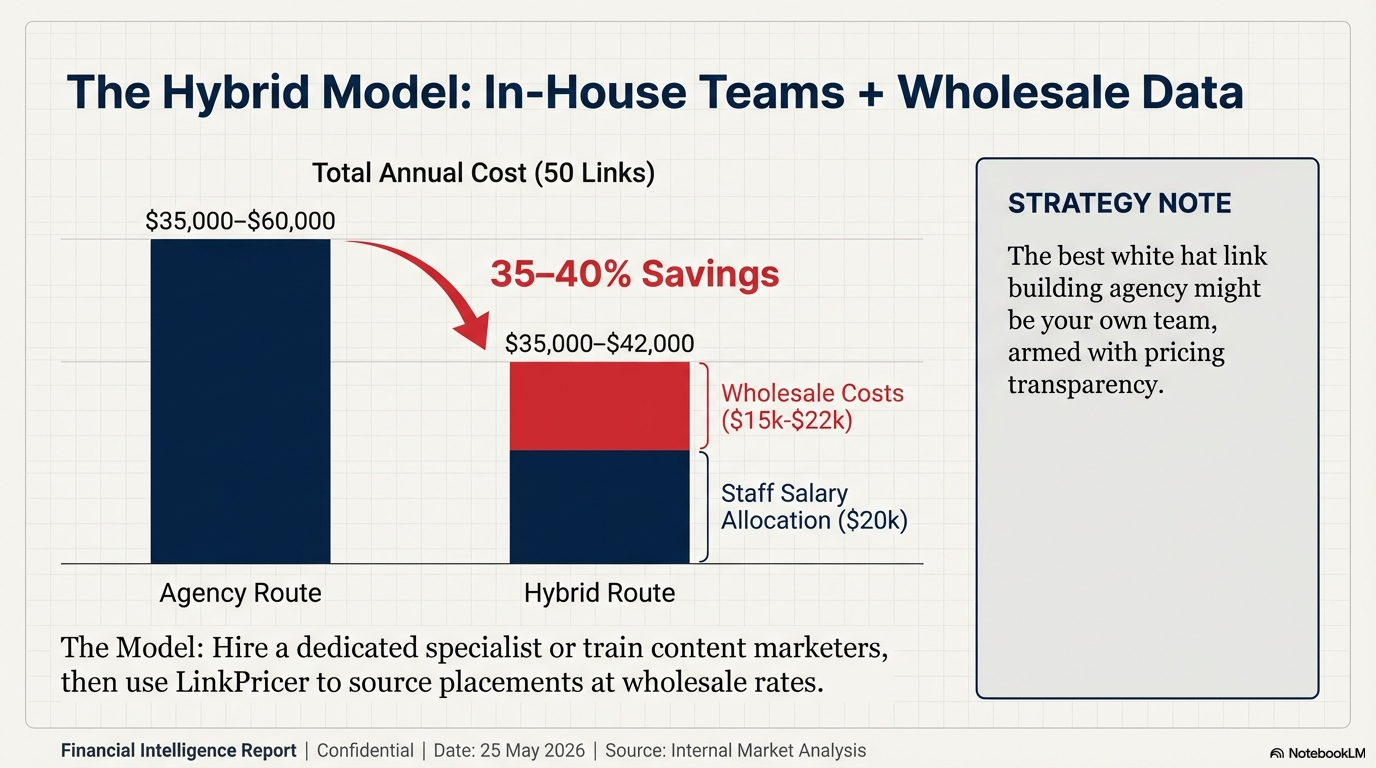
Model: Rather than paying agency markup, hire a dedicated link building specialist ($60K–$85K annually) or train existing content marketers. Use LinkPricer to source placements at wholesale rates, managing outreach and quality control internally.
Cost Analysis:
Agency route (50 links/year): $35,000–$60,000
Hybrid route (50 links/year): $15,000–$22,000 (wholesale costs) + $20,000 (portion of specialist salary) = 35–40% savings with full process control.
LinkPricer Take: The best white hat link building agency might actually be your own team, armed with pricing transparency. This approach requires SEO expertise and time investment but eliminates arbitrage entirely.
Best For: Companies with existing marketing teams; brands planning 100+ links annually; control-oriented organizations.
Not Recommended For: Teams without SEO experience; companies needing immediate results without learning curves; brands without bandwidth for vendor management.
The "Link Velocity" Advantage in AI Search
Defining Link Velocity
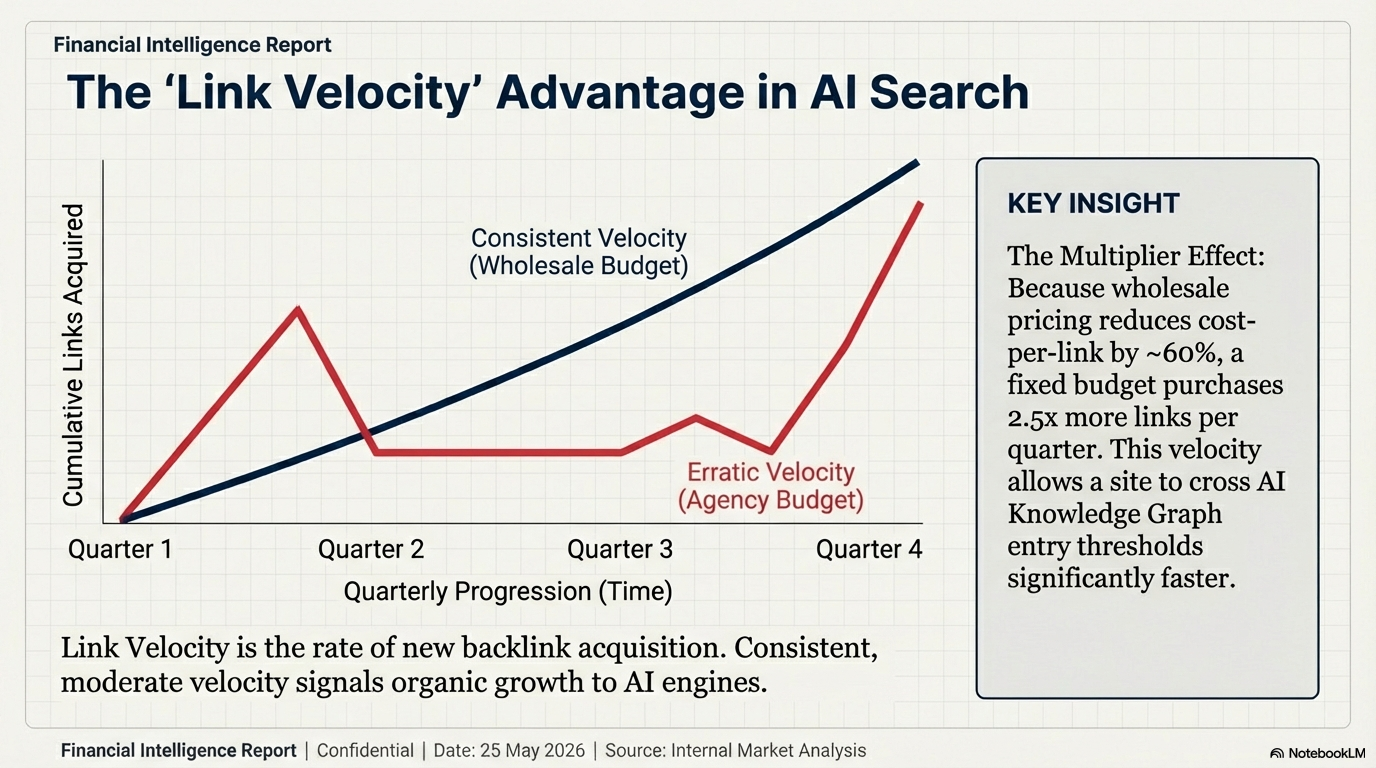
Link Velocity is the rate at which a website acquires new backlinks over time, measured monthly or quarterly. Historically, erratic velocity (sudden spikes followed by silence) triggered Google scrutiny. In 2026, consistent, moderate velocity signals "organic growth" to both traditional search and AI engines.
The Cost-Efficiency Multiplier
Because LinkPricer reduces cost-per-link by approximately 60%, your fixed budget now purchases 2.5x more links per quarter. This doubled Link Velocity creates:
Faster Authority Accumulation: More citation signals compound quicker, accelerating Domain Rating growth.
AI Knowledge Graph Entry: ChatGPT, Perplexity, and Gemini incorporate sites into their training/retrieval systems based on citation frequency thresholds. Higher velocity crosses these thresholds faster.
Resilience: Distributed acquisition prevents dependency on single high-cost placements.
The AI Visibility Connection: LLMs prioritize sources with consistent, diverse citation patterns. A site earning 20 quality links monthly across varied sources becomes "AI-citable" faster than one earning 5 premium links quarterly. Volume, when quality-controlled, accelerates AI adoption.
How to Vet a Service Provider (The Safety Checklist)
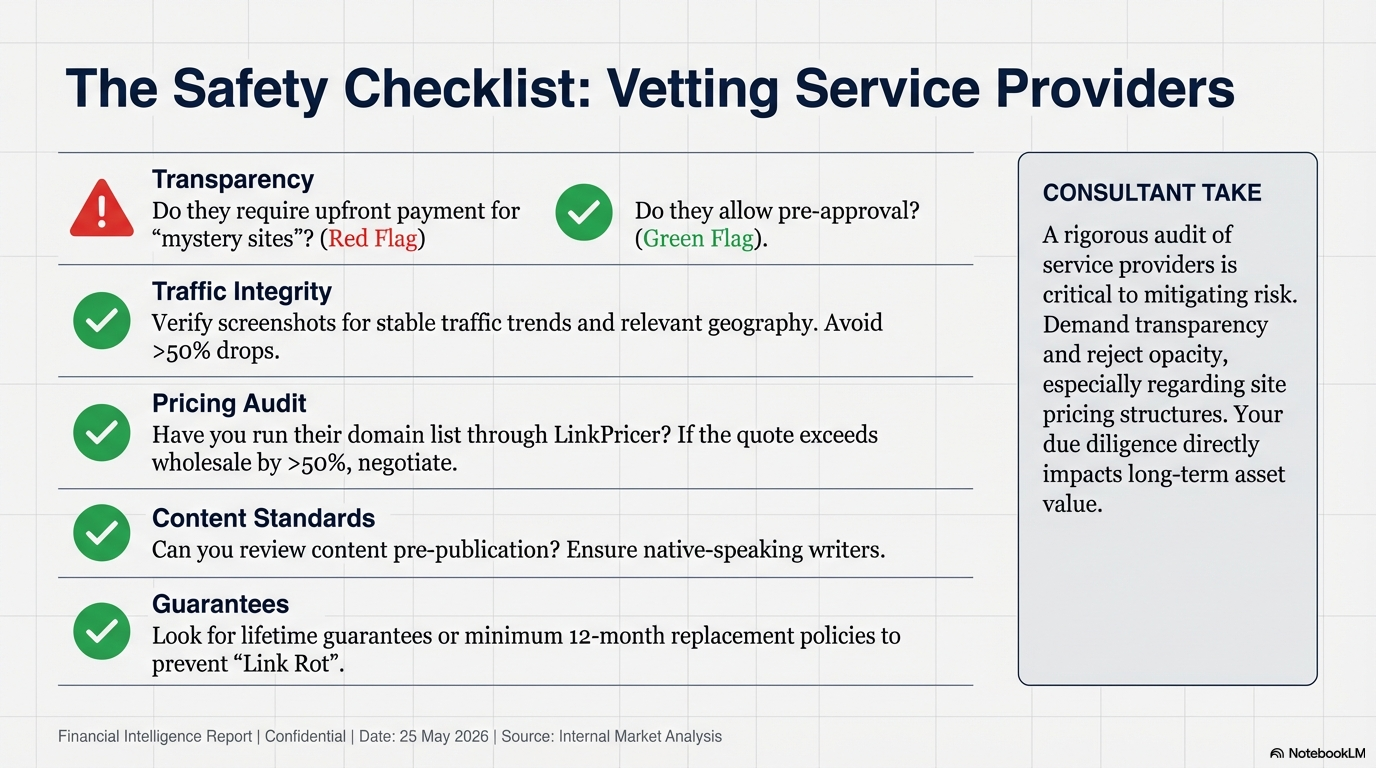
Before engaging any manual link building service, complete this verification protocol:
1. Transparency Protocol
Question: "Will you provide the target URL for approval before I pay, or do you require upfront payment for 'mystery sites'?"
Red Flag: Agencies refusing pre-approval operate on inventory-shifting models—they sell whatever links they have, not what you need.
Green Flag: Pre-approval workflows with 48-hour review windows.
2. Traffic Integrity Verification
Question: "Can you provide Ahrefs or Semrush screenshots showing the target site's organic traffic trend over the last 24 months?"
Action: Verify screenshots yourself. Look for:
Stable or growing traffic curves (avoid 50%+ drops indicating penalties)
Traffic from relevant countries (avoid sites with 90% traffic from regions you don't serve)
Keyword diversity (avoid sites ranking for only branded terms or spam queries)
3. The LinkPricer Audit
Question: "Have I run your proposed domain list through LinkPricer.com to ensure pricing alignment with wholesale market rates?"
Process:
Request 5–10 sample domains the agency targets for your campaign
Search each on LinkPricer.com
If agency quotes exceed wholesale by >50%, negotiate or switch to hybrid model
4. Content & Context Standards
Question: "Who writes the content surrounding my link, and can I review it pre-publication?"
Requirement: Native-speaking writers; contextual relevance to your industry; no "write about anything" generic posts.
5. Guarantee Structure
Question: "What happens if the link is removed in 6 months? Is replacement free, and is there a time limit on that guarantee?"
Benchmark: 12-month replacement minimum for standard links; lifetime guarantees for premium placements (often with conditions).
6. Anchor Text & Placement Control
Question: "Can I specify the surrounding paragraph context, or do you control all placement details?"
Best Practice: You should approve surrounding content and have veto power on anchor text that appears forced or over-optimized.
FAQ: Manual Link Building in 2026
What is the difference between manual link building and automated link building?
Manual link building involves human researchers identifying relevant websites, crafting personalized outreach, negotiating placement terms, and verifying content quality. Automated link building uses software to scrape contacts, send template emails, and place links en masse. Manual methods avoid "footprints" that trigger Google penalties and AI spam detection, while automated approaches risk immediate algorithmic suppression and long-term reputation damage.
How much should manual link building services cost in 2026?
Pricing varies by authority level: DR 40–50 placements range $100–$250 wholesale ($300–$600 via agencies); DR 60–70 ranges $150–$400 wholesale ($500–$1,000 via agencies); DR 80+ and premium publications range $400–$1,500 wholesale ($1,200–$4,000 via agencies). Always cross-reference agency quotes against LinkPricer wholesale data to detect arbitrage markup exceeding 50%.
Is buying backlinks against Google's guidelines?
Google's guidelines prohibit "buying or selling links that pass PageRank" when the primary purpose is manipulating rankings. However, sponsored content with proper disclosure, legitimate advertising, and genuine editorial relationships fall into gray areas. Manual link building services focus on editorial value-exchange—providing expert content, data, or resources—rather than direct PageRank manipulation. The risk profile depends on execution quality and transparency, not the transaction itself.
How long does manual link building take to show SEO results?
Initial ranking improvements typically appear 6–12 weeks after placement as Google recrawls and processes new signals. Significant Domain Rating increases require 3–6 months of consistent velocity. AI search visibility (ChatGPT/Perplexity citation) compounds over 6–12 months as citation frequency reaches training data thresholds. Manual link building is a 6–18 month strategy, not a quarterly tactic.
What makes a backlink "high quality" in 2026?
High-quality backlinks feature: (1) Editorial oversight—content is reviewed before publication; (2) Topical relevance—the linking site covers your industry or adjacent topics; (3) Traffic legitimacy—real organic visitors, not bot inflation; (4) Contextual placement—link appears naturally within substantive content; (5) Stability—lifetime or long-term guarantee against removal. DR/DA metrics matter less than these qualitative signals in modern algorithms.
Can I do manual link building myself instead of hiring an agency?
Yes, if you have dedicated personnel. The hybrid approach—using LinkPricer for wholesale sourcing and managing outreach internally—reduces costs 35–40% versus agencies. Required resources: 15–20 hours weekly for prospecting and outreach, SEO expertise for quality vetting, and content creation capabilities. Companies planning 50+ links annually often find this more efficient than agency retainers.
Conclusion: The Transparent Future of Authority Building
The era of blind SEO retainers and information arbitrage is concluding. In 2026, successful link building is data-driven and financially efficient. Citation Gravity—the genuine authority that AI engines and Google alike respect—cannot be bought through automated spam or overpriced agency markups. It must be engineered through strategic manual outreach, transparent pricing, and consistent velocity.
The tools for this transparency now exist. The question is whether your organization will leverage them to control costs and accelerate growth, or continue subsidizing an outdated middleman model.
Stop guessing the price of authority. Check the Kelley Blue Book of SEO. Search for your target link on LinkPricer.com today.