Link Building for Startups: The 2026 Playbook to Dominate Search & AI
Introduction: The Organic Traffic Crisis of 2026
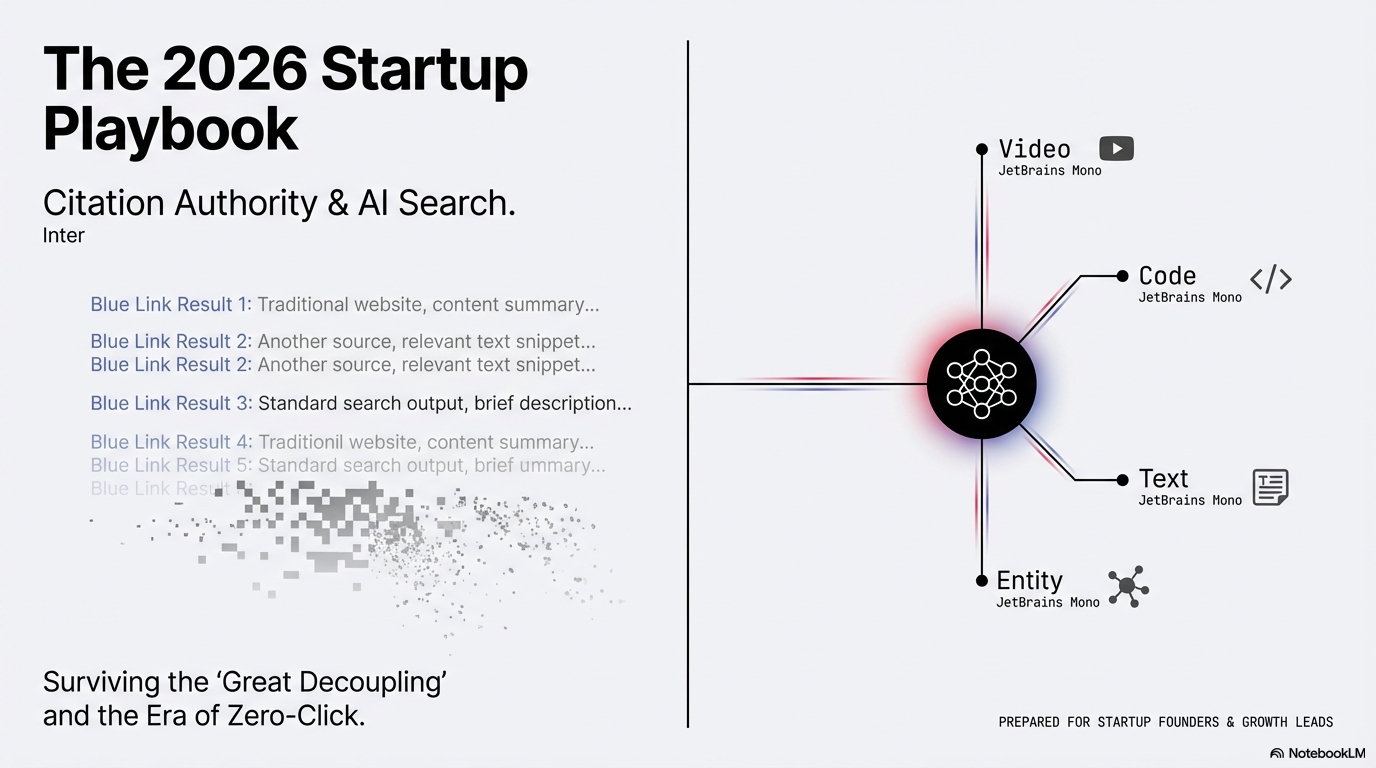
The digital marketing landscape of 2026 bears almost no resemblance to the search environments that defined the previous decade. For startup founders, growth marketers, and SEO professionals, the fundamental playbook for acquiring users through organic search has been rewritten, not by a simple algorithm update, but by a structural revolution in how humanity accesses information. We are currently witnessing "The Great Decoupling"—a definitive severance of the traditional linear relationship between search volume and website traffic.
For years, the equation was simple: high search volume on a keyword plus high ranking equaled high traffic. In 2026, that equation has broken. Data from late 2025 indicates a seismic shift in user behavior driven by the ubiquity of Artificial Intelligence. Approximately 60% of all Google searches now end without a click to an external website, a phenomenon known as "zero-click search". On mobile devices, where immediate answers are prioritized and screen real estate is at a premium, this figure rises to a staggering 77.2%.
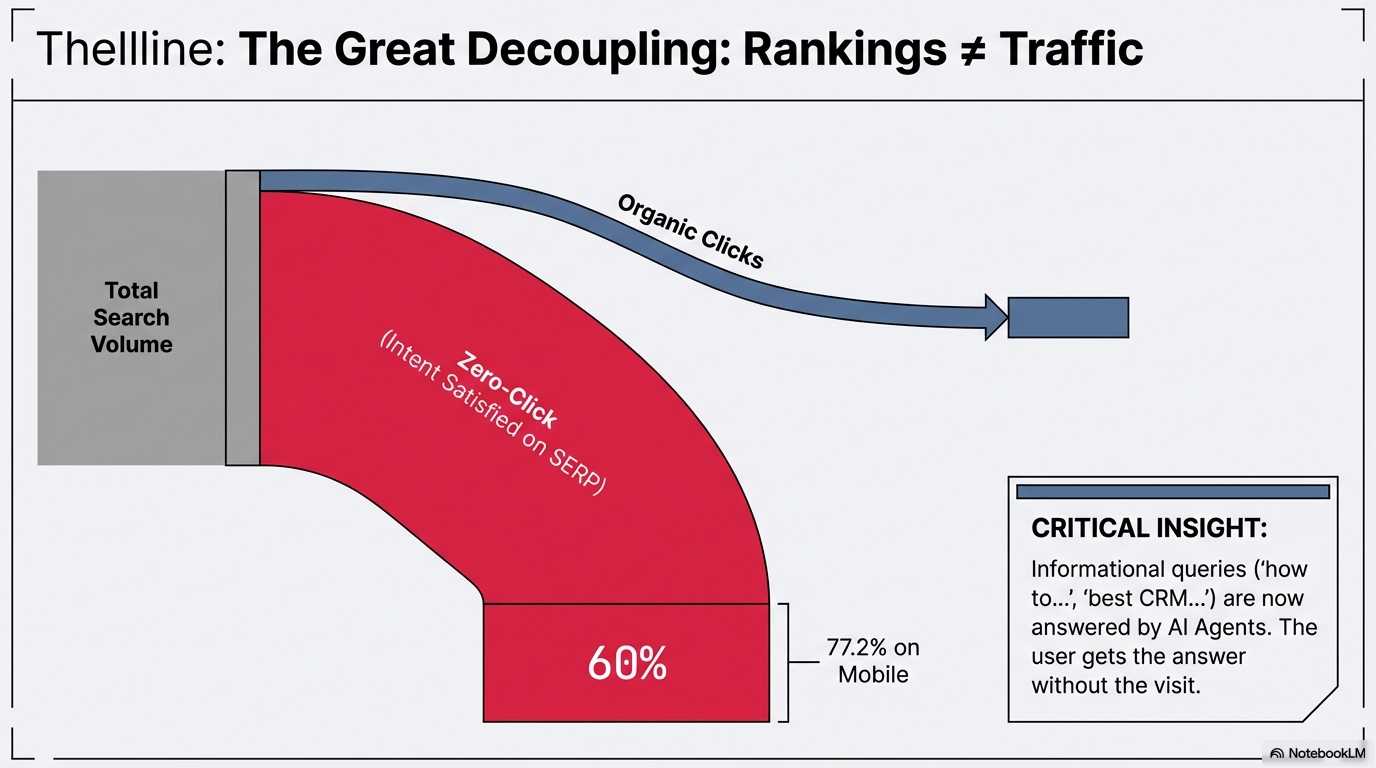
The primary driver of this change is the dominance of AI Overviews (AIO) and generative answers that synthesize information directly on the Search Engine Results Page (SERP). These systems satisfy user intent—answering questions, comparing products, and defining terms—without requiring the user to navigate to a publisher's site. For the user, this is convenience. For the startup relying on organic discovery, it is an existential crisis.
The "informational" queries that once formed the bedrock of top-of-funnel discovery strategies—questions like "how to manage remote teams," "best CRM for small business," or "what is generative design"—are now answered comprehensively by AI agents. Traffic to these informational pages has evaporated for many B2B websites, with some sectors seeing a 34% year-over-year decline in organic sessions. Major media incumbents have not been spared; outlets like HubSpot and CNN have reported visibility losses ranging from 27% to 80% for certain query types.
However, this crisis is not a death knell for organic growth; it is a forcing function for evolution. While click-through rates (CTR) for standard listings have plummeted—dropping by 61% when an AI Overview is present —the strategic value of being the source of that AI answer has skyrocketed. The new battleground is not merely about ranking #1 in a list of blue links; it is about achieving "Citation Authority."
In this new 2026 ecosystem, link building remains the primary mechanism for survival, but its function has fundamentally changed. Backlinks are no longer just "votes" for popularity in a PageRank calculation; they are the training data and verification signals that validate a startup's existence to Large Language Models (LLMs). A robust backlink profile serves as the "Entity Verification" layer, proving to engines like Google Gemini, ChatGPT, and Perplexity that a startup is a legitimate, authoritative entity worthy of citation.
This report serves as a comprehensive strategic advisor for navigating this hostile environment. It moves beyond the outdated tactics of spammy outreach and focuses on building a "Citation-Worthy" brand. It details how to execute high-impact campaigns on zero budget, how to scale through Digital PR, and, critically, how to avoid the predatory pricing models of the link-building agency industrial complex—a market where markups often exceed 300%. By leveraging transparency tools like LinkPricer and adopting a "Visibility-First" mindset , startups can dominate both traditional search and the emerging AI economy.
Why Link Building is Survival: The Convergence of SEO and GEO
The Shift from PageRank to Entity Salience
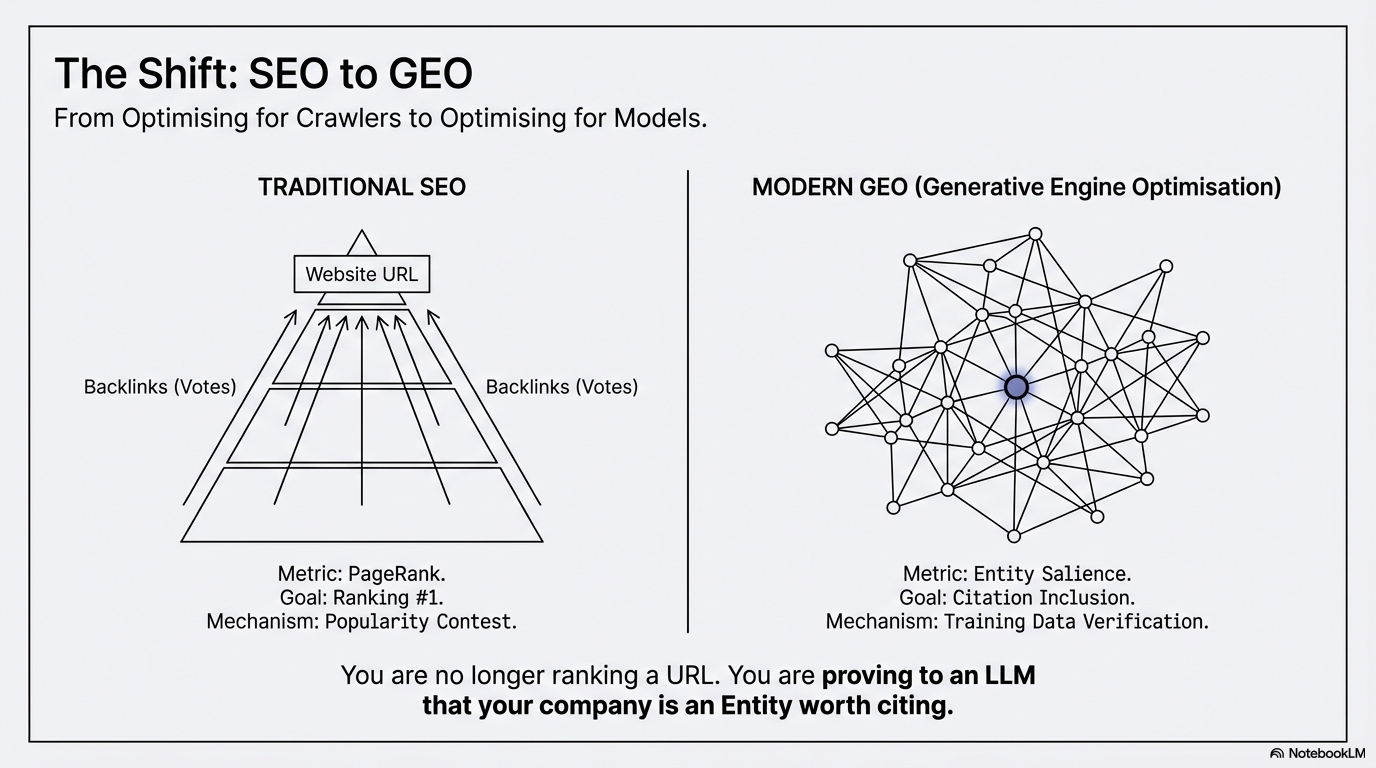
Historically, Google's PageRank algorithm treated links as democratic votes. If Website A linked to Website B, it passed "link juice" or authority. The more votes a page had, the higher it ranked. This model was fundamentally page-centric. It assumed that the document with the most references was the most relevant document.
In 2026, the model is entity-centric. AI search engines utilize Knowledge Graphs and Large Language Models (LLMs) to understand the world in terms of "Entities"—people, places, organizations, concepts, and the relationships between them. When a user asks an AI, "What is the best accounting software for a fintech startup?", the AI does not simply look for the page with the highest keyword density for "accounting software." It retrieves entities (software companies) that have the highest "Entity Salience" and "Confidence Score" within that specific context.
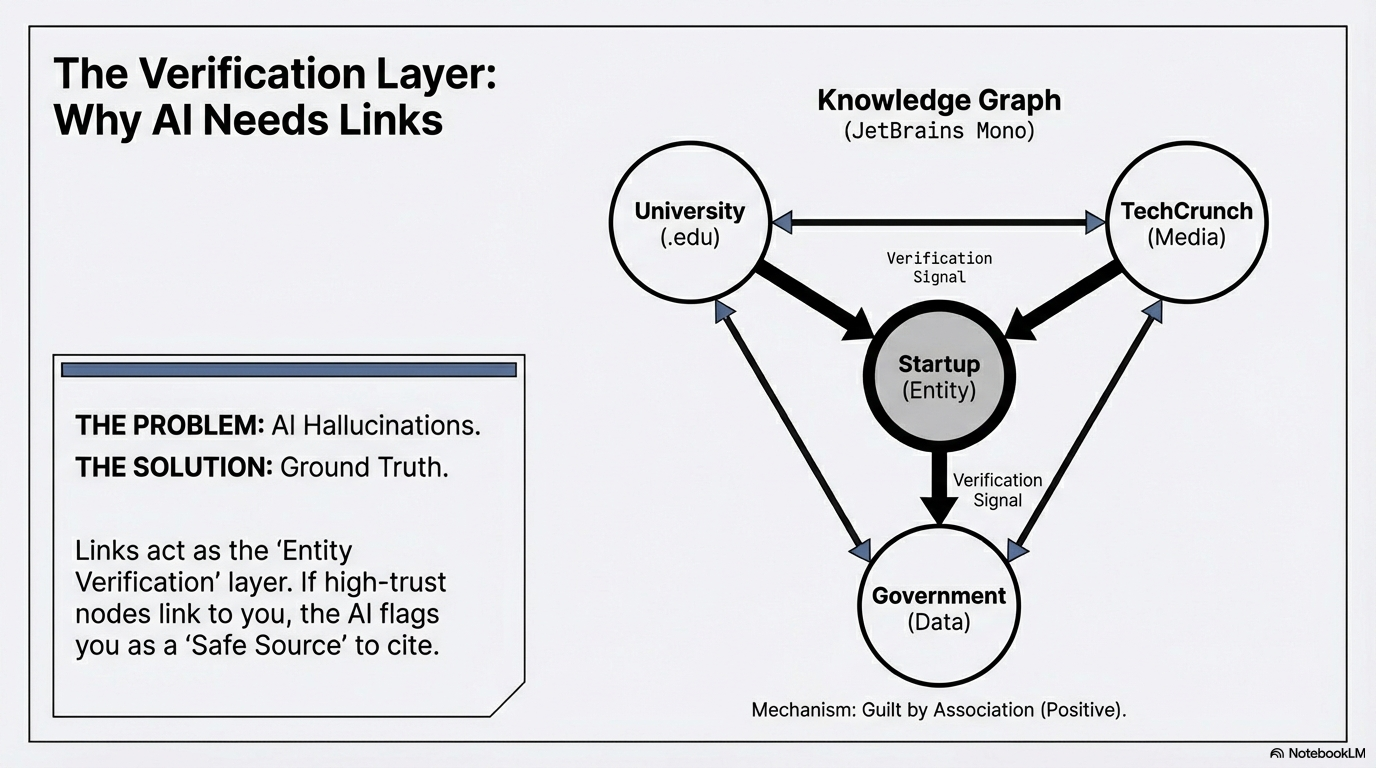
Links are the bridges that establish these connections. When a high-authority domain like TechCrunch, a university portal, or a major industry association links to a startup, it does not just pass "juice"; it validates the relationship between the startup (Entity A) and the industry topic (Entity B). Without these third-party validations, a startup is effectively invisible to the AI's "worldview." It may exist on the web as a URL, but it does not exist in the Knowledge Graph as a trusted entity.
Generative Engine Optimization (GEO)
Generative Engine Optimization (GEO) is the practice of optimizing content and brand signals to be cited by generative AI. Research indicates that implementing GEO strategies—such as schema markup, statistical citations, and authoritative backing—can increase visibility in AI responses by up to 40%.
The Role of Links in GEO:
Verification and Hallucination Control: AI models are prone to hallucination—fabricating facts. To minimize this risk, modern search engines prioritize information grounded in trusted sources. A startup with backlinks from trusted seed sets (government sites, major news, academic institutions) is flagged as a "safe" source. The AI is "allowed" to cite the startup because independent, high-trust nodes have vouched for it.
Contextual Association: The co-occurrence of links helps the AI categorize the startup. If a startup is consistently linked alongside established competitors in "best of" lists, industry reports, or market maps, the AI learns to associate the startup with that specific market segment. This is "guilt by association" in the most positive sense; being linked near industry leaders trains the model that your startup belongs in that same tier.
Retrieval Augmented Generation (RAG): Modern search engines use RAG pipelines. When a query comes in, the system first retrieves relevant documents to feed the LLM as context. Documents with high "Page Authority" (derived from links) are prioritized in this retrieval phase. If a startup's content isn't retrieved, it cannot be cited. Links are the signal that ensures your content makes the cut for the retrieval window.
The Bifurcation of Search Results
Feature | Traditional Blue Links | AI Overviews (AIO) |
Primary Utility | Navigational queries, deep research, transactional searches. | Informational queries, discovery, quick answers. |
Success Metric | Click-Through Rate (CTR), Rankings. | Citation inclusion, Brand Mentions. |
Role of Links | Direct ranking factor (PageRank). | Verification signal for Entity Trust. |
User Behavior | Search -> Click -> Read. | Search -> Read Answer (Zero Click). |
Current Status | The #1 organic position still commands a nearly 40% CTR. | CTR drops 61% for organic results when present. |
For startups, the implication is clear: You cannot opt out of link building. In a zero-click world, the link is the only signal that ensures your brand is the answer the AI provides.
Phase 1: Zero-Budget Foundational Layer
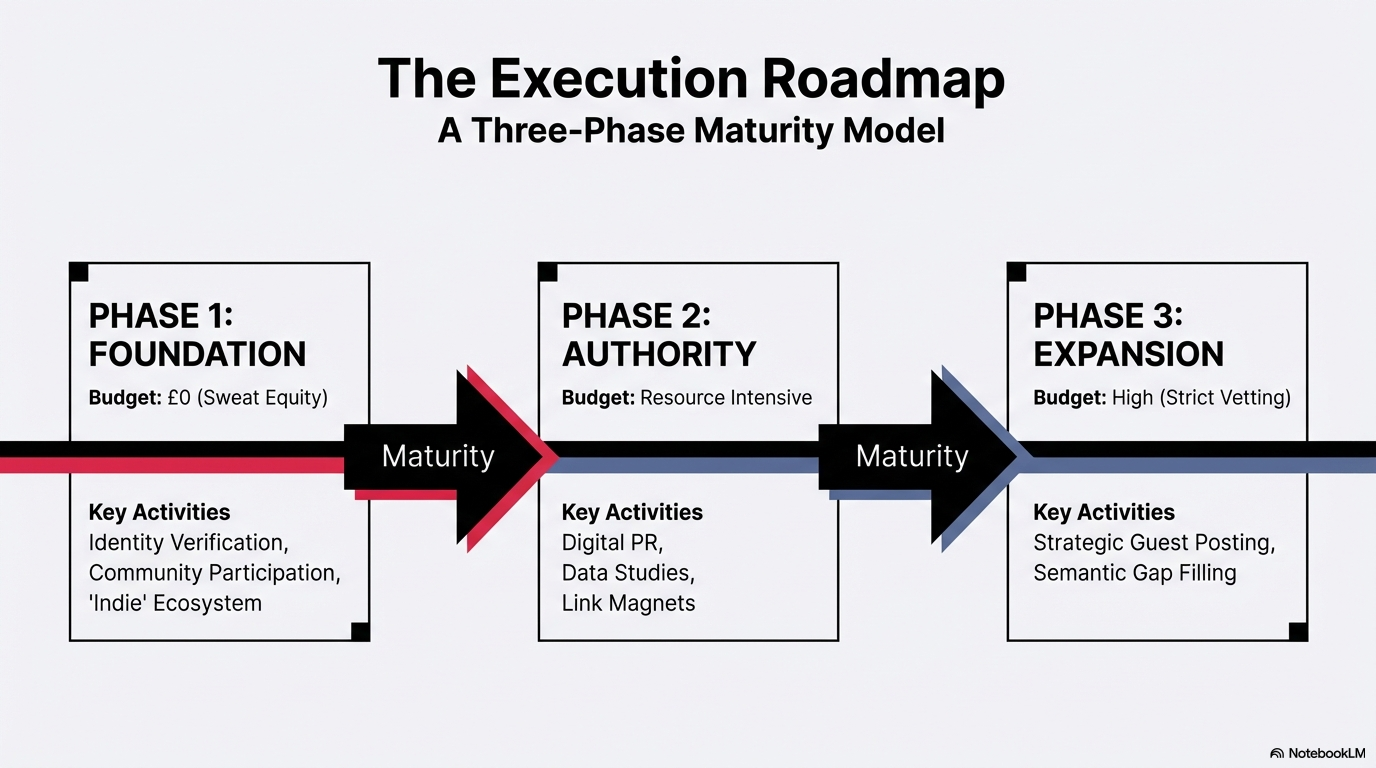
For early-stage startups, cash conservation is paramount. You likely do not have $10,000 a month to spend on a high-end Digital PR agency. The "Zero-Budget Foundational Layer" focuses on sweat equity—using time, expertise, and community participation to earn the initial backlinks that establish the domain's existence. These strategies do not require agency retainers or paid placements; they require persistence and strategic positioning.
1. The Ecosystem of "Indie" Directories and Communities
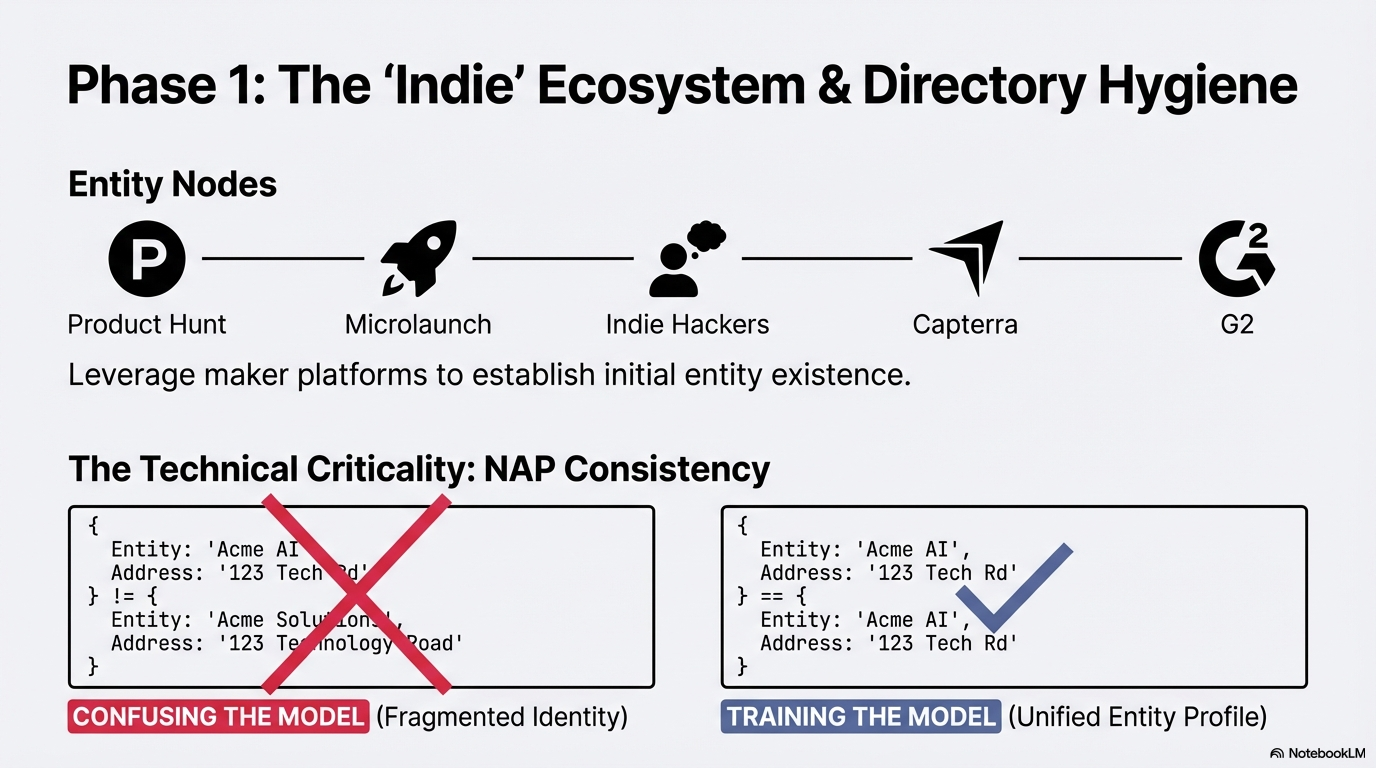
While general web directories (the "Yellow Pages" of the internet) lost their SEO value years ago, niche-specific and "maker" directories remain powerful for startups. These platforms are crawled frequently by search engines and help establish the initial entity nodes for a new company.
High-Value Targets:
Product Hunt & Microlaunch: Platforms like Microlaunch allow founders to list their startups. These are not just static links; they are traffic sources. The platform features sections like "Launching Today" and "Pro Launches," creating immediate visibility. Tools within this ecosystem, such as "Startories" (a directory submitter for SaaS), can help automate some of this friction.
Indie Hackers & Hacker News: Participating in "Show HN" (Hacker News) or Indie Hackers product pages can generate powerful signals. A successful "Show HN" post can lead to immediate indexing and scraping by other aggregators, creating a "link echo" effect where a single post multiplies into dozens of scraper links. While scraper links are generally low quality, in the very early days (Day 0 to Day 30), they help get the site indexed and recognized by the crawler.
Niche Directories: For a SaaS startup, directories like Capterra, G2, and SaaS Genius are essential. For local businesses, local chambers of commerce and "Built In [City]" directories provide geo-specific relevance that aids Local SEO and entity mapping.
Implementation Strategy: Founders must create a comprehensive profile on these platforms. Crucially, the descriptions across all directories must use consistent "Entity Language"—using the exact same company name, service description, and address (NAP) to ensure the Knowledge Graph merges these signals into a single entity profile rather than fragmenting them. Inconsistency here is a common failure point; if one directory lists you as "Acme AI" and another as "Acme Artificial Intelligence Solutions," the entity signal is diluted.
2. Relationship-Based Link Building
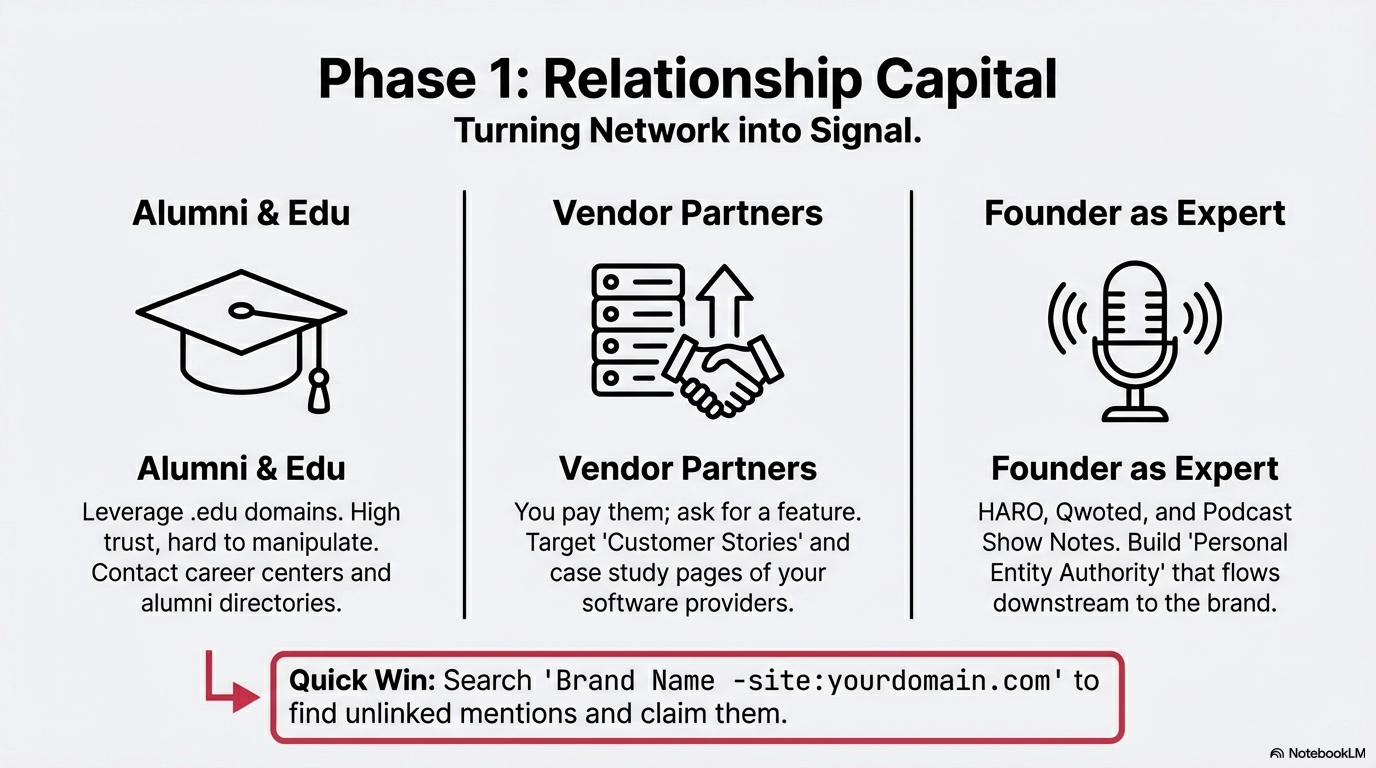
Relationships remain the highest ROI channel for zero-budget link building. This involves leveraging existing networks rather than cold outreach.
Alumni Networks: Universities often maintain directories of alumni-founded businesses. These
.edubacklinks are among the most authoritative and trusted by Google because they are difficult to manipulate. A founder should contact their alma mater’s career center or alumni association to request inclusion.Vendor Partners: Startups spend money on software, hosting, and services. Many of these vendors have "Customer Stories" or "Integration Partners" pages. A startup using a specific payment processor, hosting provider, or CRM can offer to provide a case study in exchange for a link. This is a mutually beneficial exchange where the vendor gets social proof, and the startup gets a high-authority link.
Incubators and Accelerators: If the startup is part of a program like Y Combinator or a local incubator, ensuring a link from their portfolio page is a critical first step. These domains often have massive authority.
3. The "Founder as Expert" Strategy (HARO & Podcasts)
Journalists and content creators are desperate for expert commentary. Platforms like Help A Reporter Out (HARO), Featured, and Qwoted connect experts with journalists.
The Strategy: A founder should monitor requests relevant to their industry. Speed is critical. Responses should be non-promotional, data-backed, and provide a unique angle. A quote in a Forbes or Business Insider article can instantly elevate a domain's authority.
Podcast Guesting: While audio content itself does not provide a backlink, the "Show Notes" page almost always does. Appearing on niche industry podcasts results in a contextual backlink and often a transcript that associates the founder's name with key industry topics. This builds "Personal Entity Authority," which flows back to the brand.
4. Technical Reclamation
Even new startups can have missed opportunities that are low-hanging fruit.
Unlinked Mentions: If the startup has received any press, social media buzz, or mentions in newsletters, it is likely someone has mentioned the brand name without hyperlinking it. Tools (or simple Google searches like
"Brand Name" -site:yourdomain.com) can find these instances. A polite email to the author asking for the mention to be converted to a link has a high success rate because the hard part (getting coverage) is already done.Social Profile Optimization: Ensuring every social media profile (LinkedIn, X, YouTube, Crunchbase) links back to the main site is a basic hygiene step often overlooked. These are "nofollow" links generally, but they are critical for "Entity Identity" and help AI engines verify the brand's digital footprint.
Phase 2: Scalable Strategies (Digital PR & Data)
Once the foundation is laid, the startup must transition to scalable strategies. Manual directory submissions do not scale; creating "Link Magnets" does. This phase shifts from "asking for links" to "earning links" through content that demands citation.
1. Digital PR: The Authority Engine
Digital PR is consistently rated as the most effective link-building tactic by SEO professionals, with 48.6% citing it as their top choice. Unlike traditional PR, which focuses on brand awareness, Digital PR is engineered to earn backlinks. It involves creating stories that journalists want to cover.
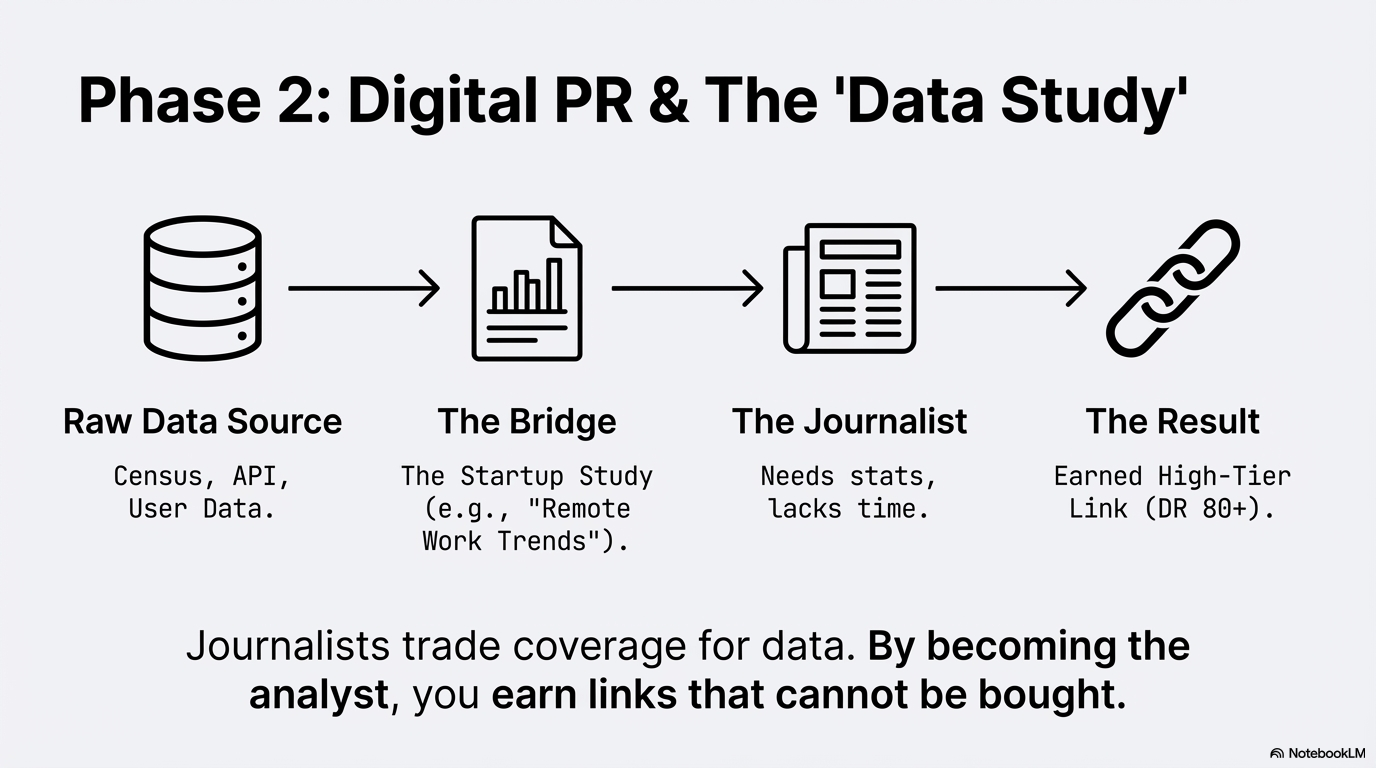
The "Data Study" Tactic:
Journalists love data but often lack the time or resources to analyze it. Startups can bridge this gap.
Methodology: Aggregate public data (e.g., government census data, API data) or use internal user data to reveal a trend. For example, a remote work software startup could analyze "The Most Productive Hours for Remote Workers" based on anonymized usage data.
Execution: Package this data into a press release with a clear hook and a visual chart.
Result: When media outlets cover the story, they cite the source (the startup) with a backlink. These links are often from high-tier news sites (DR 80+) that are impossible to buy.
Case Study: A project management SaaS created a guide on "Remote Team Management" during the shift to remote work, including original templates and stats. It earned 150+ backlinks from high-authority domains.
Newsjacking: This involves monitoring breaking news and inserting the startup into the narrative. If a major cybersecurity breach occurs, a security startup founder can offer an immediate "post-mortem" analysis or advice on prevention. This requires agility but can yield links from top-tier news organizations looking for expert commentary.
2. Passive Link Magnets
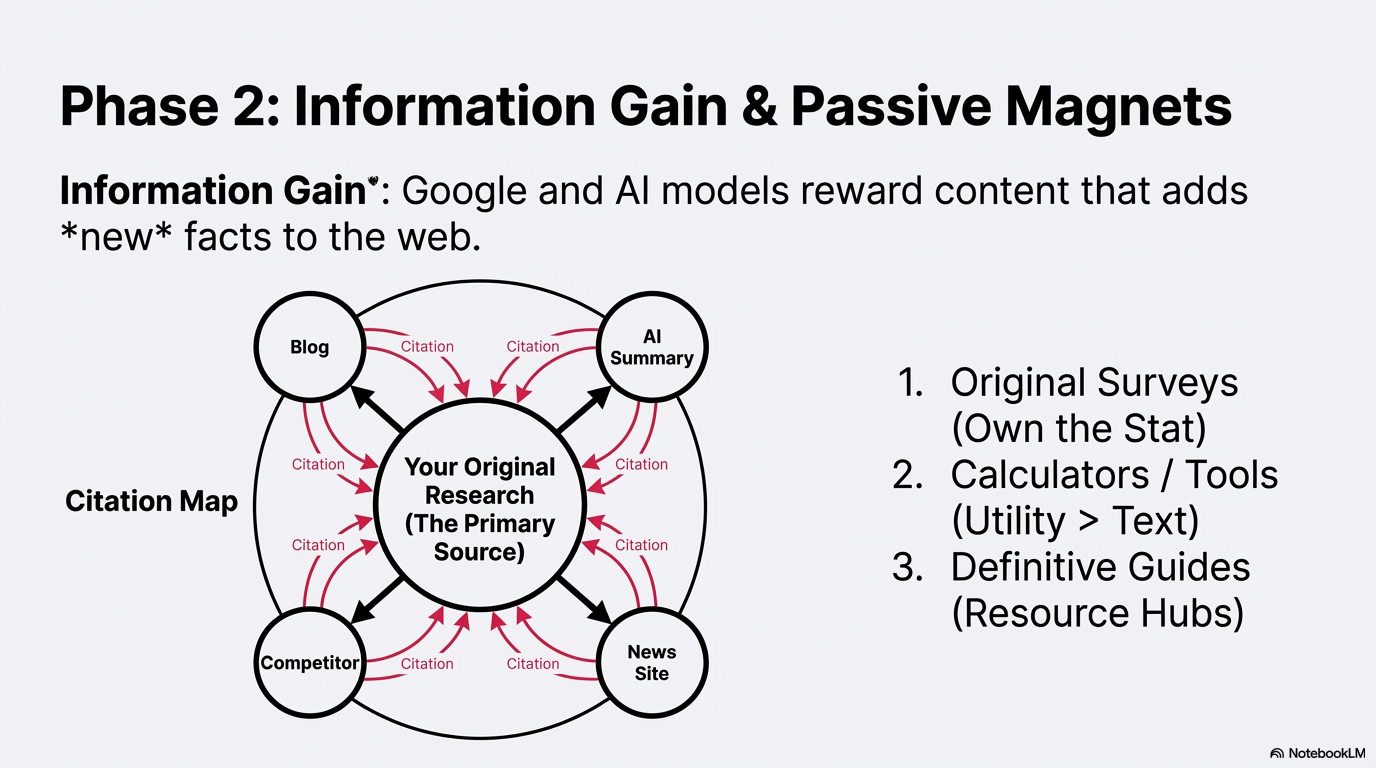
Definitive Guides & Listicles: A "Complete Guide to" or a curated list of "Best Tools for" acts as a resource hub. Writers researching the topic will cite the guide as a reference.
Tools and Calculators: Free utilities (e.g., "SaaS Pricing Calculator," "ROI Estimator") are highly linkable. Users link to them because they provide utility to their own audience.
Visual Assets: Creating high-quality infographics or diagrams that explain complex concepts encourages other bloggers to embed the image. Typically, they will provide a credit link to the source of the image.
3. The "Information Gain" Imperative
In 2026, AI engines prioritize "Information Gain"—content that adds new facts to the web rather than regurgitating existing ones.
Strategy: Startups must publish original research, surveys, or contrarian viewpoints. If a startup's content is the primary source of a new statistic, every AI summary and human article citing that stat must link back to the origin. This is the single most effective way to secure "Citation Authority" in the GEO era.
Application: If you conduct a survey of 500 industry professionals and publish the results, you become the definitive source for that data point.
Phase 3: Strategic Guest Posting
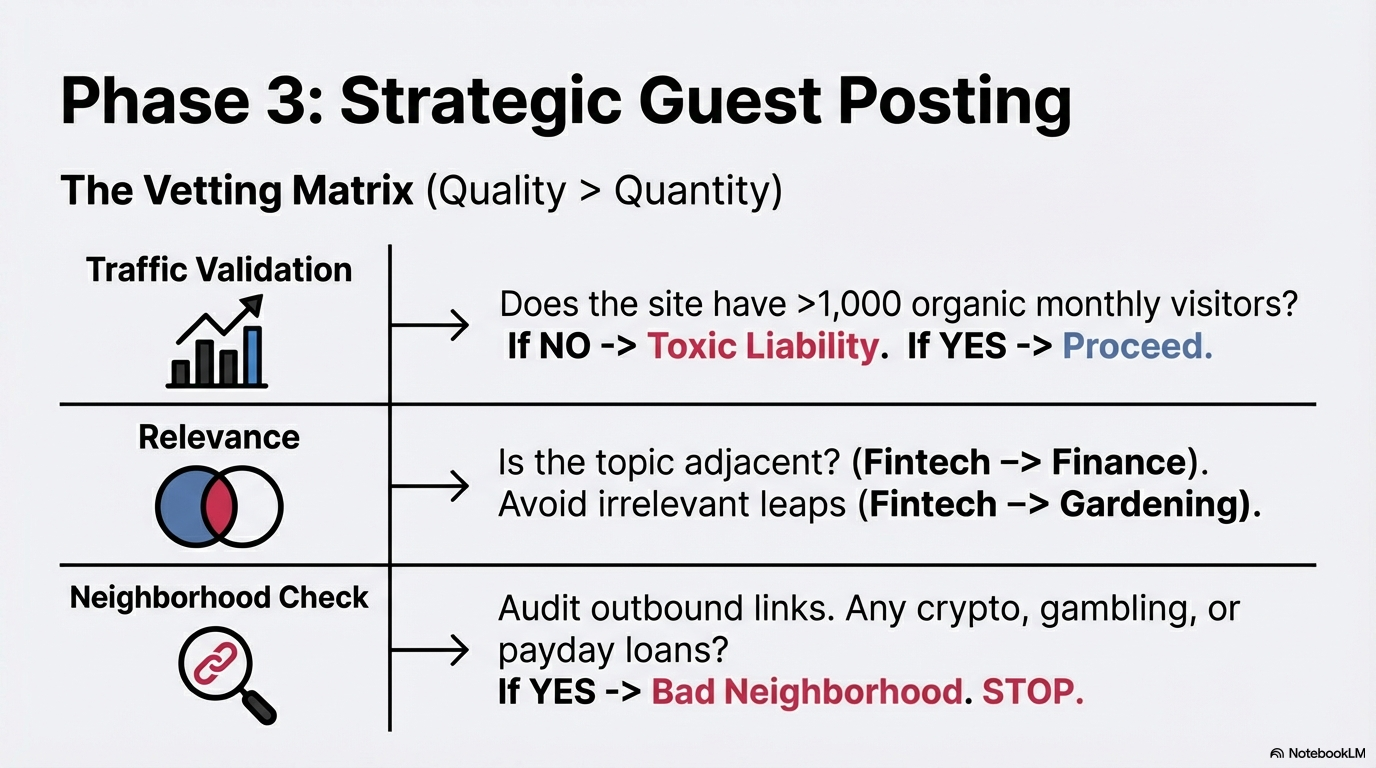
Guest posting (publishing articles on other websites) remains a staple of link building, but the landscape is treacherous. Google has aggressively devalued low-quality guest posts, and "link farms" are toxic. The 2026 approach is "Strategic Guest Posting," which prioritizes quality and relevance over volume.
1. The Vetting Matrix: Quality Over Quantity
The days of blasting 500 emails to "write for us" pages are over. A link from a low-quality site is not just useless; it is a liability that can trigger spam filters.
Vetting Criteria for 2026:
Traffic Validation: Never build a link on a site with zero traffic. If Google doesn't send visitors to the site, a link from it has no value. A benchmark of 1,000+ organic monthly visitors is a safe minimum.
Topical Relevance: A link to a fintech startup from a generic "Mommy Blog" or a general news site looks unnatural. Links must come from topically adjacent domains. AI uses these connections to build the "semantic web" around the brand.
Outbound Link Profile: Check what else the site links to. If recent posts link to gambling, crypto, or payday loans, it is a "bad neighborhood." Associating with these sites triggers spam filters.
Content Quality: Does the site publish real editorial content, or is every post a thin 500-word article with an obvious paid link?
2. The Economics of Guest Posting
This is where startups often bleed budget. The market for guest posts is rampant with price gouging and inefficiency.
The Cost Reality: Research shows the average cost of a guest post when dealing directly with a site owner is approximately $365. However, when purchased through an agency or vendor, the average price jumps to $1,459.
The Markup Trap: Agencies often apply markups of 300-400%. They purchase the link for $300 and sell it to the startup for $1,200, justifying the spread as "outreach fees" or "relationship management." While some service fee is warranted, margins of this magnitude are inefficient for a lean startup.
Industry Variance: The cost varies significantly by industry. Links in the Crypto and Real Estate sectors average around $500, while Food and Fashion links average around $350.
3. Strategic Outreach
To avoid overpaying, startups can bring outreach in-house or use smarter tools to negotiate directly.
Sniper Approach: Identify 10-20 high-value targets (partners, suppliers, industry publications) rather than hundreds of low-value ones.
Pitching Value: The pitch must offer content value, not just ask for a link. "I saw you wrote about X; I have unique data on Y that compliments that."
Negotiation: Dealing directly with editors often allows for barter (content exchange) or significantly lower "editorial fees" than agency rate cards.
Stop Overpaying: The Agency Markup Trap & The LinkPricer Solution
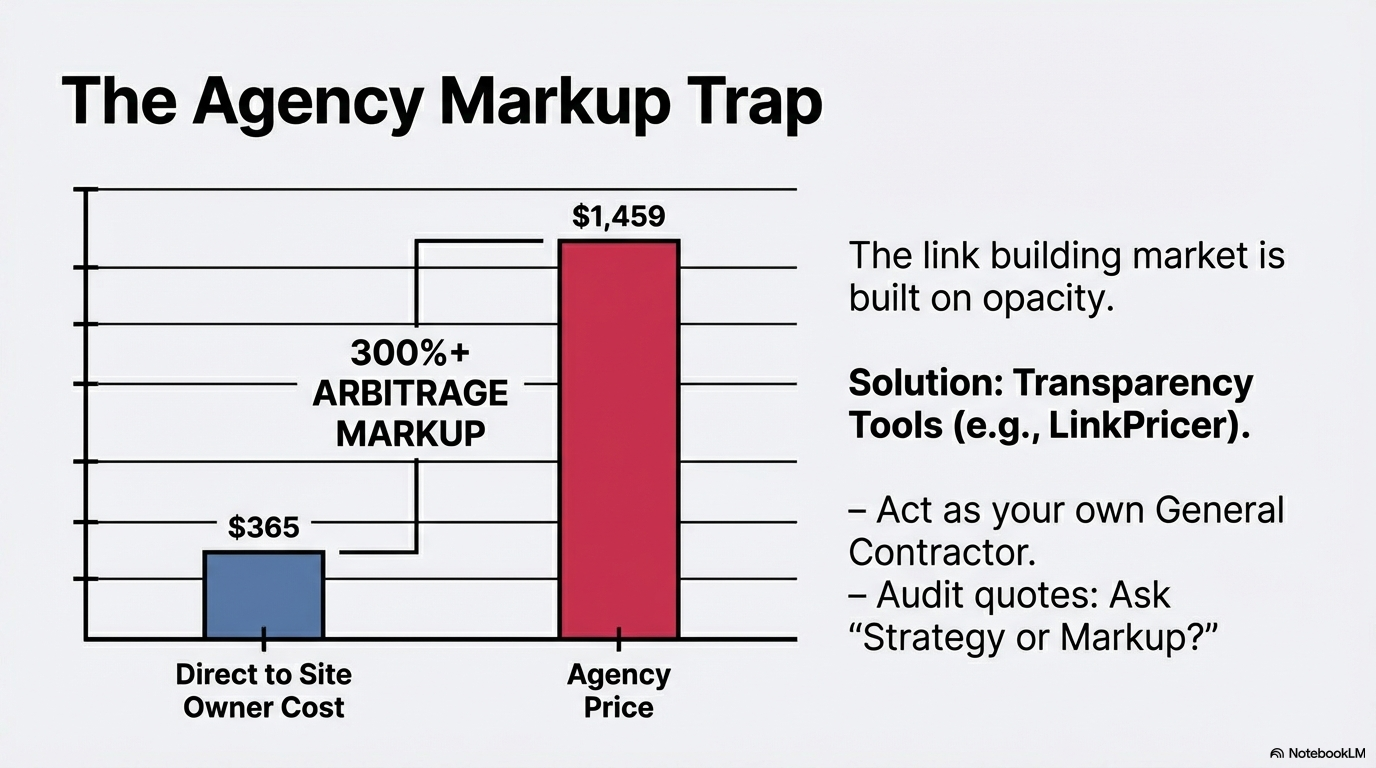
One of the most critical insights for a founder in 2026 is understanding the opacity of the link-building market. The price discrepancy for the exact same backlink can be staggering depending on where and how it is purchased.
The Arbitrage Problem
The link-building industry is largely built on arbitrage. "Vendors" maintain lists of websites that sell placements. "Agencies" buy from these vendors (or other middle-men) and resell to clients.
Example Case: A link from a prestigious site like The New York Times or Forbes might be listed on one marketplace for €71,500, while another path might secure a similar tier placement for $5,000. Even for standard mid-tier blogs (DR 40-60), the variance is high. A site owner might charge $100 directly. A reseller charges $300. The agency charges the client $900.
This chain results in the client paying a premium that delivers no additional SEO value. The link is the same; only the price tag changes.
The Transparency Solution: LinkPricer
Tools like LinkPricer.com have emerged to disrupt this inefficiency. Positioned as the "Skyscanner for Backlinks," LinkPricer aggregates pricing data from multiple marketplaces to reveal the true market rate for a specific domain.
How It Works:
Bulk Search: A user can upload a list of potential target domains (found via competitor research).
Price Comparison: The tool scans 300,000+ websites across various marketplaces (like WhitePress, Bazoom, etc.) and displays the price for a link on that domain from each vendor.
Discovery: It often reveals that Vendor A sells a link on Domain X for $200, while Vendor B sells it for $600.
Direct Savings: By identifying the lowest cost provider—or using the data to negotiate directly with the site owner—startups can stretch their budget significantly.
Strategic Advantage: Using a comparison tool allows a startup to act as its own "General Contractor," bypassing the heavy markups of full-service agencies. For a startup with a limited budget, saving $500 per link allows for double the volume or higher quality placements for the same spend. It transforms link building from a black-box service into a transparent procurement process.
The Hybrid Model
The recommendation is not necessarily to avoid agencies entirely—good agencies provide strategy, content creation, and project management that saves time. However, startups should use transparency tools to audit costs. If an agency quotes $1,000 for a link that LinkPricer shows is available for $200, the founder has leverage to ask where the extra $800 of value is coming from. Is it exceptional content? Unique strategy? Or is it simply markup?.
Common Mistakes & Red Flags
1. The "Toxic Link" Scam
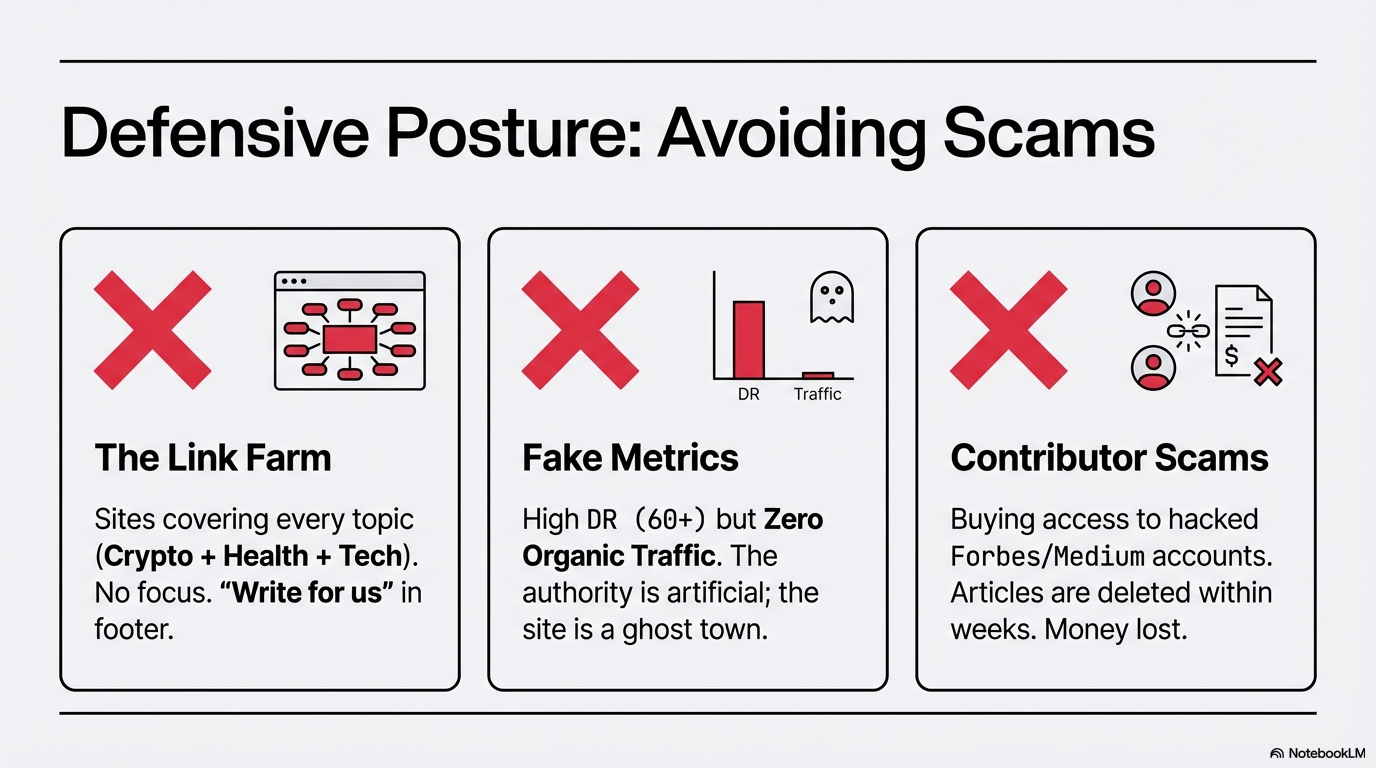
Scammers sell links on sites that look real but are actually "Link Farms"—sites created solely to sell links.
Red Flag: The site covers every topic imaginable (crypto, health, gardening, tech) with no coherent theme.
Red Flag: Traffic charts show sudden spikes and drops, indicative of bot traffic being purchased to fake the metrics.
Red Flag: "Write for us" links in the footer are prominent and aggressive.
Consequence: Google's "SpamBrain" AI identifies these patterns. At best, the links are ignored (waste of money). At worst, the site receives a manual penalty, deindexing the startup.
2. Fake Metrics
Vendors often sell links based on "DR 60+ Guaranteed."
The Trick: They artificially inflate DR by spamming their own site with millions of low-quality links. The metric goes up, but the site has no authority in Google's eyes.
The Check: Always verify Organic Traffic alongside DR. A DR 60 site with 100 monthly visitors is a fake.
3. The "Lifetime Contributor" Scam
A common scam involves selling "Lifetime Contributor Access" to sites like Forbes or Medium. These are often hacked accounts or accounts that are about to be banned. Buying access usually results in the article being deleted within weeks, and the money lost.
4. Ignoring "Nofollow" Attributes
While "dofollow" links pass authority, a natural profile needs a mix. Ignoring "nofollow" or "sponsored" tags on paid placements is a violation of Google's guidelines. Excessive "dofollow" links with exact-match anchor text (e.g., 50 links saying exactly "best crm software") is a clear footprint for manipulation.
Measuring ROI: Moving Beyond Vanity Metrics
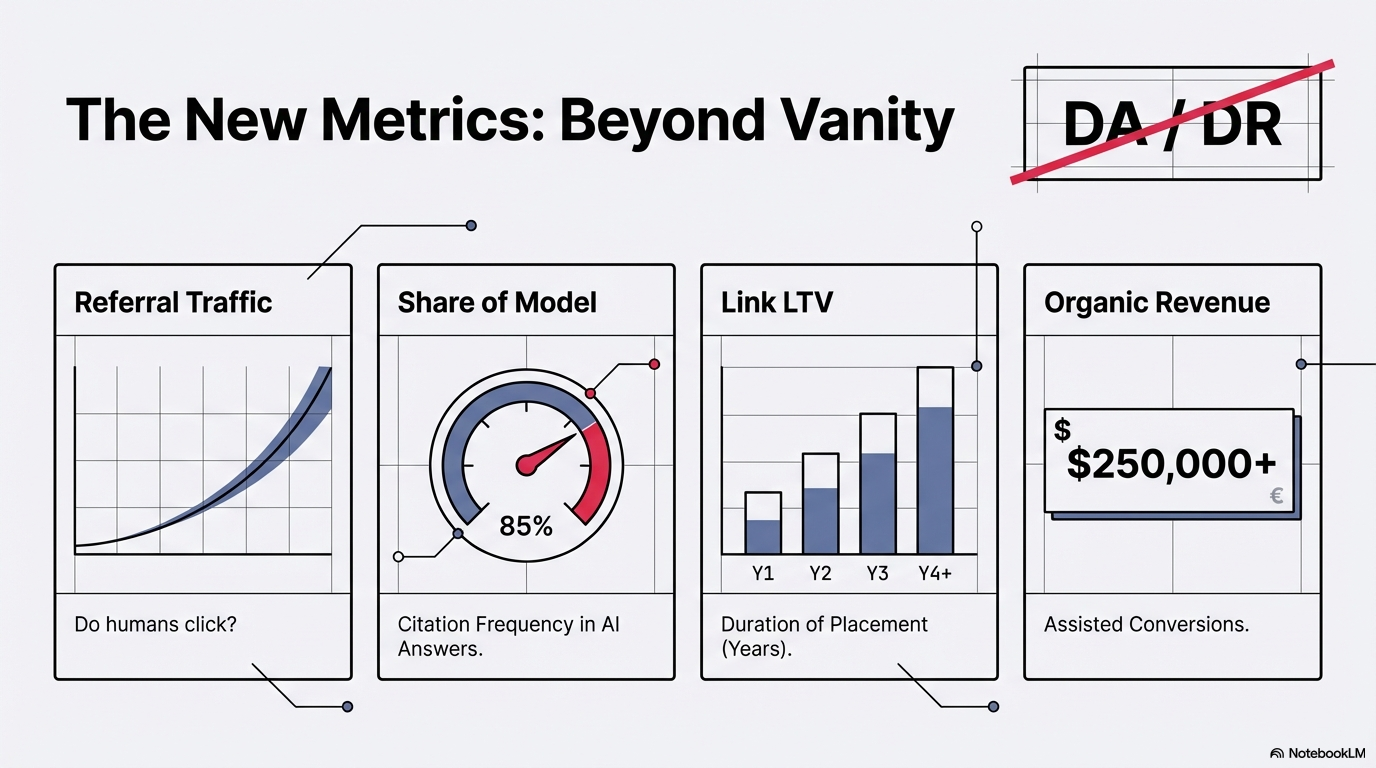
The New KPIs for 2026
Referral Traffic: Does the link actually send humans to your site? A link from a relevant industry newsletter that sends 50 qualified leads is worth infinitely more than a link from a generic high-DR site that sends none.
Brand Mentions & Share of Voice: Tools now track how often a brand is mentioned in AI Overviews. "Share of Model" is the new "Share of Voice." Are you the entity the AI cites for your core keywords?
Organic Revenue Attribution: Using advanced attribution models to see if organic traffic (even from zero-click searches that eventually convert via direct navigation) is driving revenue. This requires tracking "Assisted Conversions" in analytics.
Information Gain & Citation Velocity: Tracking how quickly new data published by the startup is picked up and cited by other sources. This measures the "virality" of your data.
Calculating Link LTV
Startups should view links as assets with a Long-Term Value (LTV).
Cost Per Link (CPL): Total Spend / Links Acquired.
Value Per Link: Estimated traffic value over time + Brand Authority lift.
Insight: High-quality Digital PR campaigns often have a high upfront cost ($5k-$10k) but generate links that persist for years and are impossible for competitors to replicate. These offer a higher LTV than rented links or PBNs which carry a risk of penalty.
Conclusion: The Road to Authority
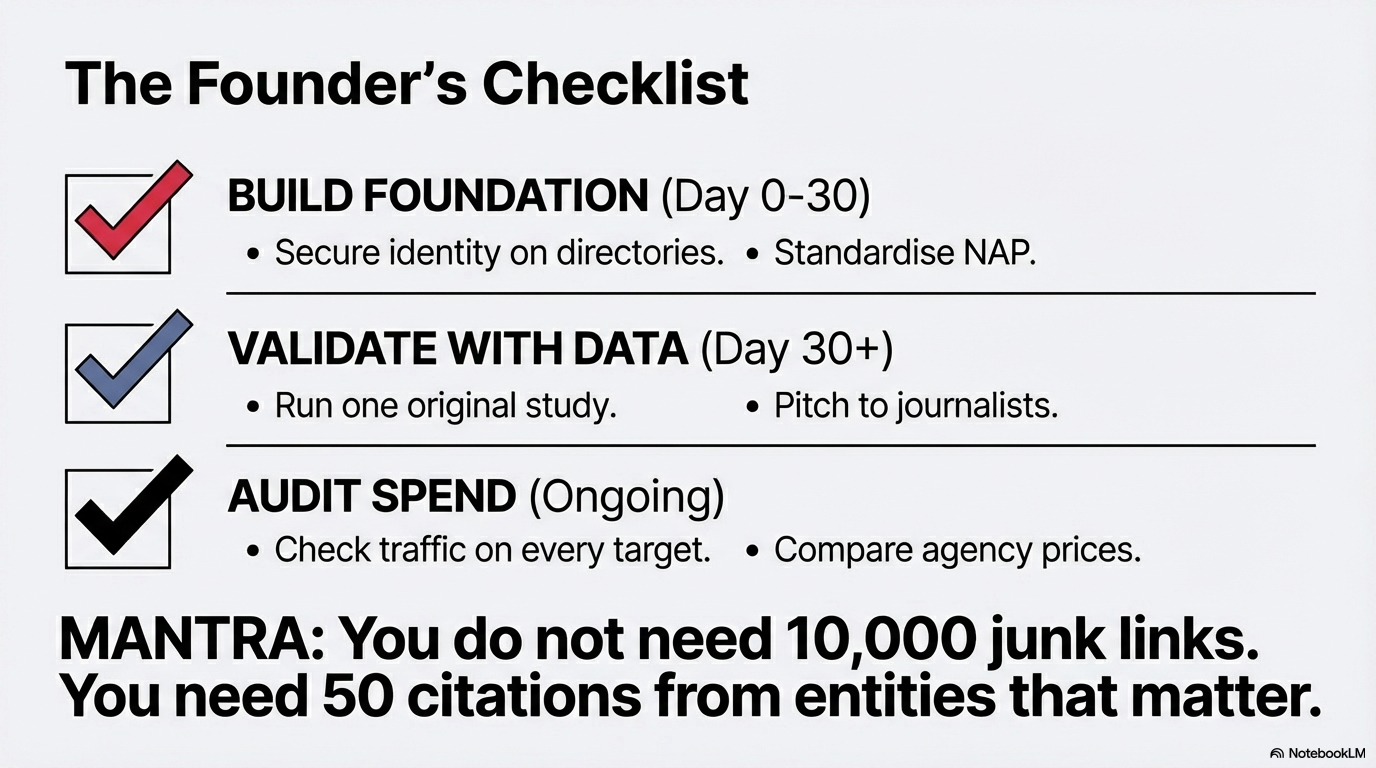
The "Organic Traffic Crisis" of 2026 is actually a quality filter. It has eliminated the viability of low-effort, spammy SEO. For startups, this is an advantage. You do not need 10,000 junk links to rank; you need 50 citations from the entities that matter.
The Executive Roadmap for Founders:
Foundation: Secure your digital identity on directories, social platforms, and through relationships. Use zero-budget tactics to get on the map.
Validation: Use data storytelling and Digital PR to earn editorial citations from news and industry hubs. Be the source of new information.
Expansion: Use strategic guest posting to fill gaps, but verify every site rigorously for traffic and relevance.
Optimization: Use tools like LinkPricer to audit costs and ensure you are not bleeding capital to middlemen. Treat link building as a procurement process.
Integration: View every link as a signal to an AI model. Does this link help ChatGPT understand who we are?
In the AI era, Authority is not a metric; it is a reputation. Build a reputation that is impossible to ignore, and the rankings—in both search engines and AI answers—will follow.